

“AI agents for business” is the most oversold phrase of the year. Every software company slapped the word “agent” on their product. Every other LinkedIn post promises you an army of them running your company by Friday. And most owners I talk to have no real idea what the word means, only that they are supposed to be worried about it. Can I shoot straight with you? An AI agent is not a robot employee you hire and forget. In most cases it is a workflow with a confident name. That is not a knock on the technology. AI does real work now, and it can take tasks off your plate this month. But you cannot deploy something you cannot define, and you cannot budget for a buzzword. So let’s cut through the noise. Here is what an AI agent actually is, the handful of jobs one can reliably do for a service business today, and the smallest place to start without hiring anyone or learning to code.
What an AI agent actually is (in plain English)
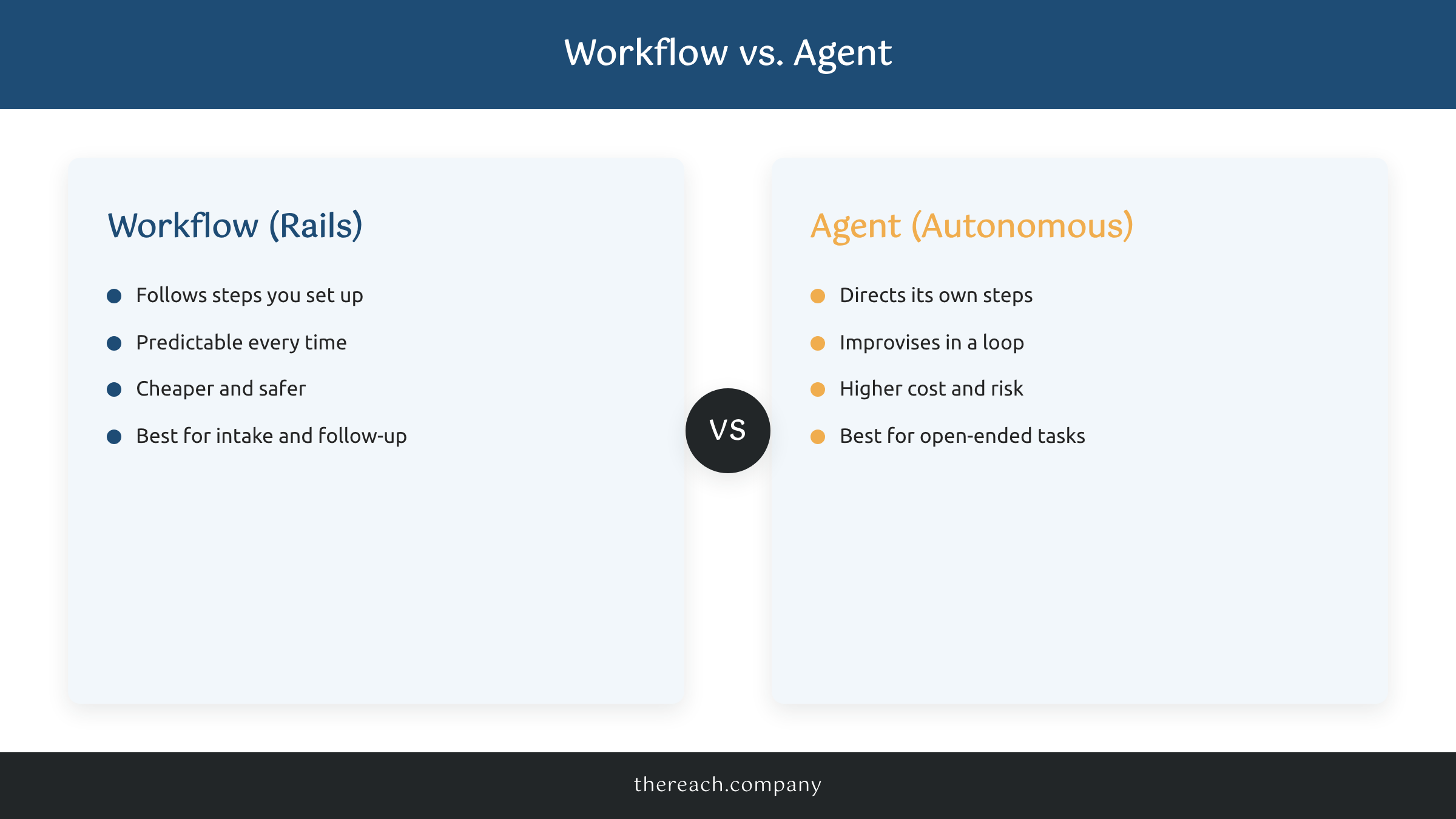
Anthropic, the company behind Claude, draws the clearest line I have seen. In their engineering guide on building effective agents, they split every “agentic system” into two buckets. Workflows are systems where the AI and its tools follow predefined steps you set up in advance. Agents are systems where the AI, in their words, dynamically directs its own processes and tool usage and keeps control over how it gets the job done. Their plain summary of an agent is even better: it is “typically just LLMs using tools based on environmental feedback in a loop.”
Read that again. A loop. A tool. Feedback. That is the whole magic trick. An agent reads a situation, picks a tool, sees what happened, and decides the next move, over and over, until the job is done. A workflow does the same useful work, but on rails you laid down ahead of time.
Why does this matter for a service business? Because the thing most vendors sell you as an “agent” is really a workflow with better marketing, and that is good news for you. Workflows are cheaper, more predictable, and far less likely to go off script. You do not need a self-directing AI to text a new lead back in ninety seconds. You need a reliable automation that fires every single time, whether you are on a job site or asleep.
The three AI agents worth deploying first
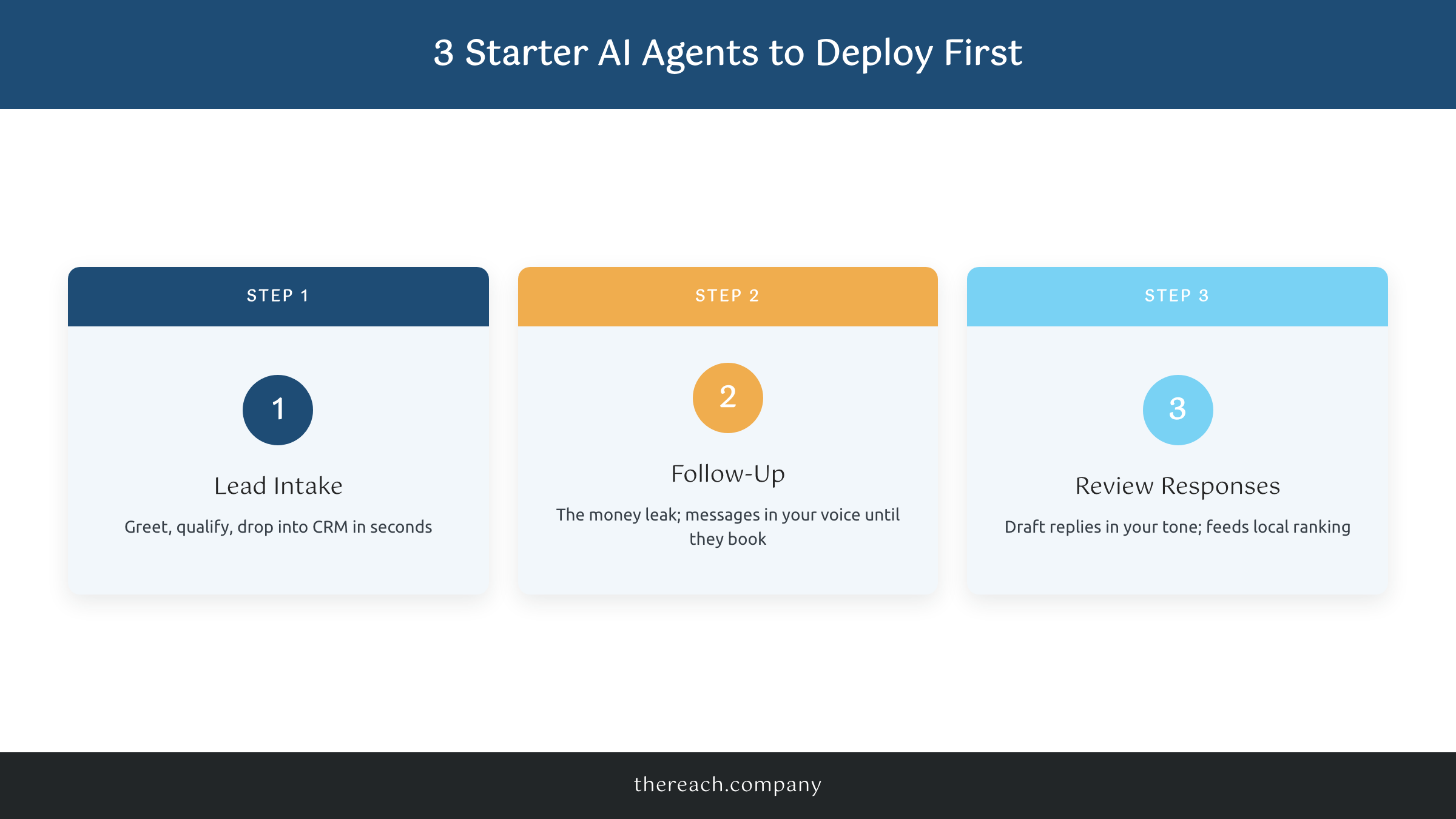
Forget the sci-fi version. Here are three jobs an AI can reliably handle for a service business right now, ranked by how fast they pay off.
1. Lead intake. When someone fills out your form or texts your number, an AI can greet them in seconds, ask the two or three qualifying questions you always ask (“what service, what timeline, what zip code”), and drop clean answers straight into your CRM. Speed matters more than most owners think. Studies on lead response have shown for years that businesses replying in the first five minutes convert far more often than the ones that reply an hour later. An AI never takes a lunch break, so no lead sits in an inbox for six hours while a competitor calls them first.
2. Follow-up. This is the big one. Most service businesses lose more money to weak follow-up than to weak lead generation. The lead was interested. Nobody chased them the third and fourth time. An AI can send those messages a busy owner never gets around to, written in your voice, until the person books or opts out. If you want the full playbook, we wrote a step-by-step on how to automate your lead follow-up without hiring anyone.
3. Review responses. AI can draft a reply to every Google review, five stars and one star alike, in your tone, so you approve in one tap instead of writing from a blank box. Reviews feed your local ranking and your trust with new customers, and responding is the task owners abandon first.
Notice what all three jobs share. They are narrow, repetitive, and have a clear finish line. That is exactly where AI earns its keep today, and none of them require you to understand a neural network.
The contrarian truth: you probably want a workflow, not an agent
Here is the rub. The word “agent” makes owners think bigger is always better. It is not. For roughly ninety percent of what a service business needs, a workflow beats a true autonomous agent, and it is not close.
A workflow that texts every new lead the same smart, tested sequence will outperform a clever agent that improvises, because the improvising one occasionally improvises wrong. A wrong message to a $12,000 prospect is an expensive kind of clever. Predictable is a feature, not a limitation, when real money is on the line.
Real autonomy earns its extra cost and risk when you genuinely cannot predict the steps in advance. Most lead intake, follow-up, and reputation work is predictable. You already know the questions, the sequence, and the outcome you want. So the honest move is to start with tight automations, add a layer of AI only where judgment actually helps, like writing the message or reading the sentiment of a review, and reach for full agent autonomy last, when the simpler thing genuinely falls short. Anthropic gives its own engineers the exact same advice: start simple, and add complexity only when it clearly improves the result. If the people building this technology tell you to keep it simple, the guru telling you to buy a swarm of agents is selling something.
What this looks like in the real world
A medspa we work with in Atlanta pulled in 1,928 leads from their website in a single year. The website brought the traffic. But the number that actually mattered was how many of those leads booked, and that came down to one unglamorous thing. Every lead got greeted, qualified, and followed up inside a system, automatically, whether or not the front desk remembered to do it. That is the real version of “AI for business.” No robot receptionist. No sci-fi. Just intake and follow-up running on rails, with AI drafting the messages so they still sound like a human wrote them.
That is the pattern worth copying. Not “go buy an agent.” Build the system that catches every lead and works it until it converts, and let AI handle the writing inside that system.
Where to start this month
Pick one job. I would start with follow-up, because that is where the money leaks fastest. Here is the smallest version you can stand up this month.
First, choose one entry point. Your website form or your Google Business Profile messages, not both yet. Second, set up an instant text-back that fires the second a lead comes in. We build this for clients inside GoHighLevel as part of the Reach Co Lead System, but the principle works in any decent CRM. Third, add a three-message follow-up sequence spread over about five days, written in your voice, with AI drafting each message so it does not read like a robot. Fourth, approve the messages once, then let it run and watch what happens.
That is it. One entry point, one instant reply, one follow-up sequence. You do not need a data team or a five-figure software contract. You will learn more about AI agents for business from running one small automation than from a hundred breathless threads about the future of work.
AI is not going to run your business. But it will run the parts you keep dropping, and it will do them at two in the morning while you sleep. Start with the one job that leaks the most money, get it working, then add the next. That is how “AI agents for business” goes from a phrase you are supposed to fear to a system quietly making you money. The finish line is a lot closer than it feels. Promise. If you want a hand building the intake-and-follow-up system that does this in the background, that is exactly what we set up for every client. You got this. And if you need a little help, we got you too.

