

Can I shoot straight with you?
If you are a service business owner doing under $5 million a year and you have spent the last six months reading articles about AI for business growth, you are probably more confused now than you were before you started. One headline tells you ChatGPT is going to replace your marketing team. The next one tells you AI agents will run your whole operation by Q3. A different one warns that if you are not AI-first, you will be out of business in 18 months.
It is a lot of noise. And almost none of it speaks to a business doing $1.8M in revenue with seven employees and a calendar full of leads that do not show up.
Here is the rub. AI is not a growth lever. AI is a multiplier on the levers you already have. If your lead generation is broken, AI will help you fail faster. If your conversion process is solid, AI will print money. Same tool, opposite outcomes, depending entirely on whether you have a real business engine for AI to plug into.
This post breaks down the 5 levers that actually move a sub-$5M business, and exactly where AI helps with each one. No magic. No “AI agent replaces your sales team” fantasy. Just the practitioner view from somebody who has been running these workflows in real businesses, with real money on the line, for real owners who cannot afford to be wrong.
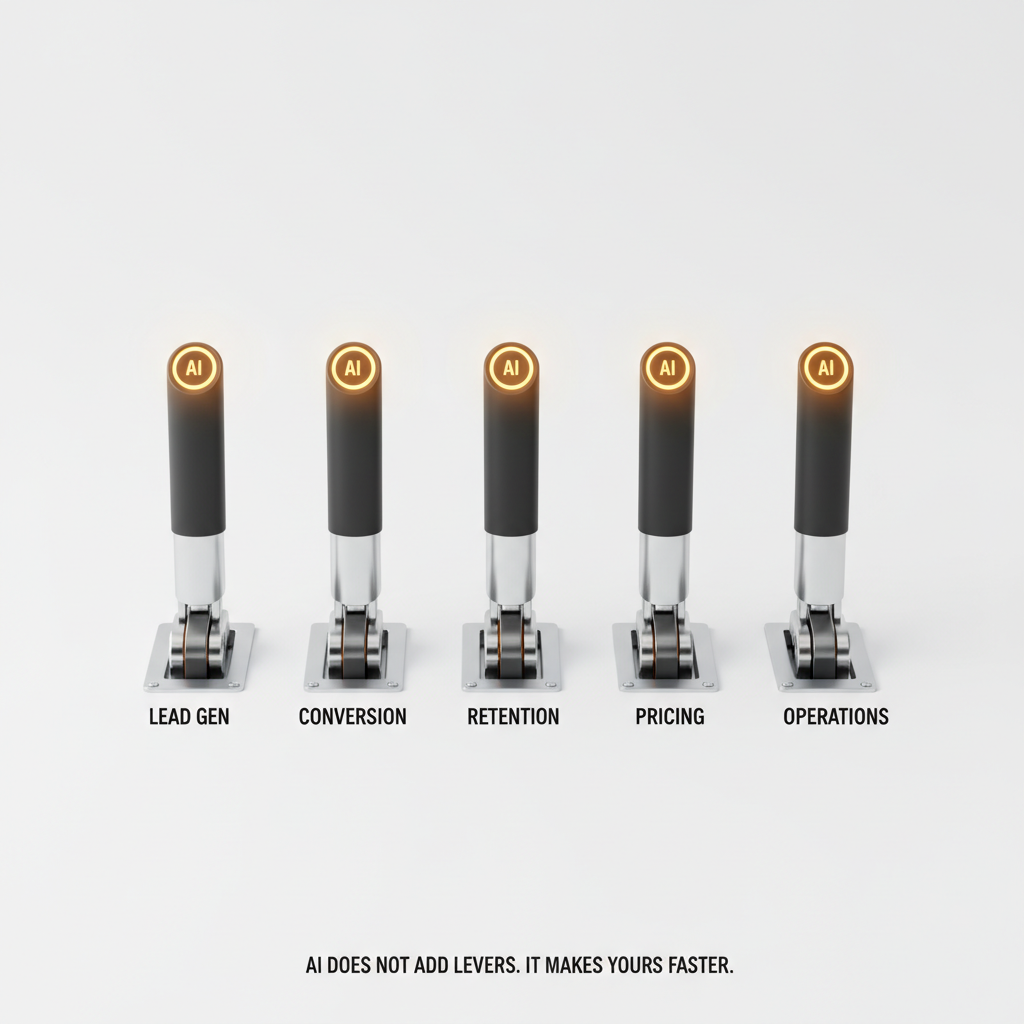
If you read nothing else, read this: AI does not add new levers. It makes yours faster. Let us go through them.
The Real Problem: Everyone Is Selling AI as a Growth Lever. It Is Not.
Walk into any Chamber of Commerce meeting right now and listen to the vendors. The website company is selling AI websites. The SEO company is selling AI content. The CRM company is selling AI automation. The bookkeeper is selling AI receipts. Even the embroidery shop is somehow selling AI.
The pitch is always the same. “AI will grow your business.”
It will not.
What AI actually does is take an existing process and make it faster or cheaper. That is it. Pretty boring when you say it out loud. But that distinction is the whole game.
Here is a quick test. Pull up your business right now and answer four questions:
- How many qualified leads did you generate last month?
- Of those leads, what percent became paying customers?
- What is your customer retention rate over 12 months?
- How many hours per week do you personally spend on tasks somebody else could do?
If you cannot answer those four questions in under 30 seconds with real numbers, you do not have a business problem an AI tool can solve. You have a measurement problem. AI is going to make whatever you cannot measure 30 percent faster, and you are going to wonder why nothing changed.
The owners who are actually getting growth from AI right now have one thing in common. They had a working system first. They knew their numbers. They knew their bottlenecks. Then they bolted AI onto a specific point in the system and saw the impact in their dashboard, not in a vendor PowerPoint.
So before we talk about which tools to use, you have to know which lever is broken. That is the whole point of the next section.
The 5 Levers That Actually Move a Sub-$5M Business
Every service business under $5 million has exactly 5 levers that matter. Not 50. Not 12. Five.
- Lead Generation. How many prospects show up on your doorstep this month.
- Conversion. What percentage of those prospects become paying clients.
- Retention. How long those clients stay and how much they buy from you over time.
- Pricing. What you charge and how it lines up with the value you deliver.
- Operations. How efficiently you deliver the thing they paid for.
That is it. Every revenue chart you have ever seen, every growth strategy you have ever paid for, every consultant pitch you have ever sat through, all of it maps back to one of those five.
A 10 percent improvement in any single lever in a $1M business is $100K. A 10 percent improvement in all five at once is closer to $611K because they compound. That math is the actual reason AI matters. Not because it is smart. Because it lets you nudge multiple levers at the same time without hiring five new people.
Let us go lever by lever.
Lever 1: Lead Generation. AI Helps Here, but Not How You Think.
Most business owners think AI role in lead gen is “write the ad” or “generate the blog post.” That is the surface level. It is also where most of the money gets wasted.
Where AI actually moves the needle in lead generation:
Long-tail SEO content at volume. A sub-$5M business cannot afford a content team. With Claude or ChatGPT plus a real editor (you), you can publish 4 to 8 well-researched, voice-on-brand long-tail pieces per month for the cost of two hours of your time a week. That is the difference between ranking for nothing and ranking for the exact phrases your prospects type at 11pm.
Local SEO geo-page generation. If you serve 12 cities and you only have one service area page, you are invisible in 11 of them. AI lets you produce city-specific landing pages with real local context (Google reviews from that area, school district names, nearby zip codes) at a pace that was impossible two years ago.
Ad copy testing. Meta Ads Manager and Google Ads both reward fresh creative. Most small business advertisers use the same three headlines for nine months and watch their cost per lead climb. With ChatGPT writing 30 headline variants in 90 seconds, you can run actual creative tests on your real budget, not on a best practices assumption from a Reddit post.
Where AI does NOT help lead generation:
Buying attention. AI does not make your ad cheaper. Meta and Google still set the price. AI just helps you spend it on better creative.
Replacing a real offer. If your offer is weak (“Get a free consultation!”), no AI tool will save it. The market wants a specific, valuable, low-friction entry point. ChatGPT will happily write 50 versions of a bad offer for you.
Andrew note: we use Claude (Anthropic) for long-form content drafts, ChatGPT for fast ad copy and structured output, and Ahrefs plus Google Search Console for the actual keyword research. AI writes the words. Tools tell us which words to write. Do not skip the second part.
Lever 2: Conversion. This Is Where AI Pays for Itself the Fastest.
If lead generation is the lever every owner thinks about, conversion is the lever they ignore. And it is the one where AI moves more money than anywhere else.
Here is the math nobody likes. The average service business converts somewhere around 8 to 12 percent of inbound leads to a paying customer. If you can move that number to 18 percent, your business doubles without spending another dollar on ads. That is the entire game right there.
The single biggest reason most businesses lose conversions: speed of response.
Studies from Inside Sales and Lead Connect consistently show that responding to a web lead within 5 minutes makes you 21 times more likely to qualify them than waiting 30 minutes. Twenty-one times. And the average small business response time is over 47 hours.
This is the exact problem AI was built for. Not because AI is smart. Because AI does not sleep, does not take lunch, and does not forget to check the lead form before its kid soccer game.
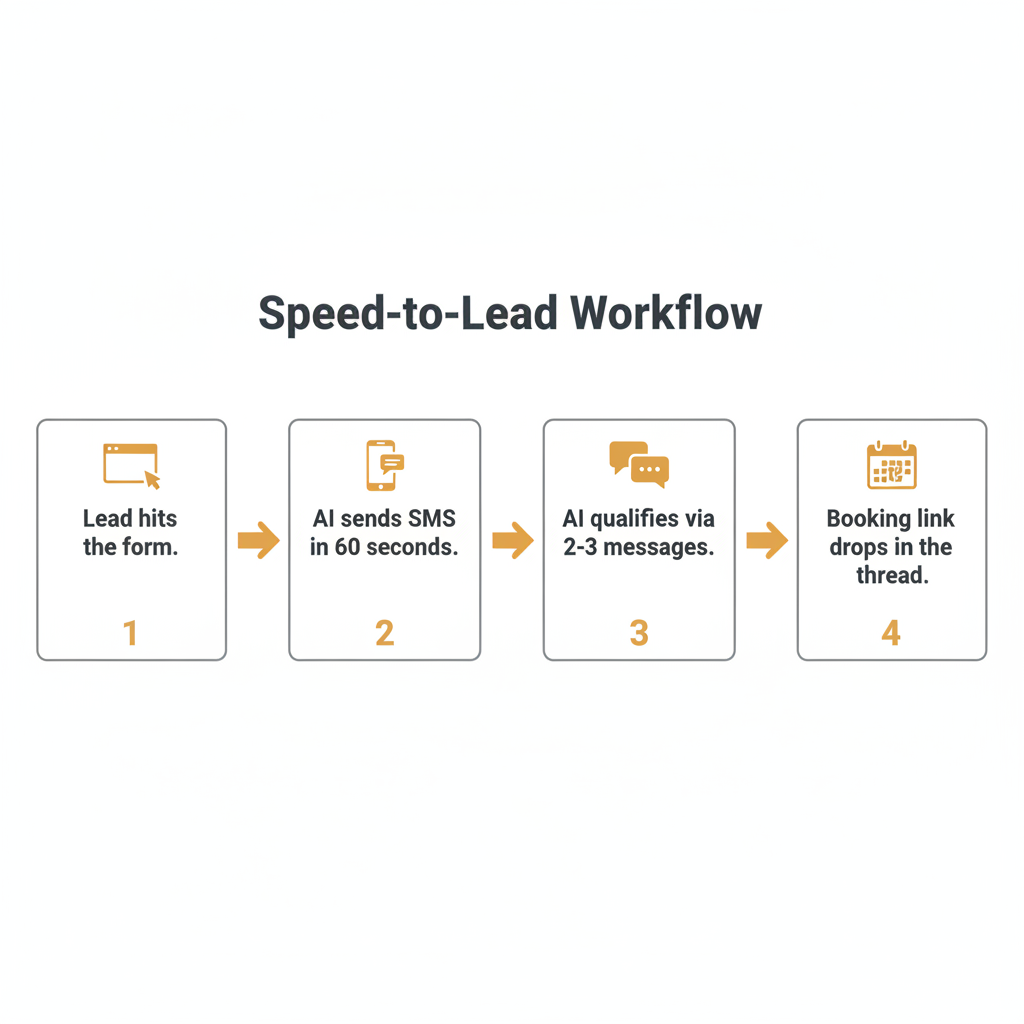
What we build for clients at The Reach Co (and what you can build for yourself in a weekend with GoHighLevel):
- Lead hits the form.
- AI-powered SMS goes out within 60 seconds. Personalized with their name and what they asked about.
- If they reply, AI handles the next two or three messages to qualify them.
- Once they confirm intent, the bot hands off to a real person or drops a calendar booking link directly in the thread.
That single workflow, implemented properly, has moved a real metro medspa client from a 9 percent web-lead-to-booking rate to a 17 percent rate. Same ad spend. Same offer. Different conversion lever.
We use GoHighLevel for this. We use it because it is the only platform we have tested where the AI follow-up, the CRM, the SMS sending, and the calendar booking actually talk to each other without a developer. There are other tools (HubSpot, Twilio plus Zapier, Manychat), but the integration friction will eat your weekend and your patience.
If you do one thing after reading this article, audit your speed-to-lead. It is the highest-ROI AI lever in the entire stack.
Lever 3: Retention. The Most Under-Automated Lever in Small Business.
Most owners obsess over new leads. The same owners send zero emails to their existing customer list for six months at a stretch.
The money is in the list. Always has been. AI just makes it easier to mine.
Here is where AI helps retention without sounding like a creepy robot:
Personalized re-engagement emails. ChatGPT can write 30 different we-miss-you emails for 30 customer segments in an hour. Then GoHighLevel or your email platform sends them at the right interval based on the last purchase date. That used to require a copywriter and a marketing automation specialist. Now it requires you and a Saturday morning.
Customer-specific upsell sequences. AI can read a transaction history, identify a likely next purchase, and draft the email pitch. A medspa client could buy Botox in March, get an AI-drafted note in May that says based on your treatment timeline, here is what we recommend next. Personal, accurate, not stalker-y.
Review and referral asks. AI can analyze which clients had the smoothest, highest-satisfaction transactions, then trigger a personalized review request 72 hours after service. Google reviews are oxygen for local SEO. Most owners ask once and quit. AI lets you ask the right people, at the right moment, every time.
What AI cannot do for retention: be a real person at the moment of friction. If a customer is upset, an AI follow-up is the wrong move. The lever you pull there is a quick personal call from the owner. That is not getting automated, and it should not be.
Retention is where most sub-$5M businesses leave six figures on the table every single year. AI does not fix the underlying relationship. It just makes sure you do not forget to nurture it.
Lever 4: Pricing. AI as Your On-Call Pricing Analyst.
Most service businesses set prices once, three years ago, and have not touched them since. Inflation is up about 18 percent over that period. Your prices are not. You have effectively given every customer an 18 percent discount and called it customer service.
This is where AI does something genuinely useful that did not exist for sub-$5M businesses before: pricing analysis.
You can drop your last 24 months of invoices into Claude or ChatGPT (anonymized, no PII), and ask it to:
- Identify which service lines have the highest margin per labor hour
- Spot pricing inconsistencies across similar jobs
- Flag customers who consistently negotiate down and what the real cost of that discount is
- Suggest price tiers based on actual customer segments instead of what feels right
That entire exercise used to require a $4,000-a-month fractional CFO or a pricing consultant. Now it is a 90-minute conversation with an AI assistant that already passed the bar exam.
A word of caution. AI is not a substitute for talking to your customers. Pricing is part math, part psychology. The math part, AI nails. The will-my-client-be-furious-if-I-raise-my-retainer-12-percent part requires a phone call. Use the AI to surface the math. Then make the human call.
We have worked with service businesses where one round of AI-assisted pricing analysis moved annual revenue up by $80K to $200K. No new clients. No new ads. Just charging accurately for the work you were already doing.
Lever 5: Operations. The Boring Lever That Prints Money.
The last lever is the unsexy one. It is also the one that compounds the longest. Operations is everything that happens after the customer says yes.
For a sub-$5M business, AI on operations looks like this:
Meeting notes and follow-ups. Tools like Fathom, Granola, and Otter sit in your Zoom calls, generate accurate transcripts, and produce action item lists. No more wait-what-did-we-agree-to emails the next day. We use Granola internally because it does not join the call as a bot.
Project management drafting. Drop a discovery call transcript into Claude, ask it to produce a scope of work, and you have an 80 percent done SOW in 12 minutes that used to take you 2 hours.
SOPs and onboarding documentation. Every service business has tribal knowledge living in one person head. AI can interview that person (literally, you record a 30-minute conversation), then produce a written SOP. We have turned 2-day onboarding processes into 4-hour onboarding because the documentation finally exists.
Customer service triage. AI can categorize incoming support requests, draft replies for common questions, and route the actual hard ones to a human. The cost of an unhappy customer ignored for 6 hours is the cost of a future referral you will never get.
Operations is where AI quietly buys back 10 to 15 hours of owner time per week. That time goes back into the levers that matter most: more selling, more strategy, more rest. Owner-burnout is a growth killer, and AI is one of the most effective tools we have ever seen for fixing it.
The Compounding Math: Why 30 Percent Faster Beats 10x Anything
Here is the part nobody on Twitter wants to admit.
AI does not make any single lever 10x. It makes each lever maybe 20 to 40 percent faster, cheaper, or more consistent. That sounds boring. It is actually the most important thing about it.
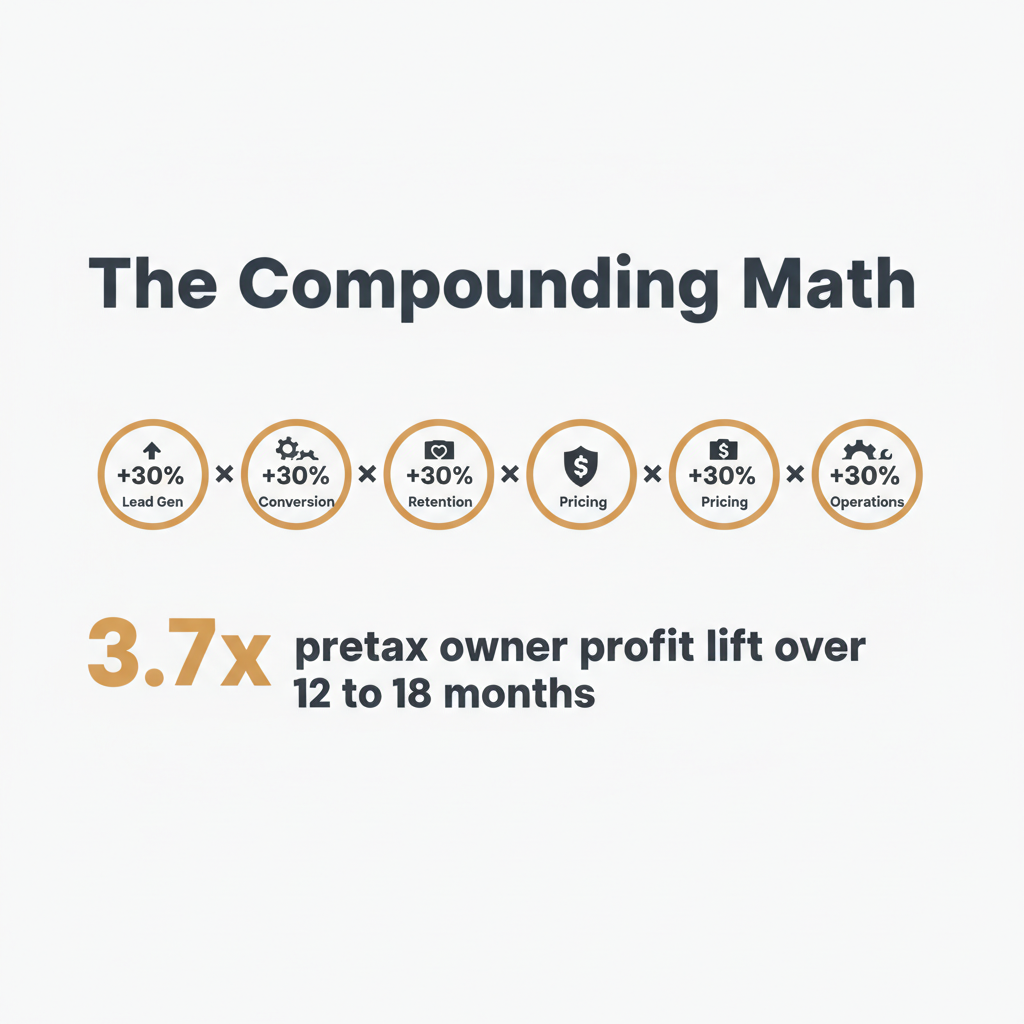
Stack 30 percent faster lead response, 30 percent faster ad copy iteration, 30 percent better retention emails, 30 percent smarter pricing analysis, and 30 percent more efficient ops, and the compounded effect is closer to a 3x to 4x lift in pretax owner profit over 12 to 18 months. Not because any single thing is magic. Because five things got 30 percent better at the same time, and they multiply against each other instead of adding.
This is the actual reason AI matters for a sub-$5M business. It is the first technology in 20 years that gives a small owner the same automation power as a 200-person enterprise. The playing field finally leveled. You just have to know which levers to pull.
Proof: What This Actually Looks Like in a Real Business
Let me show you the math from one real client. (Names changed, numbers real.)
Medspa in a major metro. Annual revenue around $1.4M when we started. Three locations, seven providers. Their lead generation was healthy (about 220 web leads a month from Google Ads and SEO), but their conversion rate sat at 9 percent. They were leaving money everywhere.
What we did over 90 days:
- Built a GoHighLevel speed-to-lead workflow with AI SMS follow-up. Average response time went from 4 hours to 47 seconds.
- Set up AI-drafted review request automation. Google reviews tripled in 60 days.
- Audited their pricing using their 18 months of invoices through Claude. Repositioned three service tiers.
- Rebuilt their email retention sequences for 14 different customer segments using AI-generated drafts.
90-day result. Bookings up 58 percent. Average order value up 22 percent. Owner hours on marketing and ops down by 11 a week. No additional ad spend.
That is not magic. That is five levers, all moved 20 to 30 percent, compounding against each other for one quarter. The AI did not grow the business. The owner did. The AI just made every move 30 percent faster.
What to Do This Week (Not Someday)
If you have read this far and you want a real next step, here is the order I would run.
Monday. Open a spreadsheet. Write down your current numbers for the 5 levers: leads, conversion rate, retention, average sale, and your weekly owner hours. If you do not know, estimate. Just write them down.
Tuesday. Pick the worst lever. Not the easiest. The one with the most upside. For most sub-$5M businesses, that is conversion. Audit your speed-to-lead specifically.
Wednesday. Spend 30 minutes inside GoHighLevel, HubSpot, or whatever CRM you use, and find your current lead response data. If you cannot find it, that is the first problem to solve.
Thursday and Friday. Plug in one AI workflow on that single lever. Do not try to do all five. Just one. Most owners try to install five things and finish zero.
Next month. Measure. Did the number move? If yes, keep stacking. If no, the problem was not AI, it was the underlying system.
If this feels like a lot, that is normal. It also feels a lot more achievable than the AI-is-going-to-replace-everything pitch you have been hearing all year. Boring, specific, measurable lever moves are what actually grow a service business.
The Honest Closing
Here is where the agencies will hate me. AI is not a service you should buy from anyone. AI is a capability you should install in your own business.
A good marketing partner (whether that is The Reach Co or somebody else) should be helping you wire AI into your existing system. Not selling you AI marketing as a brand new line item on top of everything else. If a vendor is selling you AI as a magic growth lever, that vendor does not understand AI or growth.
The Reach Co Lead System is built on this exact framework. Website that converts, SEO that ranks, paid ads that perform, CRM and AI workflows that follow up automatically, all wired together so each lever moves in concert. We use AI everywhere it makes sense. We do not pretend it does things it cannot.
If you want a free, honest audit of where your 5 levers stand and where AI could move them the fastest, schedule a free call at thereach.company/contact. No pitch. Just a clear picture of where you stand and the highest-leverage move you could make in the next 30 days.
The finish line is a lot closer than it feels. Promise.
Once the growth plan is clear, the next question is what AI is actually worth paying for in an online business.

