
Can I shoot straight with you? The single most valuable patch of real estate on the internet for a local business is about the size of a credit card. It's the little map with three businesses pinned to it that pops up when someone searches for a plumber, a medspa, or a roofer near them. Google calls it the Local Pack. Everybody else calls it the Map Pack. And if your business isn't on it, you are invisible to the exact people trying to hand you money right now.
So you did what any reasonable owner does. You typed "how to get my business on Google Maps" into a search bar, and you got back a pile of articles that either tell you to "optimize your GBP" without ever saying what that means, or try to sell you a $1,500-a-month package before you've even claimed your free listing.
Here's the rub. Getting on Google Maps is not complicated. It is free. And it is the highest-ROI move a local business can make before spending a single dollar on ads. There's just a real playbook that almost nobody bothers to write in plain English.
This is that playbook. By the end you'll know exactly how to get your business on Google Maps, how to climb into those top three spots, and why that same listing now decides whether an AI assistant recommends you when a customer asks "who's the best near me." Let's get you on the map.
Why the Map Pack Is the Best Real Estate in Local Search
Let's start with why this is worth your time, because you've got forty other hats to wear today.
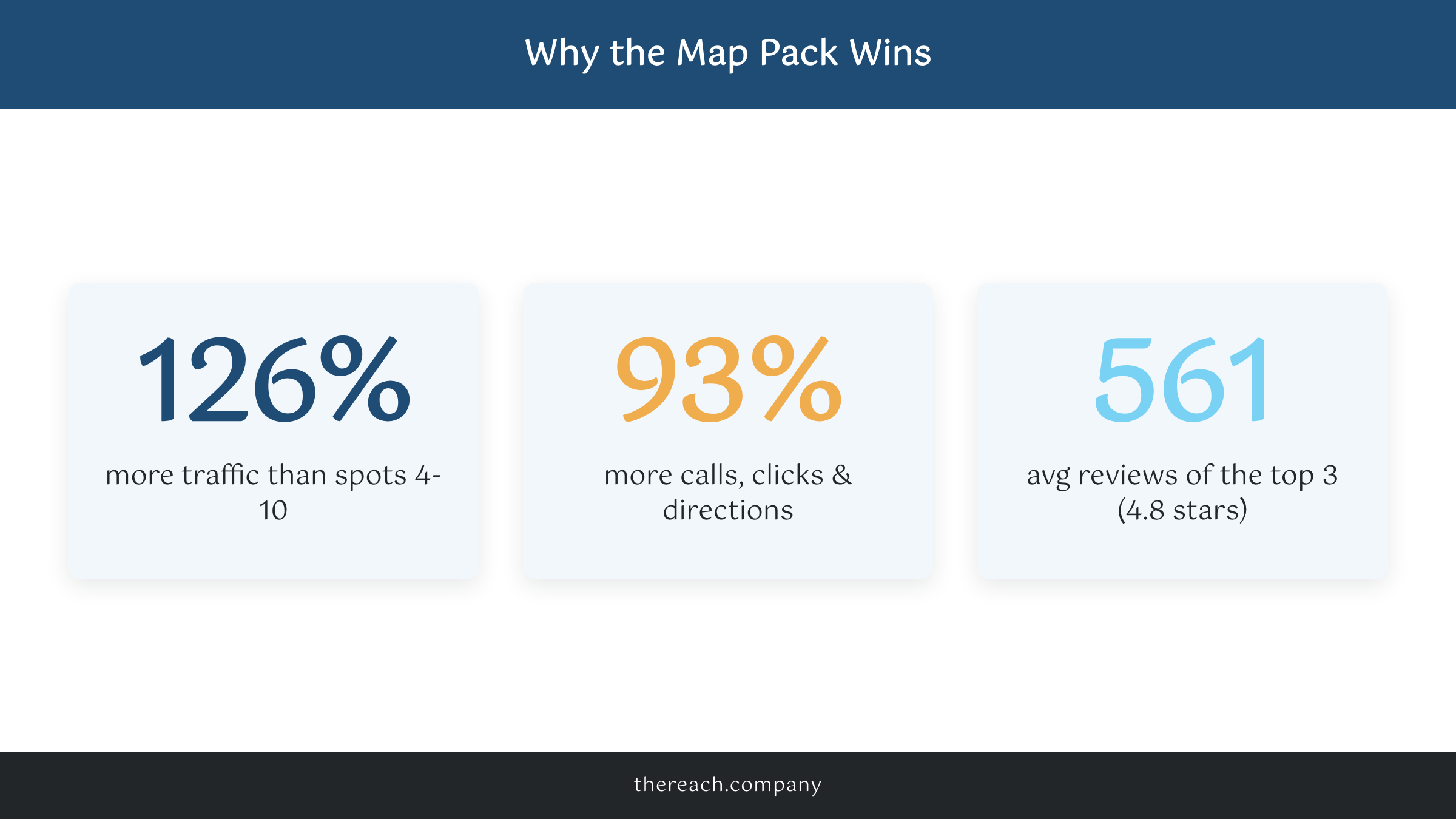
When someone searches for a local service, Google doesn't just hand them ten blue links anymore. It shows a map with three businesses pinned at the top, then the regular results below. Those three spots are the Map Pack, and they soak up the attention. According to Semrush's roundup of 34 local SEO statistics, businesses in the local Map Pack get 126% more traffic and 93% more calls, website clicks, and requests for directions than businesses ranked in spots four through ten.
Let that sink in. Let it really sink in. The difference between showing up fourth and showing up third isn't a rounding error. It's nearly double the calls.
It gets more pointed. That same data shows the top three Map Pack businesses average 561 reviews and hold a 4.8 star rating. That tells you two things. First, reviews are not a vanity metric, they are a ranking lever. Second, the businesses winning those spots are not doing anything magic. They are doing the basics consistently, for a long time.
Now compare that to ads. A click from Google Local Services or a standard search campaign can run you anywhere from a few dollars to fifty-plus per lead depending on your trade. The Map Pack listing costs you nothing per click. It just costs you the work to get there and stay there. That's the whole pitch. You're trading effort for the cheapest, highest-intent leads in local search. A person searching "emergency plumber near me" at 9pm is not browsing. They are buying.
How to Get Your Business on Google Maps (Claim and Verify First)
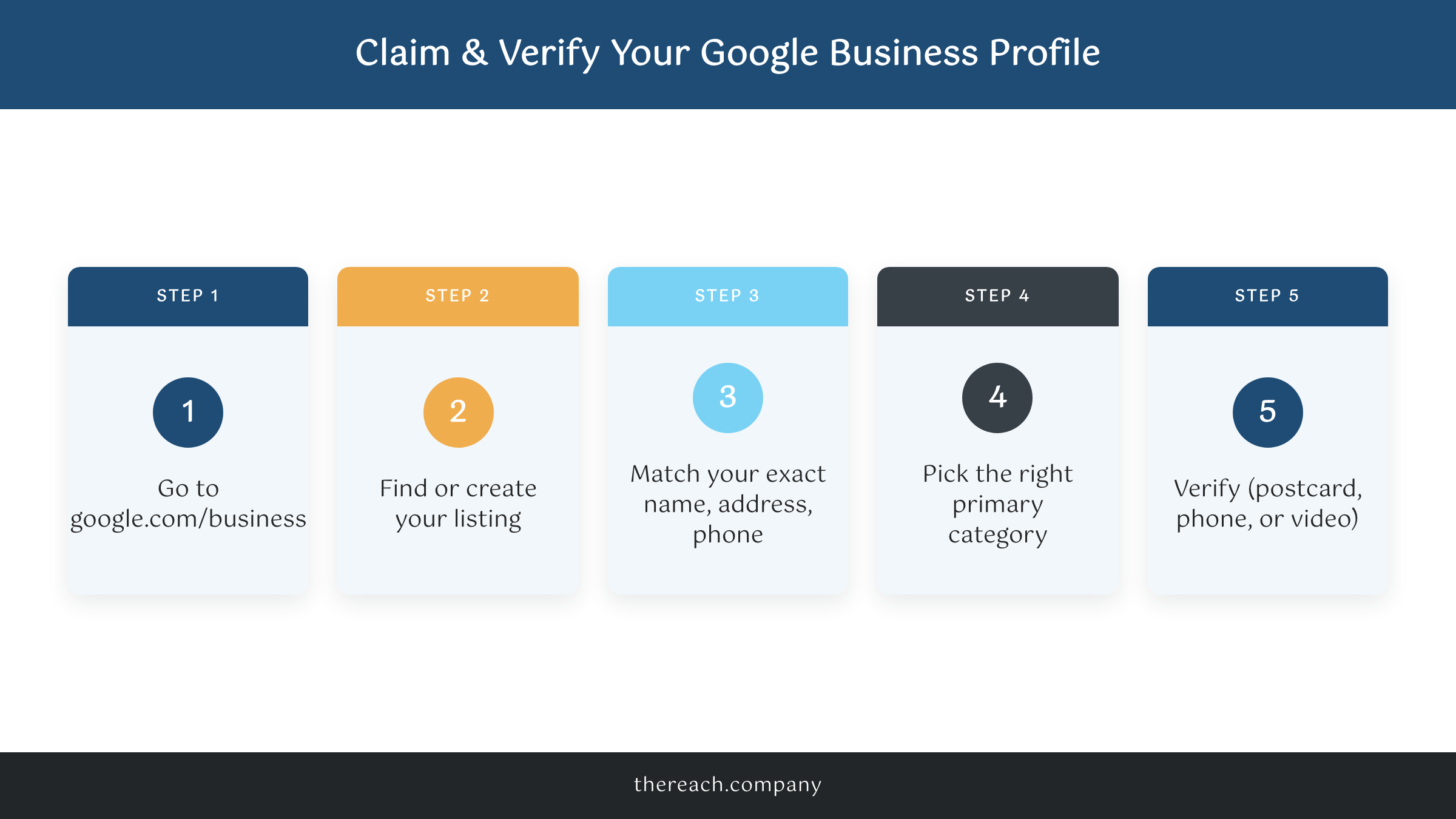
Plain and simple, you can't rank on a map you're not on. So step one is getting your business listed and verified. Here's how to get your business on Google Maps from a standing start.
Go to google.com/business and sign in with the Google account you actually want tied to the business. Not your nephew's. Not an old account you've lost the password to. The one you'll still control in three years.
Search for your business name. One of two things happens. Either Google already has a listing for you, often auto-generated from old data or a customer adding you, in which case you'll claim it. Or there's nothing, in which case you create it fresh. Claiming an existing listing matters, because duplicate profiles are one of the most common reasons a business mysteriously won't rank. If you create a second one on top of an existing ghost listing, you can split your own signal in half.
Then you fill in the core details, and this is where most owners get lazy and pay for it later. Your business name should be your real name, not "Joe's Plumbing Atlanta Emergency 24/7 Cheap." Stuffing keywords into your name is against Google's guidelines and can get you suspended. Your address and phone number need to match what's on your website and everywhere else online, character for character. Suite numbers, abbreviations, all of it. This is called NAP consistency, name, address, phone, and Google leans on it hard.
Pick your primary category carefully. "Plumber" versus "Plumbing supply store" are different searches and different competitors. Your primary category is one of the strongest relevance signals you have, so choose the one that matches what you actually want to be found for.
Last, you verify. Google needs to confirm you are who you say you are, usually with a postcard mailed to your address, sometimes a phone call, increasingly a short video showing your storefront, signage, or tools. Until you verify, you don't really exist on the map. So do it the day it's available.
The Three Things Google Actually Ranks You On
Here's where most articles wave their hands. Let me give you the real model, straight from Google.
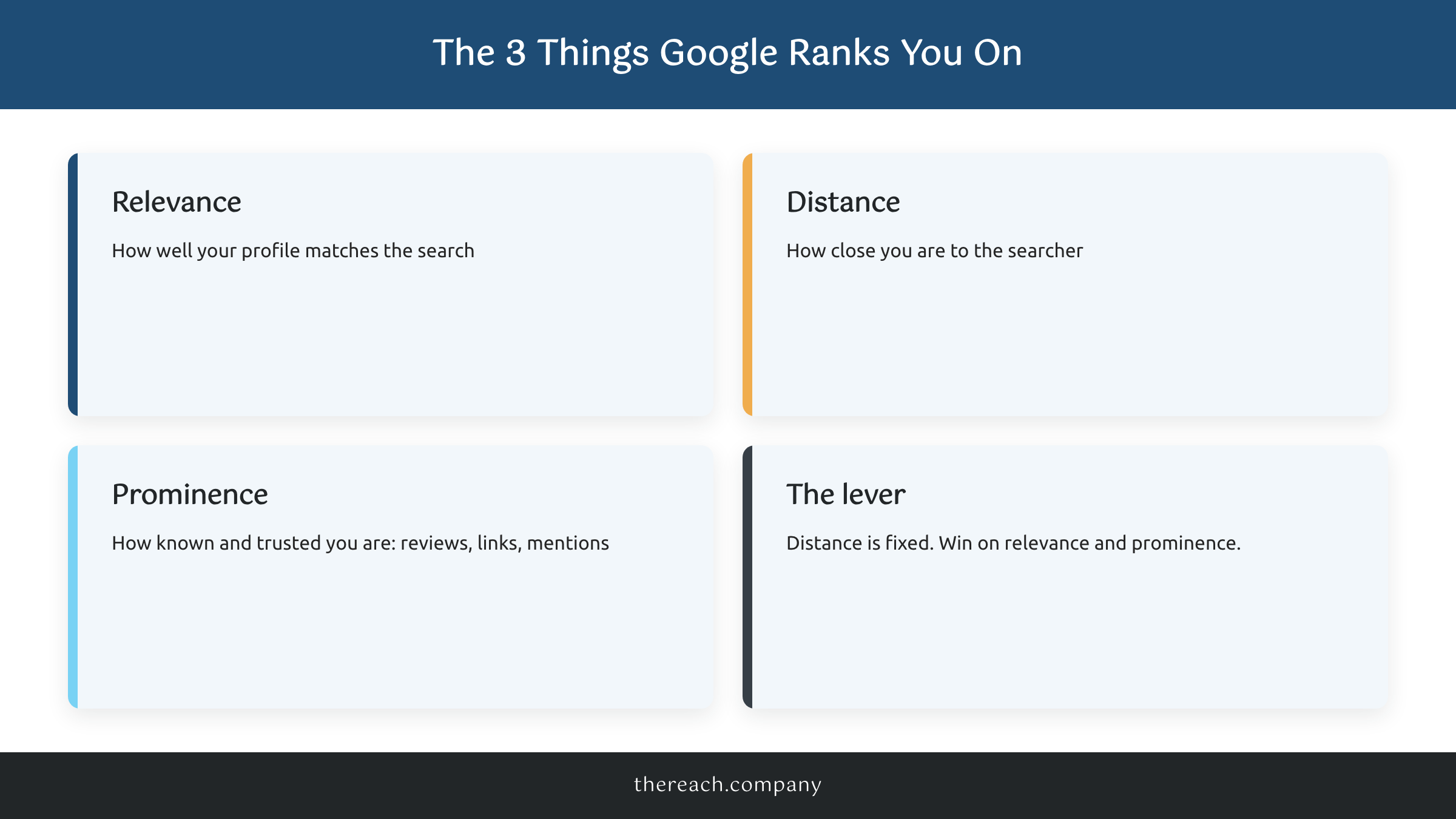
In its own Business Profile Help documentation, Google says local results are ranked on three factors: relevance, distance, and prominence. That's it. Everything else is a detail underneath one of those three.
Relevance is how well your profile matches what someone is searching for. A complete, detailed profile gives Google more to match against. If a customer searches "drain cleaning" and your profile only says "plumber" with no services listed, you're a weaker match than the shop that spelled out drain cleaning, hydro jetting, and sewer repair.
Distance is how far you are from the person searching. If they don't tell Google where they are, Google guesses from their device. You can't change your physical location, and you can't fake your way around it. A business in Marietta is not going to out-rank a Kennesaw shop for a Kennesaw searcher just by wanting it more.
Prominence is how well known and trusted your business is. Google builds this from reviews, ratings, links from other websites, mentions across the web, and your overall footprint. A business everyone reviews and links to looks prominent. A ghost listing with two reviews from 2019 does not.
Why does this model matter so much? Because it tells you exactly where to spend your effort. Two of these three are things you can move. The third one isn't. And once you see that clearly, the whole game gets simpler.
You Can't Move Closer, So Win on Relevance and Prominence
Distance is fixed. Your building is where your building is. So stop worrying about it and pour your energy into the two levers you actually control.
Start with relevance, because it's the fastest. Fill out every field in your profile, not just the ones the setup wizard nags you about. Add all your services with real descriptions. Write a genuine business description that names what you do and where you do it. Add your real hours, including holiday hours. Upload real photos of your team, your trucks, your work, not stock images, and keep adding them, because fresh photos are a signal that you're active. Post updates through the Google Business Profile posts feature the way you'd post anywhere else, a special, a finished job, a seasonal reminder. Every one of these tells Google more about what you're relevant for.
Then go to work on prominence, which is the long game and the one that compounds. Reviews are the heaviest lever here, and it's not close. Remember those top-three businesses averaging 561 reviews. You don't get there by hoping. You get there by asking every happy customer, every time, the day the job is done. The easiest way to make that consistent is to automate the ask. At The Reach Company we set clients up so a review request text or email fires automatically through GoHighLevel the moment a job is marked complete, and a real person replies to every review that comes in. That one workflow quietly moves more local ranking than almost anything else you can do.
Prominence also comes from your name showing up consistently across the web. Get listed in the directories that matter for your trade, keep your NAP identical everywhere, and earn links from local sources, the chamber, a supplier, a sponsorship, a local news mention. None of it is glamorous. All of it stacks.
Here's the honest part, and you knew it was coming. This is not a one-and-done. It really depends on your market and how long your competitors have been at it. But the businesses in those top three spots are simply the ones who kept doing this after everyone else got bored. That's the whole secret.
The New Reason This Matters: AI Is Reading Your Map Listing
Now the part that changes the math in 2026.
For years, the Map Pack mattered because humans looked at it. That's still true. But there's a second audience reading your Google Business Profile now, and it's the AI assistants your customers are starting to ask instead of typing a search. When someone asks Gemini, ChatGPT, or Perplexity "who's the best HVAC company near me," those tools don't invent an answer. They pull from structured local data, and a huge chunk of that data is your Google Business Profile. Google's Gemini is now wired directly to Business Profiles, which means the same listing that ranks you on the map is also feeding the AI recommendation.
So read this slowly. An incomplete, unverified, review-thin profile isn't just costing you Map Pack rankings. It's making you invisible to the AI a customer just asked for a recommendation. The owner who filled out every field, gathered 300 reviews, and keeps the profile fresh isn't only winning the map. They're the business the AI names.
This is the part the hype crowd gets backwards. They sell you on some new AI tool when the actual move is boring and free. Get your Google Business Profile genuinely complete and trusted, and you've simultaneously set yourself up for human search, map rankings, and AI recommendations with one effort. If you want the wider view of how this shifted, we broke down what's actually changed in local SEO and put together a practical AI playbook for local businesses. The headline is simple. The map is now the front door for both your customers and their robots.
What This Looks Like When It Works
Let me show you this isn't theory.
One of our clients is Chin Up Aesthetics, a medspa. When we took over their local presence and did the unglamorous work, complete profile, real categories for every service, a steady engine of reviews, consistent NAP, they landed first in the Map Pack for more than eight of their core services. Not one keyword. Eight-plus.
Here's what that did downstream. Their website pulled 1,928 leads in a single year. A big slice of that traffic started with a person searching a treatment "near me," seeing Chin Up pinned at the top of the map, and clicking. The Map Pack wasn't a vanity badge. It was the top of a funnel that produced real, countable leads, month after month.
None of that required a secret. It required claiming the profile, treating relevance and prominence like the levers they are, and staying consistent long enough for it to compound. The same playbook in this post. A medspa, a plumber, a roofer, a law firm, the mechanics don't change. The business that shows up on the map for the searches that matter becomes the obvious choice, and the obvious choice gets the call.
And the compounding is the quiet magic here. Every new review nudged the ranking up, every higher ranking pushed more searches into the profile, and every one of those searches turned into more reviews. That loop is why the gap between the top three and everyone else gets wider over time instead of closing. The medspa across town that never claimed its listing didn't lose to a bigger ad budget. It lost to an owner who did four boring things in the right order and refused to stop doing them.
What to Do This Week
You don't need a thirty-step project. You need momentum. Here's the short list, in order.
First, claim and verify your Google Business Profile if you haven't, or log in and confirm you control it if you have. No verified profile, no ranking, full stop.
Second, fill it out completely. Every service, real descriptions, accurate hours, real photos, the correct primary category. Block out an hour and just finish it.
Third, turn on the review engine. Pick one method and make it automatic, a text or email that goes out the moment a job is done, and commit to replying to every review. This is the single highest-leverage habit on the list.
Fourth, fix your NAP everywhere. Make your name, address, and phone identical on your website, your profile, and your top directory listings.
Fifth, add one fresh photo and a quick post. A single real photo of a recent job, plus a one-line update about a special or a finished project, tells Google the profile is alive and active. It takes two minutes from your phone while you're sitting in the truck, and it's the kind of small signal that separates an active listing from a dusty one.
Do those five and you'll be ahead of most of your competitors, who are still sitting on a half-built listing. If you'd rather not wear this hat, this is exactly the kind of work we handle inside Local SEO done for you, the map, the profile, the reviews engine, the citations, all of it built and managed so you can stay focused on the actual job. It's one piece of the bigger machine, the website that converts, the SEO that brings traffic, the follow-up that closes, all working together.
You're Closer Than You Think
Getting on Google Maps is not the dark art the agencies make it sound like. It's a free listing, three honest ranking factors, and the discipline to do the basics longer than the other guy. That's it.
The owner who wins the map isn't smarter than you. They just claimed the profile, filled it out, asked for the reviews, and kept showing up. You can do every bit of that, starting this week. And now there's a bonus, the same effort that wins you the map is what gets you recommended when a customer asks an AI who to call.
The finish line is a lot closer than it feels. Promise. Go claim your spot on the map. You got this.

