

Can I shoot straight with you? You do not need a $149-a-month rank tracker to figure out how to track your keyword rankings. I know that is not what the software companies want you to hear. Every SEO tool on the planet wants to sell you a glowing dashboard with little green arrows. Most owners I talk to bought one, logged in twice, then let it auto-renew for a year while they never opened it again.
Here is the rub. Google already gives you most of this data for free. The rest you can check in about 30 seconds with a browser you already have open. So before you put another subscription on the card, let me show you exactly what to look at, how often, and which number actually matters.
Why owners overpay just to see where they rank
Rank tracking got turned into a product. Tools like Ahrefs and Semrush are genuinely great, and at The Reach Company we pay for them. But they are built for agencies tracking hundreds of keywords across dozens of clients. You are one business owner who wants to know if you are showing up for “emergency plumber Atlanta” and a handful of other terms that put food on the table.
Paying $99 to $199 a month for that is like buying a commercial dump truck to haul one load of mulch. It works. It is also wildly more than you need. The tool is not the thing that moves you up Google. The work is. The dashboard just tells you a number you can get somewhere else for nothing.
The free way to see where you actually rank
Start with Google Search Console. It is free, it uses your real data, and it shows your average position for every query you already appear for. Google defines position simply: 1 is the topmost spot, 2 is the next, and so on. One detail matters a lot. Google only records your position when your result actually earns an impression, so the numbers reflect searches where you genuinely showed up, not theoretical rankings (you can read Google’s own breakdown of how position is measured in the Search Console Help docs).
Open the Performance report, sort by your money keywords, and you have a rank tracker that costs zero dollars and never lies to you. If you want to go deeper on pulling lead-driving keywords out of that same report, we wrote a whole piece on the SEO hack hiding in your Google Search Console.
A couple of pointers so the report actually tells you something. Set the date range to the last 3 months and turn on the comparison to the previous 3 months, so you see direction instead of a single-day snapshot. Add a filter for one specific query to watch a single keyword over time, or filter by page to see every term that one page ranks for. Average position bounces around day to day, sometimes a full spot or two. The trend line over weeks is the part you care about, not Tuesday’s number.
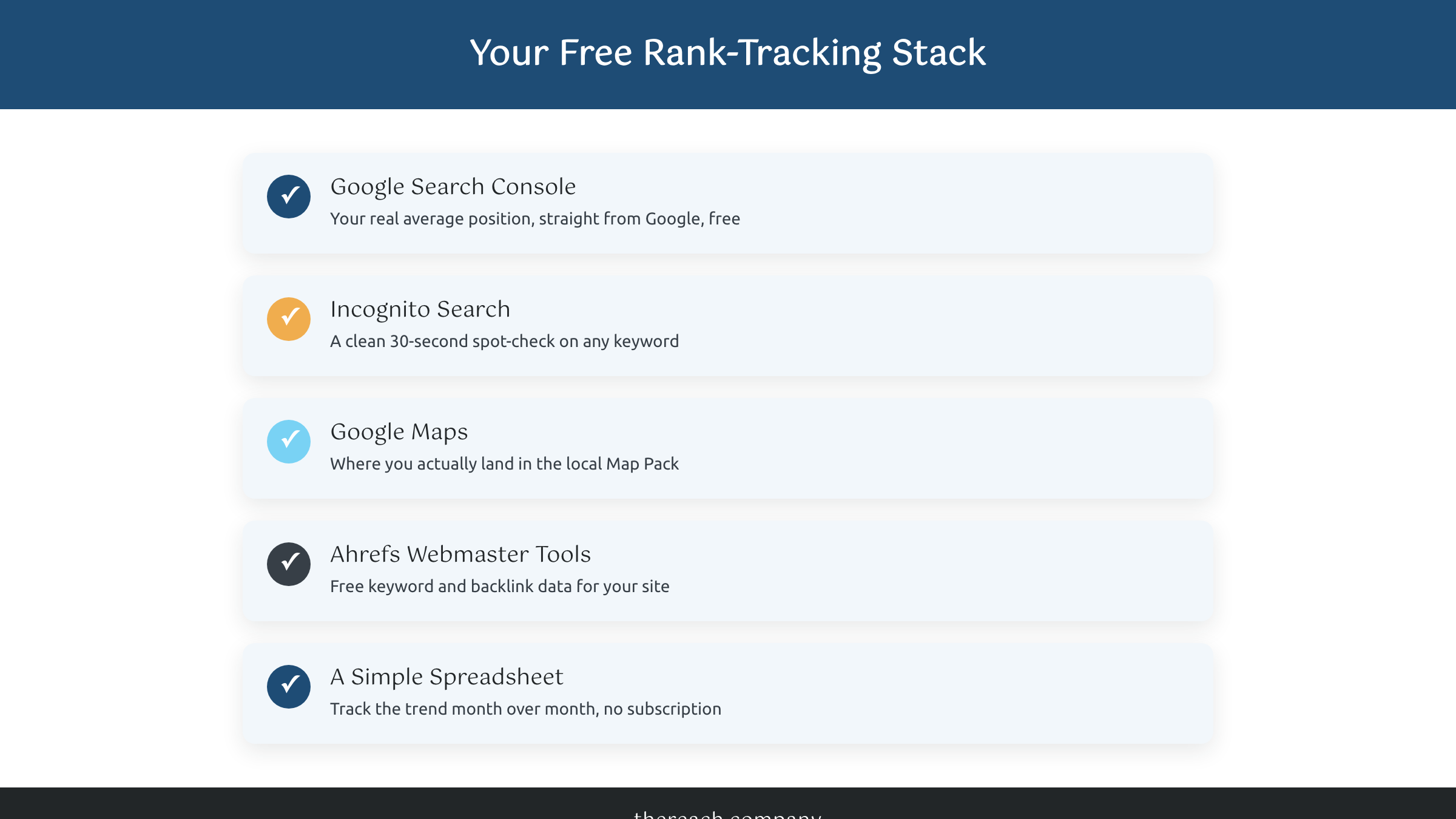
Two manual checks fill the gaps. First, open an incognito window, type your keyword, and look. Incognito strips out your login and most personalization, so you see something close to a clean result. Second, for anything local, search the term in Google Maps and find where you land in the Map Pack. Search Console will not always show you Map Pack position cleanly, and for a service business the Map Pack is often where the calls come from. Plain and simple.
The number most rank trackers get wrong
Here is where the expensive tools quietly lead you astray. They make position the hero. Position by itself is a vanity metric. Ranking #1 for a keyword nobody clicks is a trophy on a shelf. It does not pay your team.
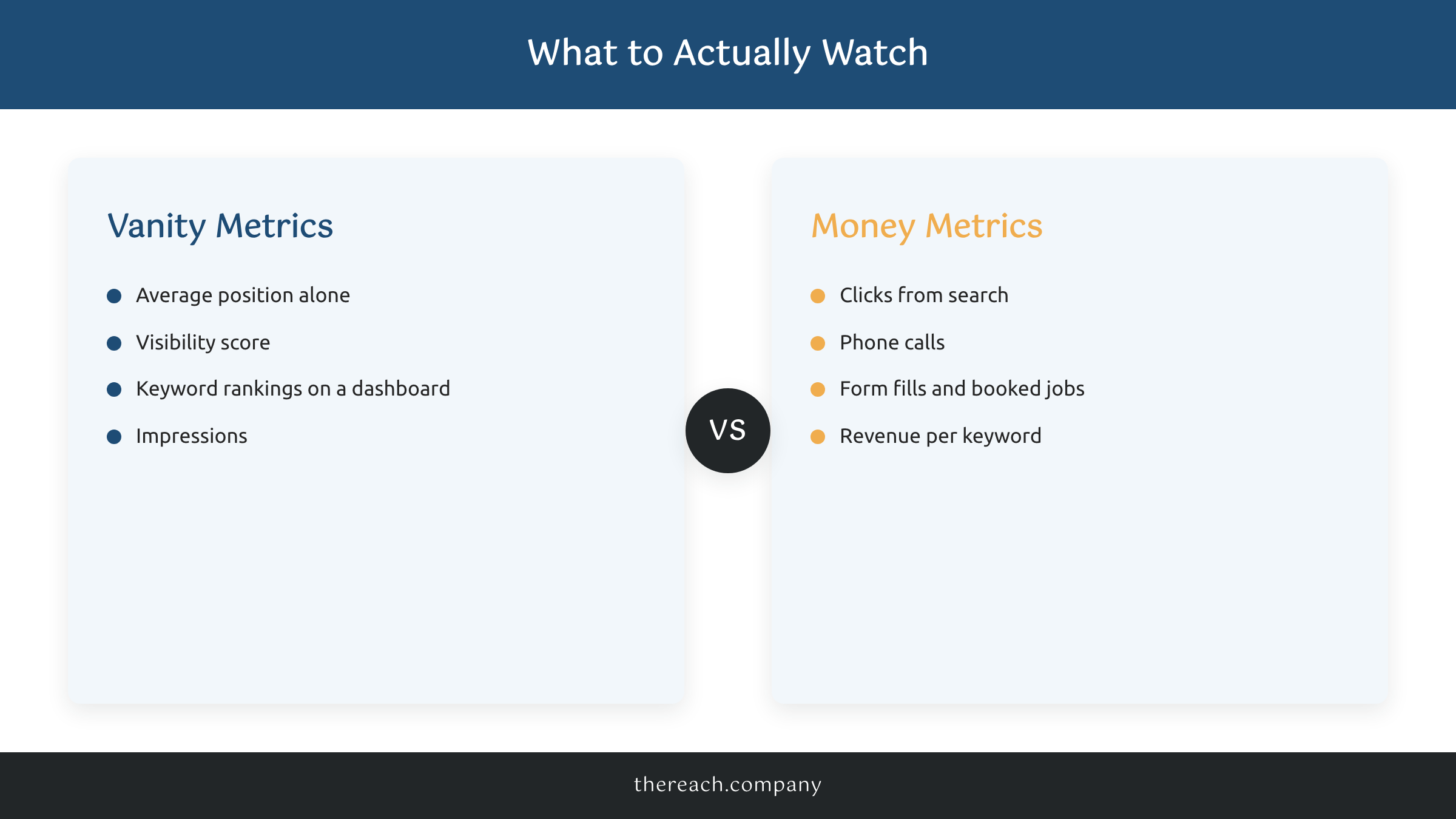
What you actually want to watch is the chain from ranking to revenue. Clicks from search. Phone calls. Form fills and booked appointments. A #3 ranking that sends you 12 calls a month beats a #1 ranking that sends you none, every single time. Track position so you know which direction you are heading. Track clicks and calls so you know whether it is working. The money is in the result, not the rank.
This is where a little plumbing pays off. Put a call tracking number on your site with something like CallRail so you can tie a phone call back to the exact page and search that drove it. Make sure your form fills and booked appointments land somewhere you can actually count them, whether that is your CRM or a simple GoHighLevel pipeline. Now your monthly check answers the only question that matters: did more of the right people find you and reach out?
What this looked like for a real medspa
We work with a medspa, Chin Up Aesthetics, that ended up 1st in the Map Pack for 8 or more of its core services. That is a great ranking story. But the number that actually mattered to the owner was 1,928 leads from the website in a single year. The rankings were the cause. The leads were the point.
If they had only ever watched position, they would have missed the part that funded the business. We tracked both, side by side, the whole way up. That is the habit to copy.
A 15-minute monthly routine you’ll actually keep
You do not need a daily ritual. Daily rank checking is a great way to make yourself anxious over normal Google wobble. Once a month is plenty for most service businesses.
Here is the routine. Open Google Search Console and note the average position and clicks for your 5 most important keywords. Run a quick incognito search on those same 5. Check your Map Pack position for the local terms. Drop all of it in a basic spreadsheet so you can see the trend across a few months. That is the whole thing. Fifteen minutes, no subscription.
What you are looking for across those months is a slow climb with rising clicks, not a perfect ranking. Months 1 and 2 might barely move. That is normal. By month 3 or 4 you usually see a handful of keywords creep from page 2 onto page 1, and the clicks follow them up. If everything is dead flat after a full quarter of real work, that is your signal that something deeper is off, like slow site speed, thin service pages, or a weak Google Business Profile.
If you run that for 90 days and you are still stuck on page 3, that is real signal. It means the underlying work needs attention, not that you need a fancier tracker. That is the point where it makes sense to hand it off, and it is exactly what our Local SEO service is built to do.
Knowing how to track your keyword rankings is not the hard part. Doing the work that moves them, consistently, is. But at least now you can see clearly where you stand without paying a dime for the privilege. The finish line is a lot closer than it feels. Promise. You got this. And if you want a hand, we got you too.
Once you know what to track, the next question is which tools to run. Here are the AI SEO tools for small business that actually moved rankings for our clients.

