
Most “ChatGPT marketing” reads like a robot because owners do three things: type a one-line prompt, copy the first thing that comes out, and hit publish. The tool did its job. The owner skipped theirs. If you have ever pasted a ChatGPT email into your business and thought “this doesn’t sound like me,” that is exactly why.
Learning how to use ChatGPT for marketing is not about finding a magic prompt. It is about feeding the model enough of you that it stops sounding like everyone else, then editing the output like a human who actually runs the business. We use AI every single day at The Reach Company. It writes faster than any of us. It also produces beige, hedgy, “in today’s fast-paced digital landscape” filler the second you let it run on autopilot. The difference between copy that converts and copy that screams “a bot wrote this” is about fifteen minutes of work most people refuse to do.
Why ChatGPT Sounds Like a Robot in the First Place
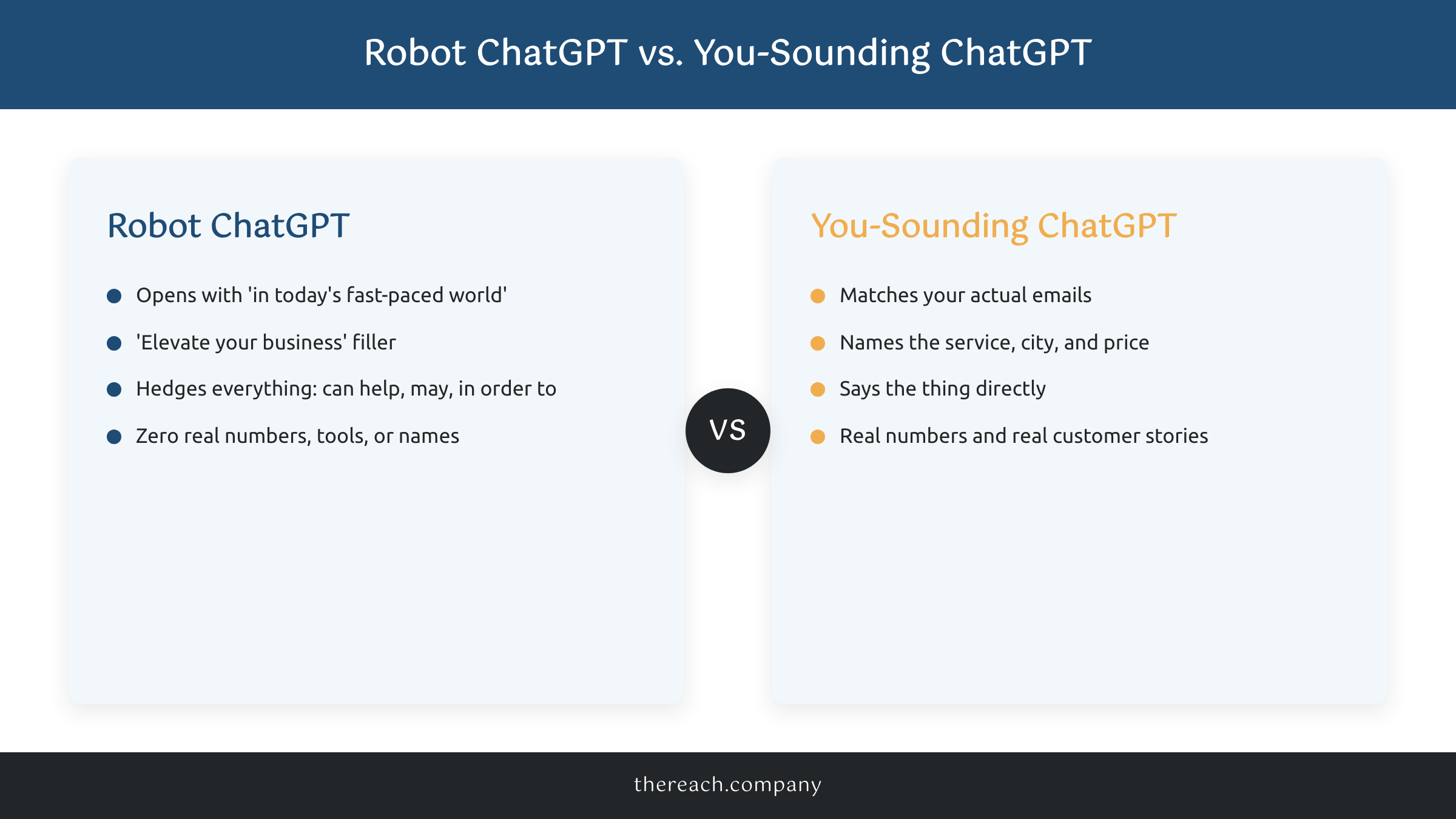
ChatGPT is trained on the average of the internet. Ask it a generic question, you get the average answer. That is why unedited AI copy has a sound. It opens with “in today’s fast-paced world.” It loves the phrase “elevate your business.” It hedges every claim with “can help” and “may.” And it never names a single real number, tool, or customer.
Those are tells. A reader cannot always explain why a paragraph feels hollow, but they feel it, and they trust it less. Nobody hands money to a business that sounds like a press release written by a committee. Worse, every competitor pasting the same lazy prompts gets the same beige output, so you end up sounding identical to the businesses you are trying to beat. The fix is not a cleverer one-line prompt. It is giving the model something specific to work from.
Feed It You, Not a One-Line Prompt
The reason your output is generic is that your input is generic. “Write a Facebook post about my plumbing company” gives the model nothing, so it fills the gap with the average plumbing post. Give it three things instead and the output changes completely.
First, give it your voice. Paste two or three things you have already written, an email, a text to a customer, an old post, and tell it to match that tone. Second, give it real details: the exact service, the city, the price, the actual objection a customer raised last week. Third, give it the job. Tell it who it is talking to and what you want them to do.
Here is what that looks like in one prompt: “You are writing a Facebook post for my HVAC company in Marietta. Match the tone of the emails I pasted above. We just had a customer whose AC died during a heat wave, and we got there in two hours. The goal is to get homeowners to save our number before their system fails. Keep it under 120 words and write like a real person, not an ad.”
That gives the model a lane. It cannot drift into beige filler because you boxed it in with your voice, your facts, and your goal. Specific tools like ChatGPT and Claude both reward this. Vague in, vague out. Detailed in, and the draft already sounds like your business instead of a stock template.
The Editing Step Everyone Skips
Here is the part nobody wants to hear: the first draft ChatGPT gives you is a starting point, not a finished product. The owners who get burned are the ones who treat “Generate” as the last step instead of the first. The edit is where the post becomes yours.
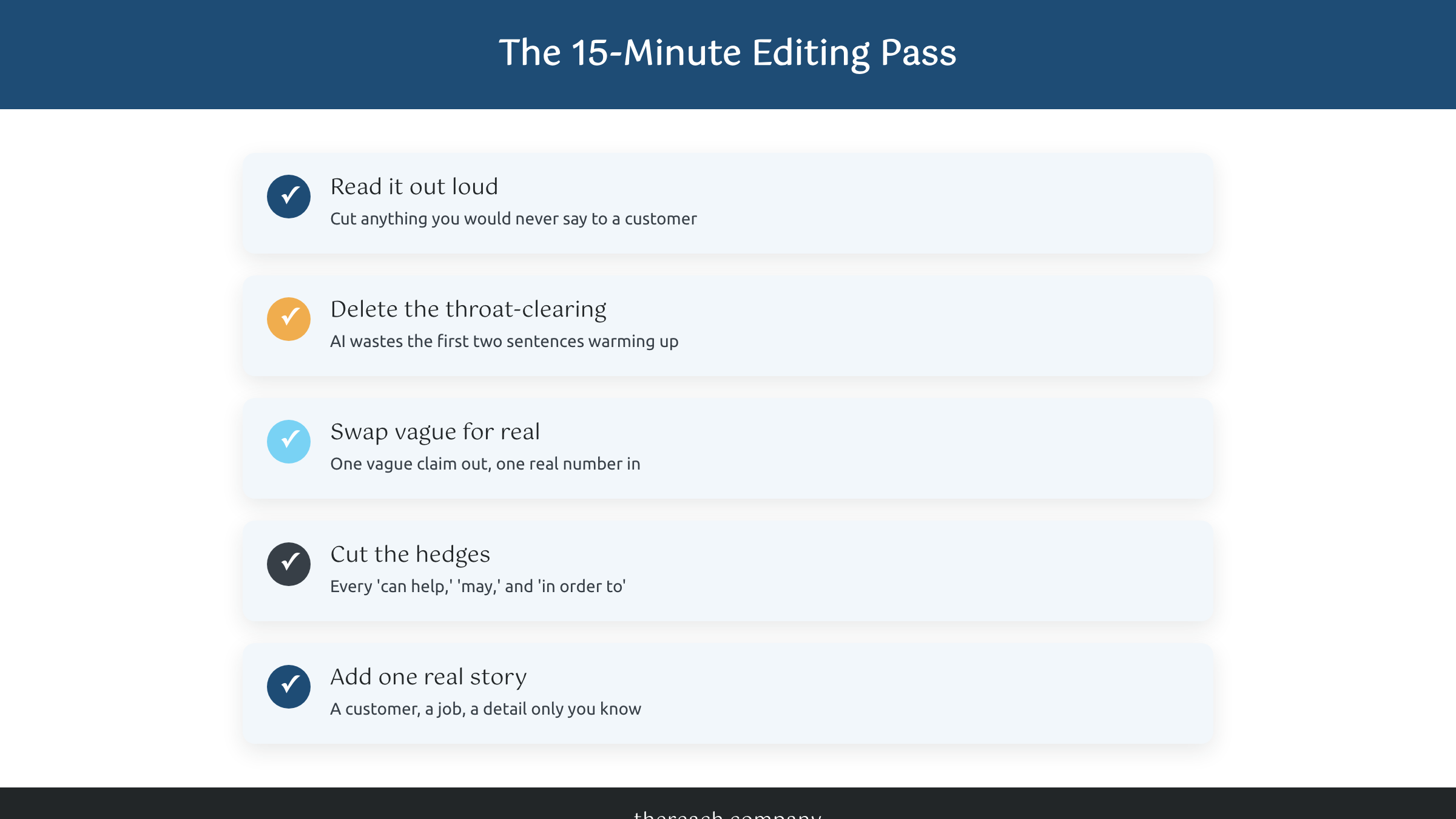
Read it out loud. If a sentence is one you would never actually say to a customer, cut it or rewrite it. Delete the throat-clearing intro, because AI almost always wastes the first two sentences warming up. Swap one vague claim for one real number or one real story. Cut every “can help,” “may,” and “in order to.” Then read it out loud one more time and ask whether it sounds like you on a good day.
That fifteen-minute pass is the whole game. It is the difference between content that sounds like a thousand other businesses and content that sounds like the specific person a customer is about to hand money to. Keep a short list of your own banned phrases next to the keyboard if you have to, the words you would never actually say, and strike them every time you see one. After a week of doing this, you start spotting the robot voice in about two seconds. AI gets you a draft in thirty seconds. You get it across the finish line.
Google Is Fine With AI. It Is Not Fine With Lazy.
Owners worry that using ChatGPT will get them penalized by Google. It will not, as long as you do the editing step. Google’s own Search Central guidance says it rewards high-quality, people-first content regardless of how it is produced. The problem is not AI. The problem is using AI to mass-produce content with the primary purpose of gaming rankings, which violates their spam policies. Appropriate use of AI is explicitly fine.
Read that again, because it is the whole point. Google does not care that a machine helped you write. It cares whether the result is actually useful and original. Generic, unedited AI copy fails that test. Edited copy with your real expertise, your numbers, and your voice passes it. That is the same standard a customer applies the moment they land on your page, just automated.
This is not theory for us. We have used AI to draft first versions of emails and posts behind real client results, like the 1,928 leads in a single year a medspa client pulled in. AI did not earn those leads. It sped up the boring part so a human could spend their time on the part that actually moved the number.
What to Do This Week
Pick one thing you write often: a follow-up email, a Google Business Profile post, a service-page paragraph. Open ChatGPT, paste two examples of your own writing, give it the three inputs above, and generate a draft. Then spend fifteen minutes editing it like a human. Compare it to what you would have shipped on autopilot. That gap is the entire skill, and it is most of how to use ChatGPT for marketing without sounding like a robot.
If you want AI doing more than drafting, the real leverage is wiring it into your follow-up so leads get answered in seconds instead of hours. That is the lead generation system we build for clients, and it is where AI stops being a writing toy and starts making you money. For the bigger picture on putting AI to work across your marketing without the hype, here is a practical AI marketing playbook.
Knowing how to use ChatGPT for marketing comes down to one habit: feed it you, then edit like you mean it. The owners who sound like robots are the ones who skipped both steps. The ones who sound like themselves, only faster, treated AI as a sharp assistant instead of a vending machine. The tool is not going to make you sound human. You are. It just gets you to the edit a lot faster.
And if you run a consulting practice, ChatGPT is only one piece: here is the 4-app AI stack for consultants that covers drafting, meeting notes, proposals, and your inbox.
And if you’re wondering what else belongs in the stack, here is our full rundown of the best AI tools for small business.

