

Can I shoot straight with you? The reason your blog isn’t bringing in leads has nothing to do with how good a writer you are. Most business owners think learning how to write a blog post for SEO means becoming a better writer. It doesn’t. It means following a structure. The owners who rank aren’t more talented than you. They’re just more organized. They write one post, about one thing, built to answer one question a real person typed into Google. That’s it. By the end of this, you’ll have a repeatable system you can run in an afternoon, even if you failed every English class you ever took.
Why “Just Write More” Doesn’t Work
Here’s the rub. Someone told you to “start blogging,” so you did. You wrote a post about a project you were proud of. Then a post with five tips. Then one about the holidays. Six months later, nothing. No traffic, no leads, no movement. So you quit. The problem was never your effort. It was that none of those posts had a job. You published volume with no target. Google had nothing to match your post to, because you weren’t answering a specific question anyone was actually searching for. It’s like opening a store and stocking random shelves, then wondering why nobody walks in for the thing you never put a sign up for. Writing a blog post for SEO starts before you write a single sentence. It starts with picking the one thing that post is going to be the best answer for on the entire internet for your little corner of it.
Start With One Keyword (and the Job Behind It)
One post. One keyword. One question. That’s the rule. A keyword is just the phrase a customer types into Google. “How much does a roof inspection cost.” “Best time to fertilize Bermuda grass.” “Do I need a permit to finish my basement.” Notice those aren’t clever. They’re plain. They’re how real people actually talk. You don’t have to guess at these. Open the low-volume keywords already hiding in your Google Search Console. Those are the exact phrases people used to find you, including the ones you barely rank for. Each one is a post waiting to be written. Pick one with clear intent, meaning you can tell exactly what the person wants the second you read it. Then ask the most important question in this whole article: what is this person actually trying to get done? Someone searching “how much does a roof inspection cost” wants a number and to know if you’re trustworthy. They don’t want your company history. Match the post to the job, and you’re already ahead of 90% of the businesses in your town. This is the part of how to write a blog post for SEO that nobody slows down to explain. Search engines aren’t trying to reward the prettiest writing. They’re trying to give the searcher the best answer to what they meant. So your only real job is to figure out what they meant, then be the clearest, most honest answer on the page. You spot the difference between a tire-kicker and a real buyer every day on the phone. This is the same instinct, just written down.
The 5-Part Structure That Does the Heavy Lifting
Every post that ranks has the same skeleton. Once you see it, you can’t unsee it, and you’ll never stare at a blank page again. First, the title uses your keyword and makes a promise. Second, the intro answers the question fast, in the first hundred words, so nobody bounces. Third, your H2 headers are the smaller questions people ask about the topic, in plain language. Fourth, you actually answer each one, with real specifics, numbers, and names instead of fluff. Fifth, you link to your service pages and your other posts so the reader (and Google) can see how it all connects.
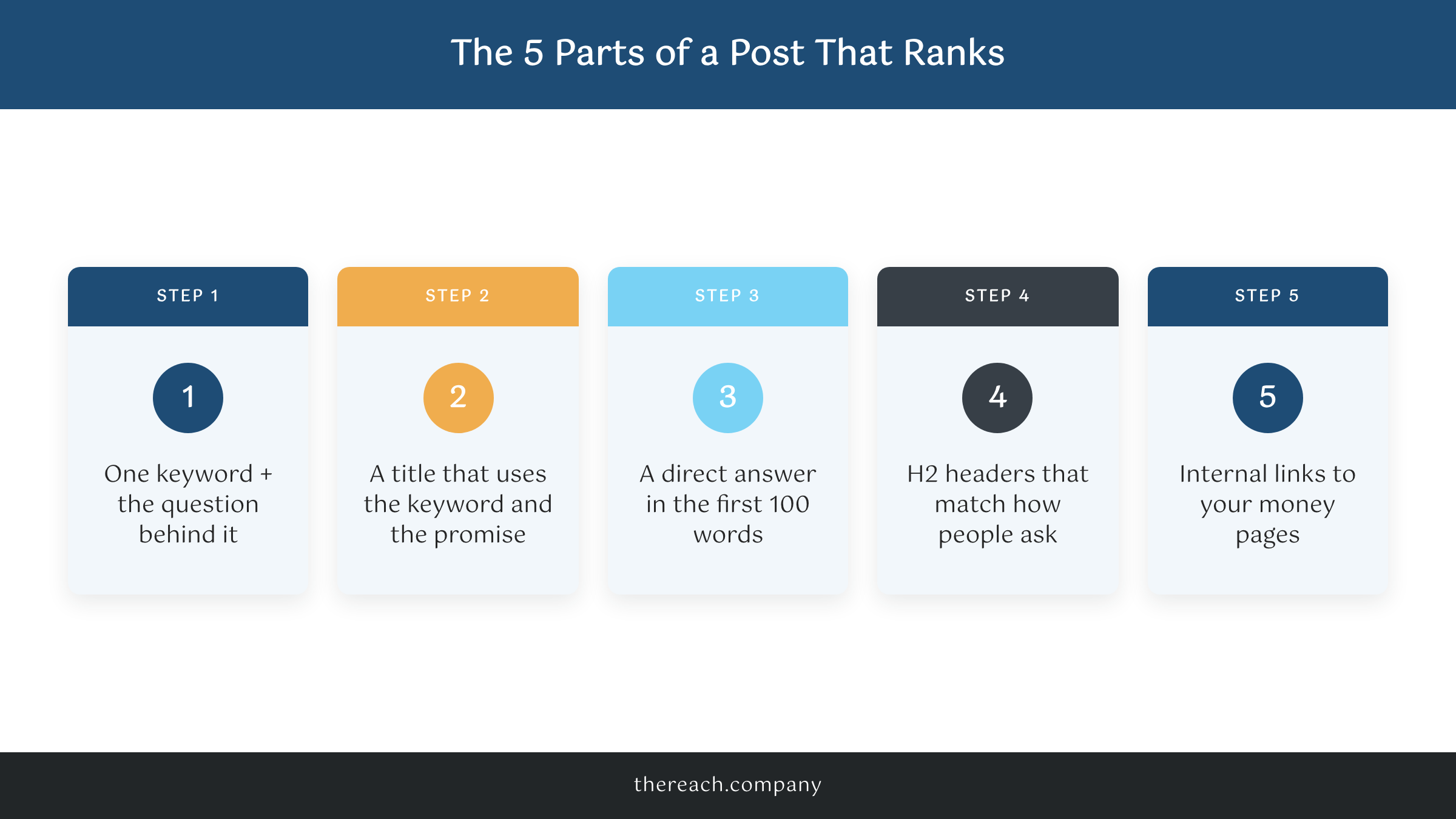
That’s the whole game. You’re not writing an essay. You’re filling in a structure. The structure does the ranking. You just bring the honest answers, because you already know this stuff cold. You answer these questions on the phone every week.
Forget the Word Count (Yes, Really)
Now the part nobody tells you. You do not need 2,000 words. You don’t need 1,500. You need exactly enough to answer the question completely, and then you stop. Don’t take my word for it. Google says it flat out. In its own guidance on helpful content, Google addresses the word-count myth directly and answers it for you: “Are you writing to a particular word count because you’ve heard or read that Google has a preferred word count? (No, we don’t.)” Google rewards content “created to benefit people,” not content padded to hit a number. Let that sink in. The agency that quoted you for “1,500-word SEO articles” was selling you word count because it’s easy to bill for, not because it ranks. A 600-word post that fully answers “do I need a permit to finish my basement” will beat a 2,000-word post that buries the answer under introductions and stock photos. Answer the question. Then quit while you’re ahead.
What This Looks Like for a Real Business
Here’s proof this isn’t theory. One of our clients, a medspa, ranks first in the Google Map Pack for eight-plus of their core services. That didn’t happen because they wrote beautiful prose. It happened because their content and their local SEO were built to answer the exact questions their customers were searching, and those answers pointed back to the pages that book appointments. Content that ranks isn’t a writing contest. It’s a matching game. The businesses that win are the ones that answer real questions clearly and connect every post back to the work they want to be hired for. Plain and simple. And it doesn’t take a huge team or a fat retainer to pull off. One owner, one keyword a week, one honest answer at a time. Six months of that quietly stacks into a library of pages, each one ranking for a question a paying customer is already typing into Google. The agency wants you to believe this is complicated so they can charge you $1,500 a post. It isn’t. It’s a habit.
Your Repeatable Writing System
So here’s your system. Pick one keyword from Search Console. Figure out the job behind it. Write the title with the keyword in it. Answer the question in the first 100 words. Break the rest into H2 headers that are just smaller questions. Answer each one like you’re talking to a customer across the counter. Link to a service page and one other post. Then publish.
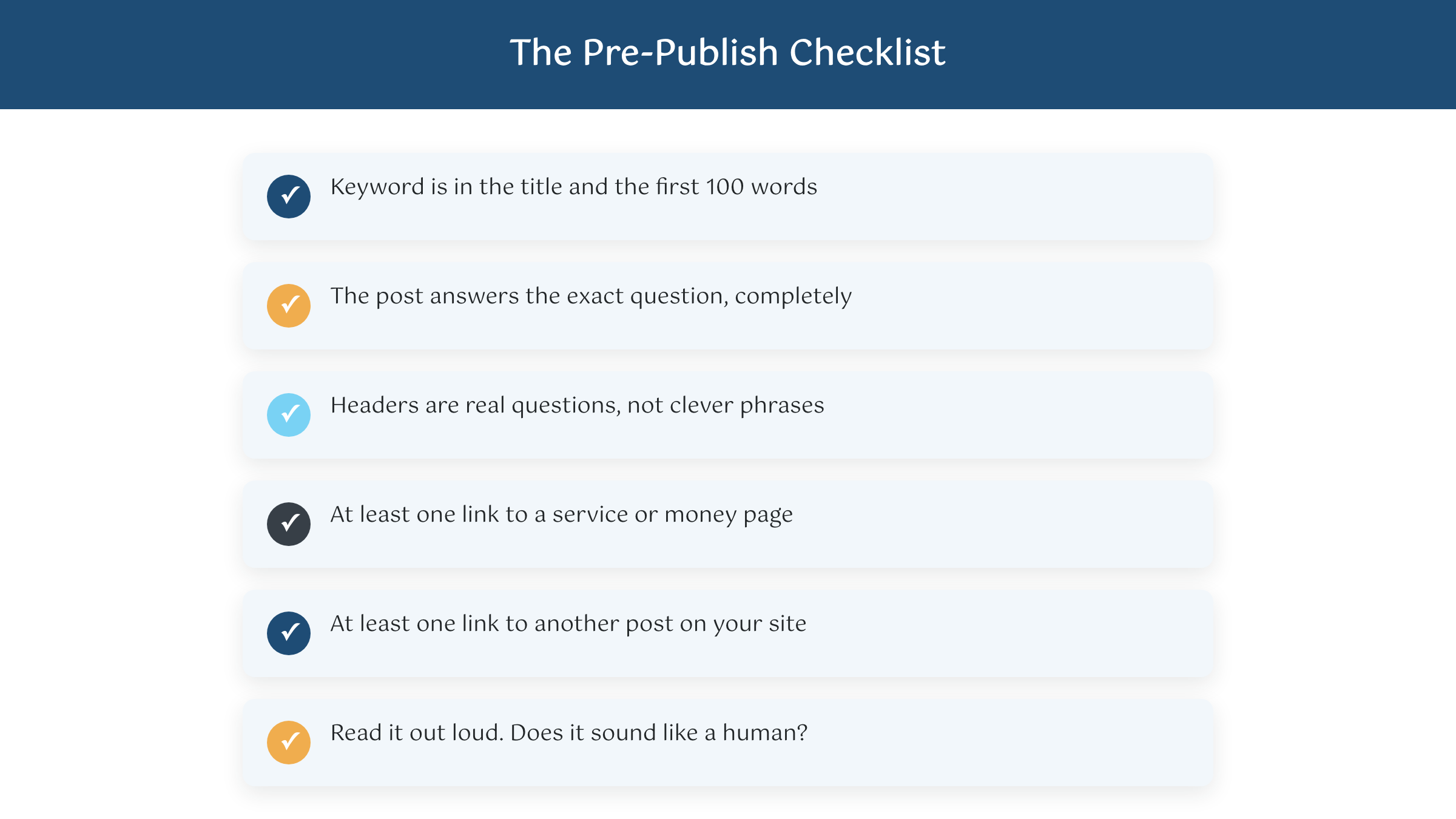
Run that every week and you’ll have a library of posts that each do a job, instead of a pile of posts that do nothing. It compounds. Slowly at first, then all at once. And if writing still isn’t your thing, that’s fine. It’s not supposed to be. You’re great at running your business. Writing SEO content is one of the 38 hats you’re wearing, and it’s a hat we’re happy to take. That’s a big part of what our Local SEO service does for clients: the keyword research, the structure, the publishing, all of it, so you can keep doing what you do best. Either way, the finish line is a lot closer than it feels. You got this. And if you want a hand, we got you too.

