

Can I shoot straight with you? Most agencies are counting on you not knowing what to ask. You walk into the sales call, the deck looks slick, the account manager is charming, and ninety minutes later you’ve signed a twelve-month contract for a service you can’t quite describe. Six months in, you’re paying $3,000 a month and you genuinely can’t tell what you got for it.
Here’s the good news. The questions to ask before hiring a marketing agency are not complicated. You don’t need to understand SEO bidding or ad algorithms to ask them. You need to know which nine to ask, and what a straight answer sounds like. That’s the whole game.
Why the Questions Matter More Than the Pitch
The pitch is the part agencies are best at. Of course it is. It’s the part they’ve practiced. The polished deck and the confident closer tell you almost nothing about what your account will look like on a random Tuesday in month four.
That’s where owners get burned. They evaluate the logo, the office, and the vibe, then sign. The mechanics, who does the work, what you actually own, how you’ll know it’s working, never come up until it’s too late to matter. Spend any time in small-business forums and you’ll see owners asking the same three things after the fact: who gets access to my accounts, who’s on the pitch versus who does the work, and is this reporting real or just vanity metrics. Those questions belong before you sign, not after.
So the questions below aren’t about catching an agency in a lie. They’re about making the invisible part of the relationship visible while you still have all the leverage.
The 9 Questions to Ask Before You Hire a Marketing Agency
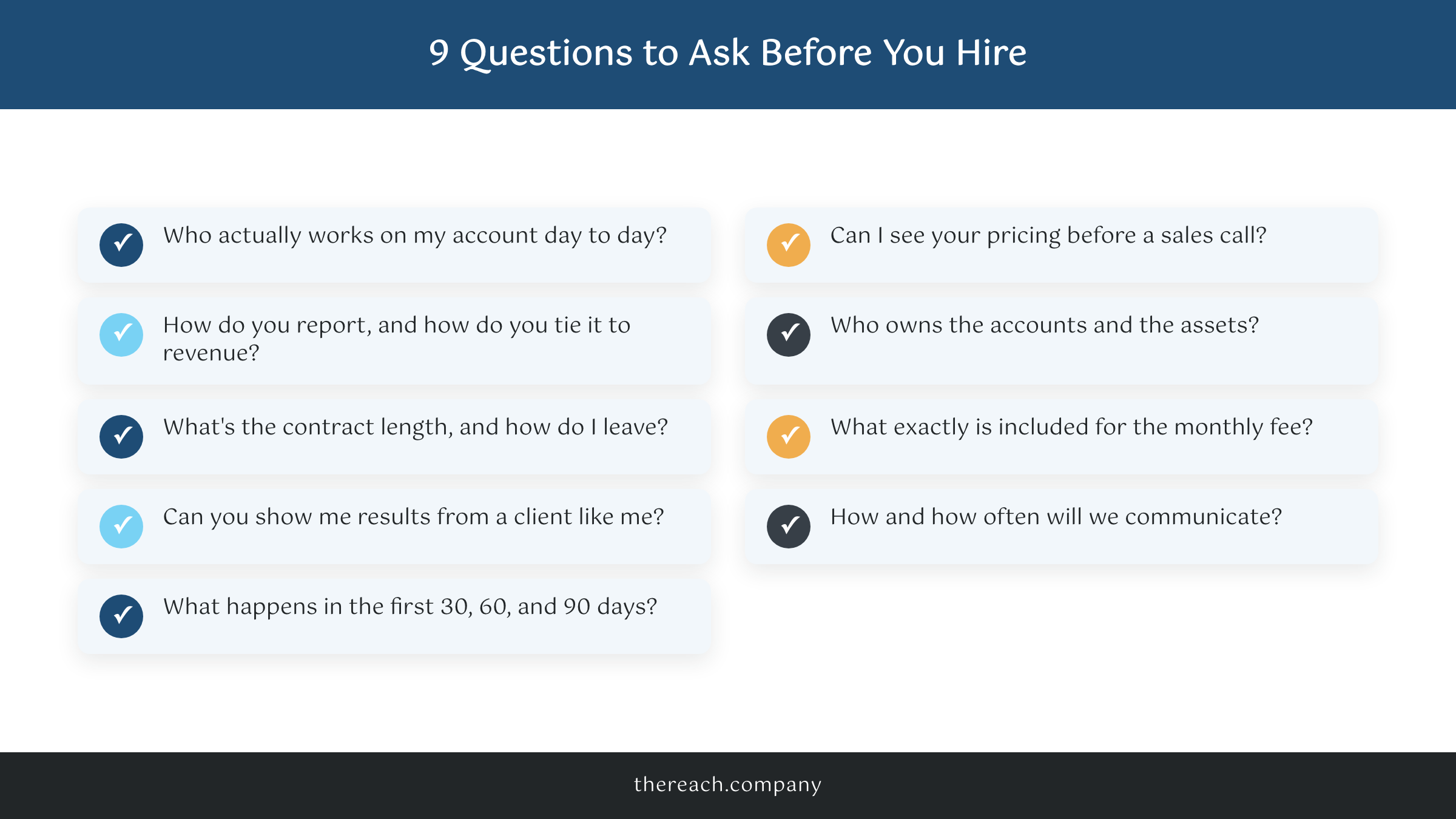
1. Who actually works on my account day to day? The person selling you is rarely the person doing the work. Ask for the name and role of who runs your account, and whether that’s a senior strategist or a junior whoever-is-free. A confident “you’ll always work directly with the person managing your campaigns” is what you want.
2. Can I see your pricing before a sales call? Mystery pricing exists to keep you on the phone long enough to get talked up. There’s nothing wrong with a call, but an agency that won’t give you a ballpark until you’ve sat through a pitch is protecting its margin, not your time.
3. How do you report, and how do you tie it to revenue? This is the big one. Measuring marketing ROI is one of the top challenges marketers named in HubSpot’s 2026 State of Marketing report, so if the pros find attribution hard, a vague monthly PDF of impressions and “reach” is a red flag, not a deliverable. You want reporting tied to leads and booked jobs, not likes.
4. Who owns the accounts and the assets? Your Google Ads account, your Google Business Profile, your domain, your ad data. If the agency builds everything inside accounts they control, leaving them means starting from zero. The right answer is simple: it’s all yours, and you keep it if we part ways.
5. What’s the contract length, and how do I leave? Long lock-in contracts protect the agency from having to earn your business every month. Ask what happens if you want out. Month-to-month, or a short term with a clear exit, signals an agency that plans to keep you by delivering, not by trapping you.
6. What exactly is included for the monthly fee? “Full-service marketing” is not a scope. Get specific. How many ad campaigns, how much content, how many hours, what’s a paid add-on. Vague retainers are where scope creep and surprise invoices live.
7. Can you show me results from a client like me? Not a generic case study with the name blurred out. Real numbers from a business in your world. A good agency will happily point you to named clients and what changed. We can show a medspa that pulled 1,928 leads from its website in a year, and a 5-year client whose conversions rose 54%.
8. How and how often will we communicate? The most common complaint after the contract is signed is silence. Ask who you call when something breaks, and how often you’ll actually hear from them. “We send a monthly report” is not a relationship.
9. What happens in the first 30, 60, and 90 days? An agency worth hiring has a plan before you pay them. If the answer is fuzzy, they’re going to figure it out on your dime. You want to hear a real sequence: what gets built first, what gets measured, and when you should expect to see movement.
The One Question That Matters Most
If you only press hard on one of these, make it the first one. Who actually touches your account.
Agencies sell with their best people and deliver with whoever is available. You meet the charismatic founder or a senior strategist in the pitch, you sign, and your account quietly gets handed to a junior coordinator juggling thirty others. Nothing about the deck warned you. The work just slowly drifts, and you can’t figure out why the energy from the sales call never showed up in the results.
Press on it. Ask for the name. Ask how many other accounts that person runs. Ask if you can talk to them before you sign. How an agency answers tells you more than any portfolio, because it reveals whether you’re a relationship or a line item.
What a Straight Answer Actually Sounds Like
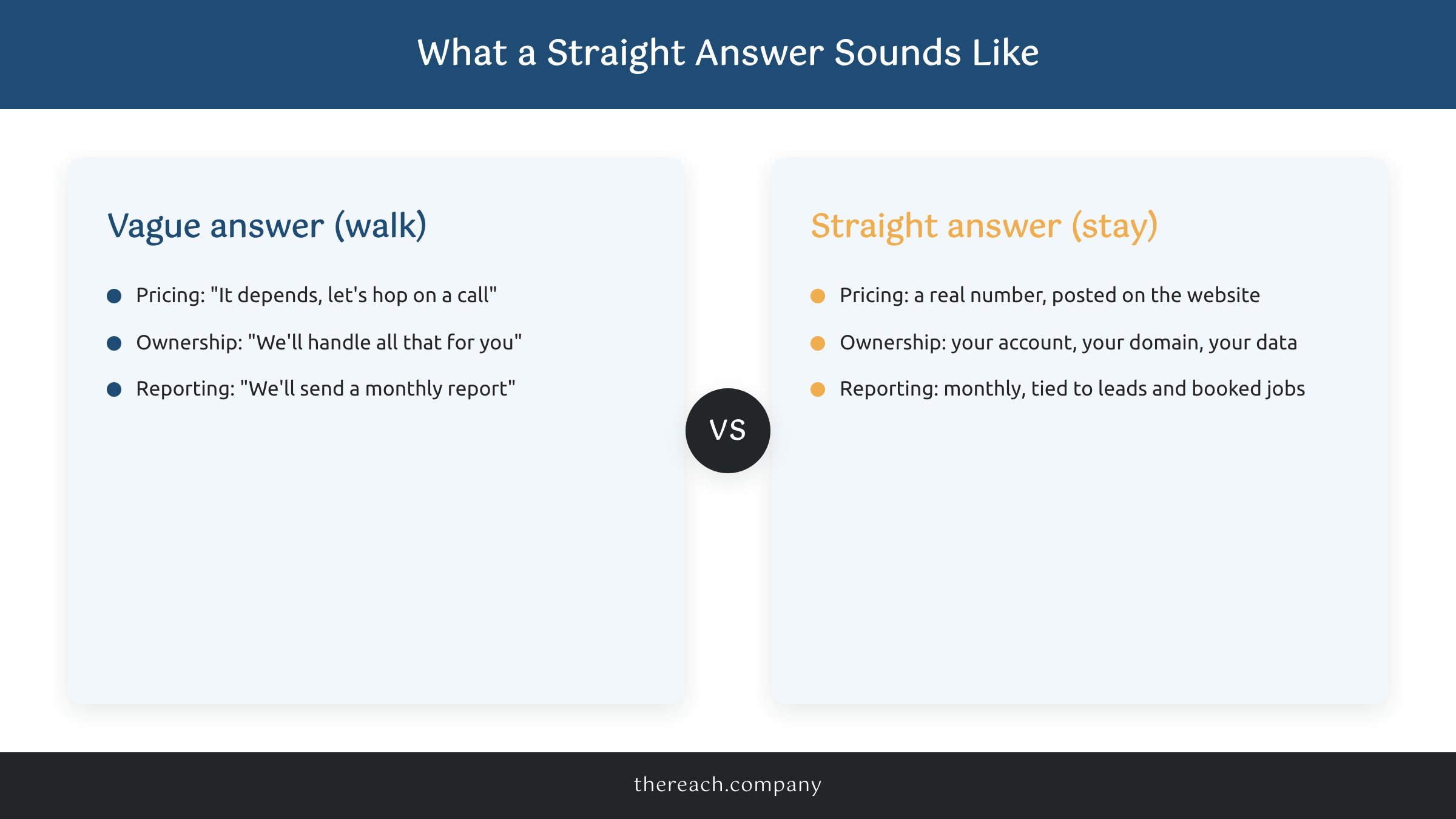
You’ll feel the difference. A vague answer hedges, redirects to a call, or buries you in jargon. A straight answer gives you the number, the name, and the plan without flinching.
On pricing, vague sounds like “it depends, let’s hop on a call.” Straight sounds like a real number. We put our pricing on the website on purpose, so nobody has to sit through a pitch to find out what something costs. On ownership, vague is “we’ll handle all that for you.” Straight is “it’s your account, your domain, your data, and you keep it.” On reporting, vague is “we’ll send you a monthly report.” Straight is “monthly, tied to leads and booked jobs, and I’ll walk you through what it means.”
The pattern is simple. The right agency is comfortable being specific because specifics are how it earns trust. That comfort is also why the relationships last. Our longest clients have been with us close to five years, not because of a contract, but because they always know what they’re paying for and what it’s doing.
What to Do With the Answers
Don’t overthink the scoring. Ask the nine, and notice where they dodge. One soft answer is human. A pattern of dodging on pricing, ownership, and who does the work is the whole story.
If an agency won’t tell you what it costs, won’t let you own your own accounts, or can’t name who’ll run your campaigns, walk. Those aren’t quirks, they’re the agency red flags that should make you walk. There’s no contract worth signing with someone who’s already hiding the answers while they still want your business.
You don’t need to become a marketing expert to hire well. You need nine questions and the nerve to wait for real answers. The right partner will be glad you asked, because the questions are exactly how they prove they’re different. You got this. And if you want to see what straight answers look like in practice, our pricing and our process are right there on the site, no call required.

