

You just launched your website. It looks great. The photos are sharp, the copy finally says what you do, and you hit publish feeling like you crossed a finish line.
Then you Google your own business name and your site barely shows up. You search the service you actually sell and you are nowhere. Page five. Page eight. Not at all.
Can I shoot straight with you? That is normal. SEO for a new website is not about ranking number one in month one. A brand-new site is a beautiful store on a street nobody has found yet. Google does not know you exist, the few people who do find you do not trust you yet, and that is exactly the problem you spend your first 90 days solving.
Here is the good news. The first 90 days are the most controllable part of SEO you will ever have. You are not fighting an algorithm. You are building a foundation, in order, the same way you would frame a house before you paint it. Do these things in the right sequence and you stop guessing. Skip them and you will spend six months wondering why nothing is happening.
This is the plain-English plan. No crawl-budget jargon, no acronyms you have to Google. Just what to do in week one, what to do in month two, and what to expect by day 90.
The Real Problem: A New Site Has No Authority and No History
Every website that ranks above you has one thing your new site does not: time. They have been around. Google has crawled them hundreds of times, other sites link to them, real people have visited and stayed. That track record is what Google calls authority, and on day one you have exactly zero of it.
This is not an opinion. Google says it plainly. In its own crawling and indexing documentation, Google states that “the most common reason that a site is not indexed is because it’s just too new.” Read that again. Your first obstacle is not competitors. It is that Google has not even added your pages to its index yet, which means you cannot rank for anything because you are not in the race.
So the job in your first 30 days is not ranking. It is discovery. You have to wave your arms and get Google to come look at your site, confirm your pages are real, and add them to the index. Everything else, the keywords, the content, the local results, comes after that.
This is also why patience matters more than effort right now. If you want the honest version of the calendar, we wrote a whole piece on how long SEO actually takes, because the number-one reason owners quit SEO is they expected month-one results from a month-one effort. A new site getting found and trusted is a 6 to 12 month arc. The first 90 days just make sure you are pointed the right direction.
Days 1 to 30: Get Google to Notice You Exist
Month one is technical, and it is the part most owners skip because it feels invisible. Do not skip it. This is the plumbing.
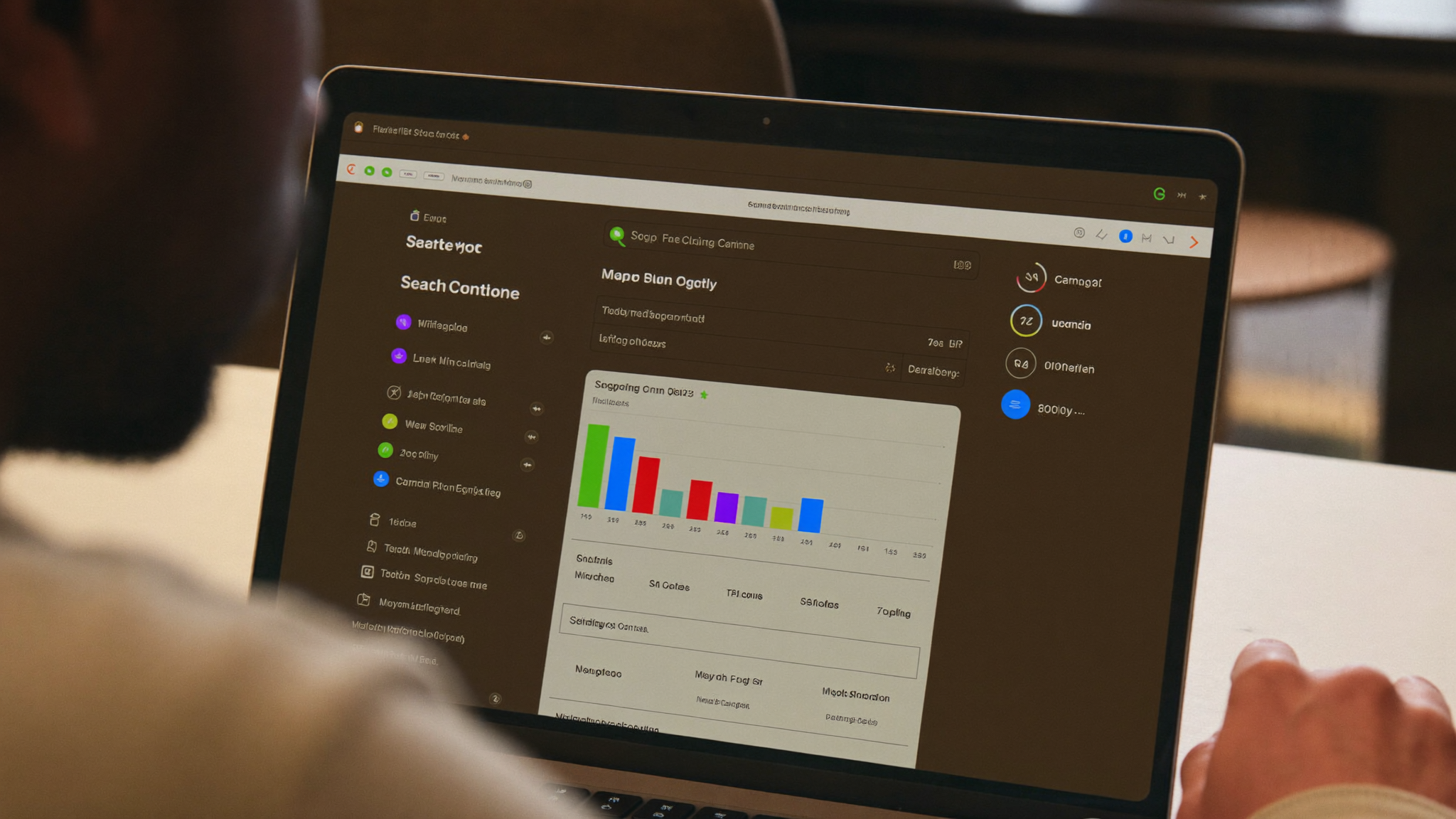
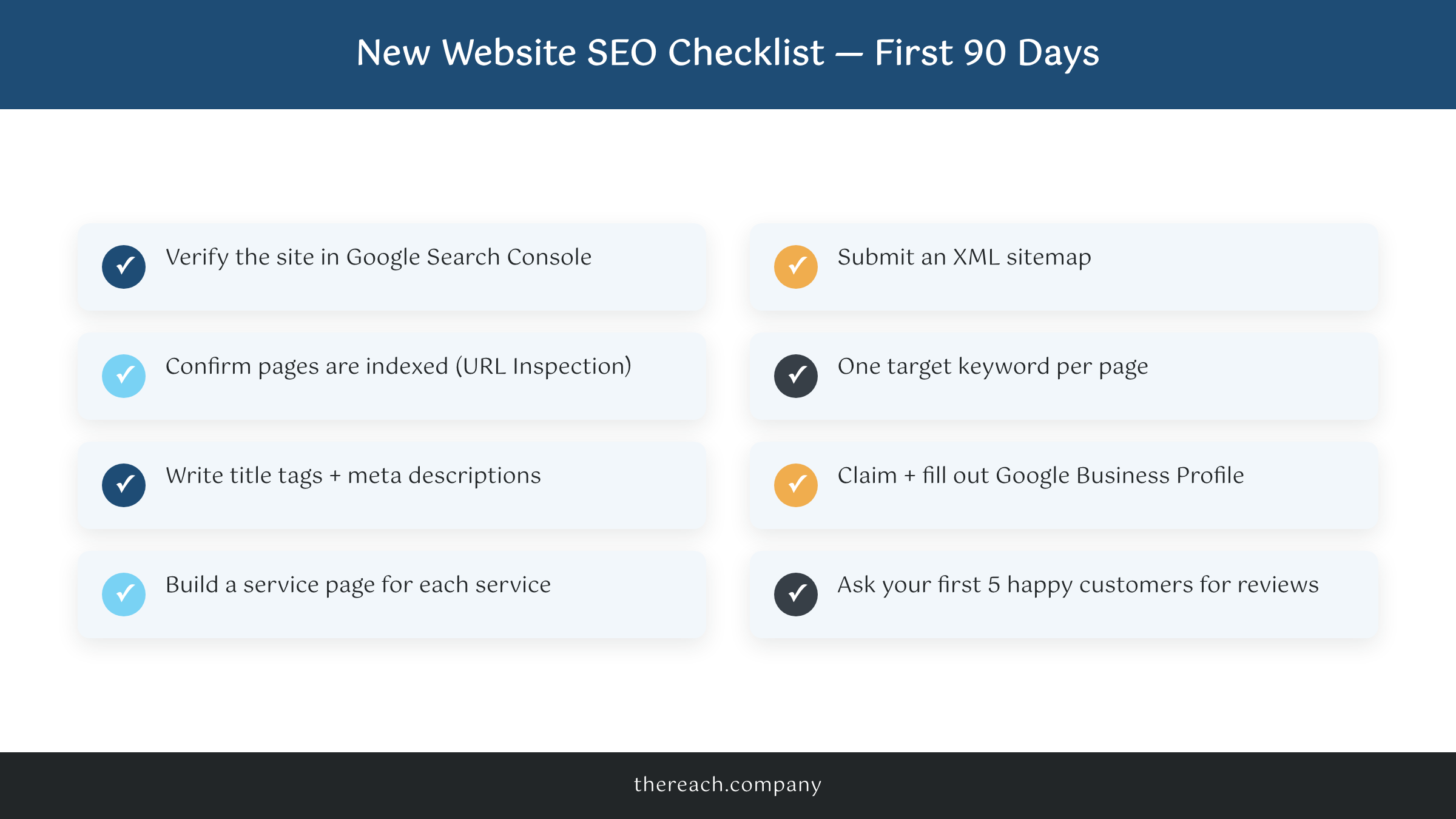
Start with Google Search Console. It is free, it is Google’s own tool, and it is the single most important thing you will set up. Go to search.google.com/search-console, add your site, and verify ownership (your web host or a plugin like SEOPress makes this a two-minute job). Search Console is where Google tells you what it sees, what it indexed, and what is broken. Flying without it is like running a business without a bank account.
Next, submit your sitemap. A sitemap is just a list of every page on your site, written in a format Google reads. WordPress with SEOPress or Yoast generates one automatically at yoursite.com/sitemap.xml. Copy that URL into Search Console under the Sitemaps section and hit submit. You just handed Google a map of your store.
Then check that your pages are actually indexed. In Search Console, use the URL Inspection tool, paste in your homepage and your main service pages one at a time, and if it says “URL is not on Google,” click Request Indexing. Google says crawling a new page takes anywhere from a few days to a few weeks, so do not panic if it is slow. You are getting in line, not getting ignored.
While you are in here, confirm three boring things that quietly kill new sites. One, your site is not accidentally blocking Google. A lot of WordPress sites launch with a “Discourage search engines” box still checked from when the site was being built. Uncheck it (Settings, Reading). Two, you have an SSL certificate, so your site loads as https with the little padlock. Most hosts include it free. Three, your site works on a phone, because the majority of local searches happen on mobile and Google judges your mobile version first.
None of this gets you ranked. All of it makes ranking possible. This is the difference between a site Google can find and one it keeps tripping over.
While you are setting up free tools, add Google Analytics 4 (GA4) too. Search Console shows you what Google sees. GA4 shows you what real people do once they land: how many visitors you get, which pages they read, and whether they call. You want both running from day one, because in 90 days you will want a baseline to measure progress against, and you cannot measure what you never started tracking. It takes ten minutes to connect and it is the difference between guessing and knowing whether any of this is working.
The On-Page Basics Most New Sites Skip
Now that Google can find your site, you tell it what each page is about. This is on-page SEO, and the rule is dead simple: one page, one keyword.
Every page should target one main thing a customer would search. Your kitchen remodeling page targets “kitchen remodeling [your city].” Your bathroom page targets bathrooms. When you cram every service onto one page, you are telling Google your page is about everything, which means it is about nothing. Plain and simple.
For each page, get four things right. The title tag is the clickable blue headline that shows up in Google results. Put the keyword near the front and keep it under 60 characters. The meta description is the gray text under it. Google does not rank you on it, but a good one gets more clicks, so write it like an ad, not a summary. The URL slug should be short and readable: yoursite.com/kitchen-remodeling, not yoursite.com/page-id-4471. And the H1, the big headline on the page itself, should match what the page is actually about.
A plugin like SEOPress or Yoast gives you a box for the title and description on every page, so you are not editing code. Fill it out for every single page. It takes an afternoon for a 10-page site.
Two more quick wins. Add image alt text that describes the photo in plain words, because it helps accessibility and gives Google more context. And link your pages to each other. Your homepage should link to your service pages, your service pages should link to your contact page, and a blog post about kitchen costs should link to your kitchen remodeling page. Internal links are how Google understands which pages matter and how they connect. Most new sites have almost none, and it is free to fix.
The AHA Moment: You’re Not Ranking #1, You’re Getting Found One Search at a Time
Here is the rub, and it is the thing that changes how you think about this whole project.
You do not need to rank for “plumber.” You will not, not this year, maybe not ever, and it does not matter. The person typing “plumber” into Google is not ready to call anyone. The person typing “emergency water heater repair Marietta GA” is standing in a flooded basement with a credit card in their hand. That is your customer.
Those longer, specific searches are called long-tail keywords, and they are where a new website actually wins. They have less competition, so a brand-new site can rank for them in weeks instead of years. And they convert better, because the searcher knows exactly what they want. Ten visitors searching “emergency water heater repair Marietta” are worth more than a thousand searching “plumber.”
Let that really sink in. SEO for a new website is not one big battle for a single famous keyword. It is a hundred small wins for searches that each bring one ready-to-buy customer. You are not trying to be the most popular site in your industry. You are trying to be the obvious answer to a very specific question. That is a fight a small business can win, and it is the whole reason local SEO works for new sites when national SEO would crush them.
Days 31 to 60: Build the Pages and Profile That Bring Local Customers
Month two is where you build the actual assets that bring in calls. Two things matter most: your service pages and your Google Business Profile.
Build a dedicated page for every service you offer. Not a single “Services” page with a bulleted list. A full page for each one, because each page is a separate fishing line in the water. If you do kitchen remodels, bathroom remodels, and basement finishing, that is three pages, each targeting its own keyword, each with real detail about how you do that work, what it costs, and why someone should pick you. If you serve multiple towns, a page per town (a location page) does the same thing for each city you want to show up in.
Then claim and fully fill out your Google Business Profile. For a local service business, this is arguably more important than your website in the first 90 days, because it is what feeds the map results, the three listings that show up with the little map at the top of local searches. Claim it at google.com/business, pick the right categories, write a real description, add your service areas, upload actual photos of your work, and list your services with prices if you can. Half-finished profiles are everywhere. A complete one beats them without much effort.
This local layer is the part most owners underestimate and the part that pays off fastest. It is the bulk of our local SEO work for exactly that reason: for a service business, getting into the map pack moves the needle faster than almost anything else you can do in your first three months.
Days 61 to 90: Earn Trust
By month three, Google knows you exist and knows what your pages are about. Now you build the thing you started with zero of: trust. Trust is earned three ways, and you work all three at once.
First, reviews. Ask your five most recent happy customers to leave a Google review, today. Reviews feed your map ranking, they are the first thing a new customer reads, and a new business with 12 real reviews beats an established one with 3. Make it a habit: every finished job ends with a review request. The money is in the list, and the trust is in the reviews.
Second, a content cadence. Start publishing one genuinely helpful article a week answering the questions your customers actually ask. “How much does a kitchen remodel cost in [city]?” “How long does a bathroom remodel take?” Every post is another page Google can index, another long-tail search you can show up for, and another internal link back to your service pages. One post a week for a year is 52 new front doors to your business.
Third, your first backlinks. A backlink is another website linking to yours, and it is one of the strongest trust signals Google has. You do not need hundreds. Start with the easy, legitimate ones: your local chamber of commerce, any trade associations you belong to, suppliers who list their partners, local sponsorships, the directories real customers use. Skip the spammy “buy 500 backlinks for $50” offers. They do more harm than good. While you are building those listings, keep your business name, address, and phone number identical everywhere they appear. Google reads matching details across the web as a trust signal, and mismatched info, an old phone number on one directory, a missing suite number on another, quietly drags down a new local site. Consistency costs nothing, and almost nobody bothers to check it, which means doing it puts you ahead.
Proof: What 90 Days of Doing It Right Looks Like
Here is what this looks like when the foundation gets built right instead of guessed at.
Chin Up Aesthetics is a medspa we work with. The local search piece, the part you start in your first 90 days, got them to first place in the Google map pack for more than 8 of their core services. Not page one. First. And the website that local visibility feeds into pulled 1,928 leads in a single year.
That did not happen because of a magic trick in month one. It happened because the boring foundation got laid in the right order: get found, build the pages, claim and fill the profile, earn the reviews, keep publishing. The first 90 days did not make them number one. The first 90 days made number one possible.
That is the honest promise of new-website SEO. The early work is unglamorous and mostly invisible. Nobody claps when you submit a sitemap. But it is the difference between a site that compounds for years and a site that sits there looking pretty and generating nothing.
What to Do Instead of Guessing
If you read all of this and felt the overwhelm creeping in, that is fair. It is a lot of small steps, and you are already wearing 38 other hats running your actual business.
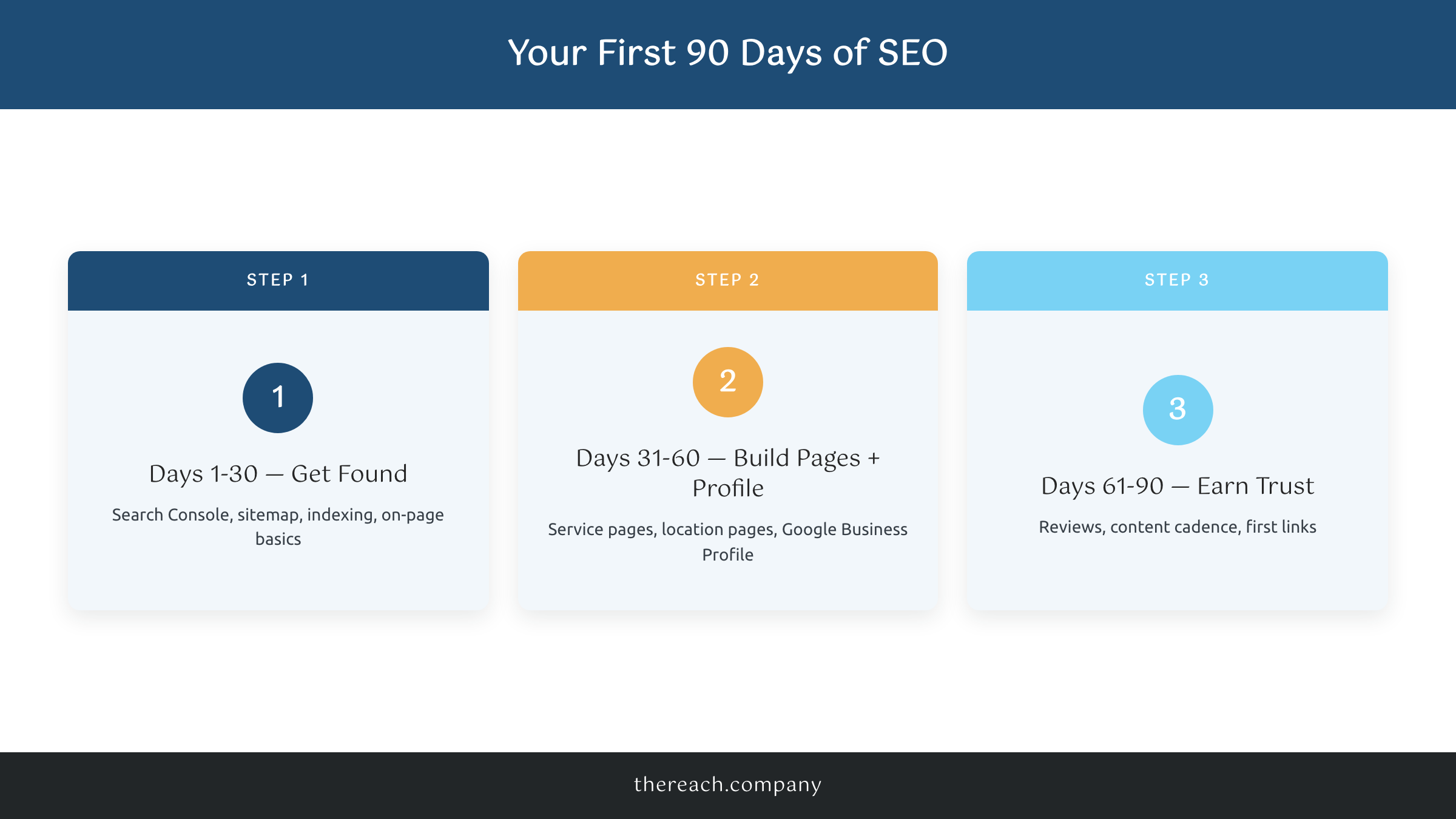
Here is the simplest version. Month one, get found: Search Console, sitemap, indexing, on-page basics. Month two, build: a page per service, a fully filled-out Google Business Profile. Month three, earn trust: reviews, weekly content, your first real links. Do those three things in that order and you are ahead of almost every new site in your city, because almost nobody does them in order, and a lot of them never do them at all.
The reason this works is that SEO is not a standalone trick. It is one part of a system, where your website converts the traffic, search brings the traffic, and the two feed each other. When the pieces are built to work together instead of bolted on randomly, a new site that started at zero turns into a machine that brings in customers while you sleep. That is the whole idea behind the Reach Co Lead System, and it is why we do not treat SEO as a checkbox.
You do not have to do all of this alone, and you do not have to do it perfectly. You just have to do it in the right order. If you want a second set of eyes on your first 90 days, or you would rather hand the hat off entirely, that is what we are here for.
The finish line is a lot closer than it feels. Promise. You got this, and if you need a little help, we got you too.

