
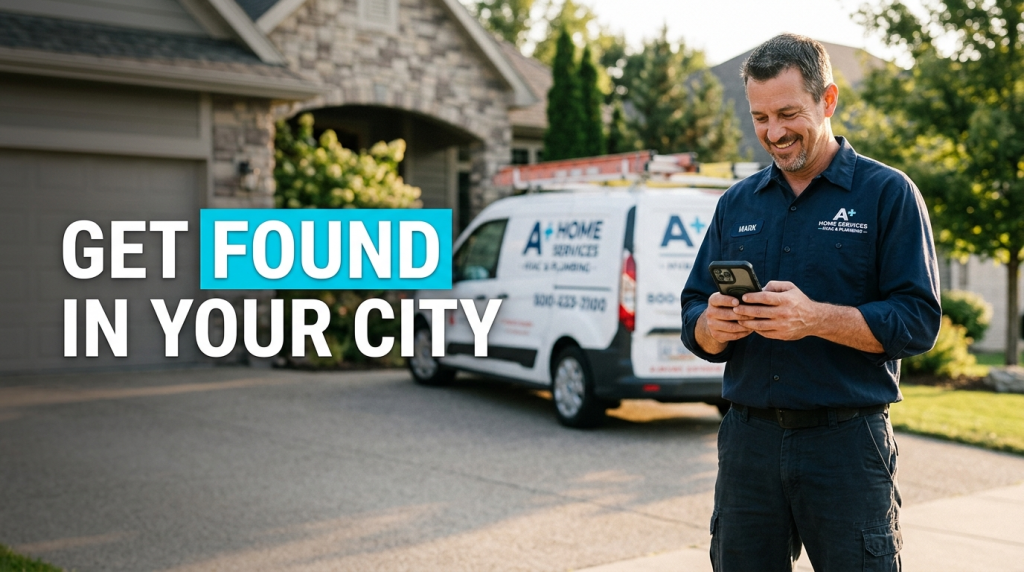
Picture this. It’s 11pm on a Tuesday. A homeowner three miles from your shop wakes up to water spreading across the kitchen floor. The water heater finally gave out. They grab their phone, half-asleep, and type “water heater repair near me.” Whoever shows up first in that search gets the call. Everybody else might as well not exist.
That’s the whole game. SEO for contractors isn’t some mysterious tech ritual, and it isn’t writing blog posts nobody reads. It’s making sure that when someone in your city has the exact problem you solve, you’re the name they see first.
Here’s the rub. Most contractors think SEO means paying an agency $3,000 a month to send back a PDF full of charts they don’t understand. It doesn’t have to. For a plumber, a roofer, an HVAC tech, or an electrician, SEO is local. It comes down to three things: your Google Business Profile, real pages for the cities you actually serve, and reviews that tell Google you’re the real deal.
Plain and simple. Let me show you how it actually works, what to fix first, and how to know if it’s paying off. No jargon. No fluff. Just the stuff that gets your phone ringing.
What “SEO for Contractors” Really Means (and Why It’s Different)
When a software company does SEO, they’re fighting the entire internet for a keyword. When a contractor does SEO, you’re fighting the four or five other shops across town. That’s a completely different game, and it’s a far more winnable one.
You’re not trying to outrank Home Depot for the word “water heater.” You’re trying to own “water heater repair Marietta” and “emergency plumber near me” inside your service area. National volume doesn’t matter. The 600 people in your county who need you this month matter.
Two things show up when somebody runs a local search. First, the map pack: that little box with three businesses, a map, and star ratings sitting at the top of the results. Most of the clicks go there. Second, the regular blue links below it. Local SEO is the work of earning a spot in both.
Here’s the part that should make you feel better. The keyword “seo for contractors” carries a difficulty score of about 3 out of 100. Local service terms in your specific city are usually just as soft. Translation: this is not Mount Everest. With the right setup, a small contractor can outrank shops that have been around for 20 years, because most of those shops never did the basics. You can.
Your Google Business Profile Is the Whole Ballgame
If you only fix one thing this month, fix this. Your Google Business Profile, the free listing that powers the map pack, is the single highest-leverage asset in contractor SEO. It’s also the one most contractors set up once in 2019 and never touched again.
Google decides who shows up in the map pack based heavily on what your profile tells it. So tell it everything, accurately:
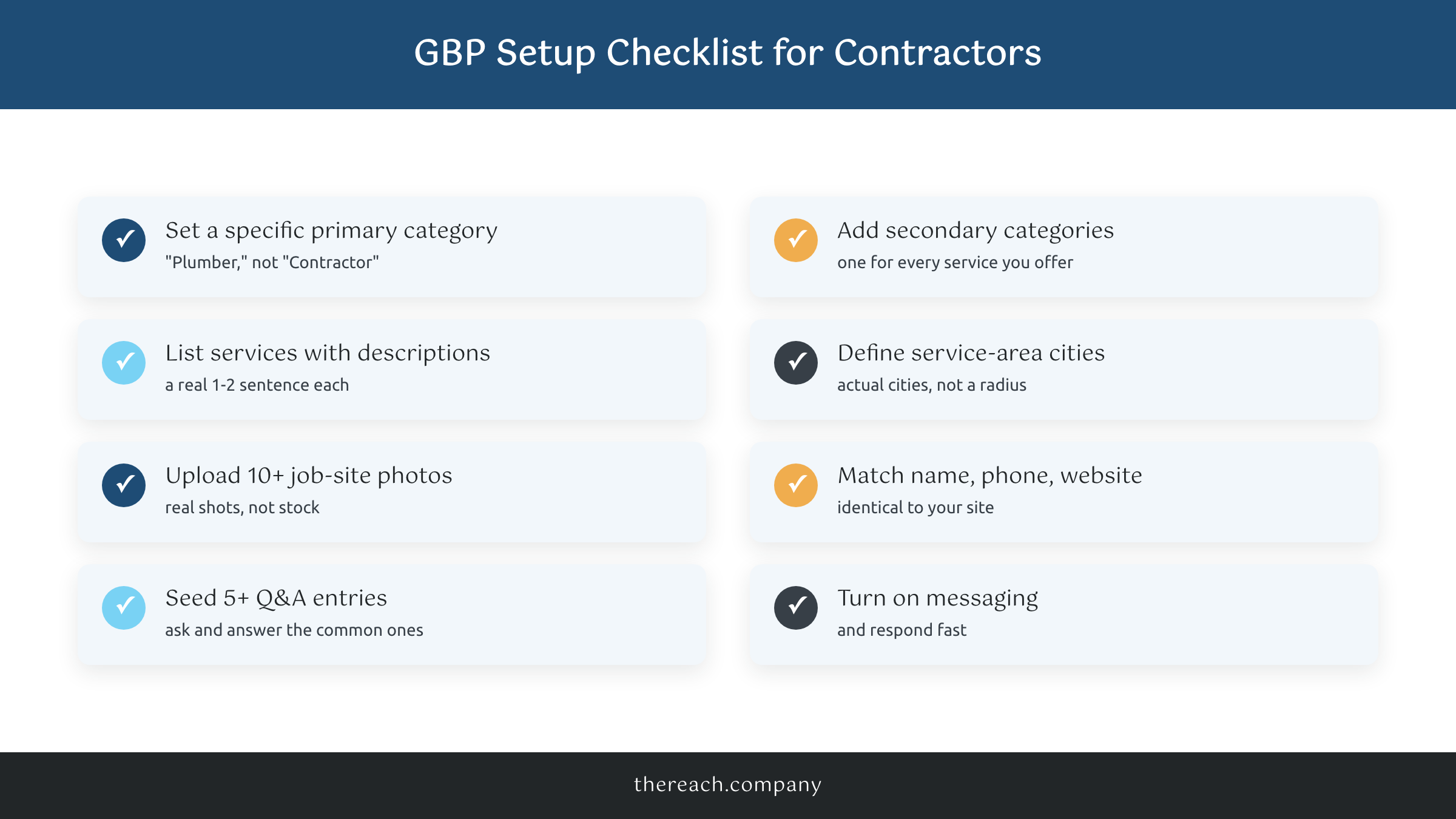
- Set your primary category as specific as possible. “Plumber,” not “Contractor.” “Roofing Contractor,” not “Home Services.”
- Add secondary categories for every service you offer, so you show up for more than one type of search.
- List each service with a real one or two sentence description in your own words.
- Define your service areas by the actual cities you cover, not a vague radius.
- Upload real job-site photos, not stock images. Google reads fresh, geotagged photos as a signal that you’re active.
- Make sure your name, phone, and website match your website exactly. Mismatched info confuses Google and tanks trust.
Does this actually move the needle? A medspa client of ours landed first in the Map Pack for eight-plus of their core services after we tightened up the profile, built out review flow, and added local pages. Different industry, same machine. A plumbing or electrical shop running the same play wins the same way, because the local algorithm doesn’t care whether you do Botox or boilers. It cares whether your profile is complete, active, and trusted.
Service-Area Pages: One Real Page Per City You Serve
This is the move that separates contractors who rank from contractors who don’t. If you serve Marietta, Smyrna, Kennesaw, and Roswell, you shouldn’t have one “Service Areas” page listing all four. You should have a real, useful page for each city.
Why? Because when someone searches “AC repair Kennesaw,” Google wants to hand them a page that’s genuinely about AC repair in Kennesaw. A dedicated page tells Google, “this is the most relevant result,” and it gives the human reader the local proof they’re looking for.
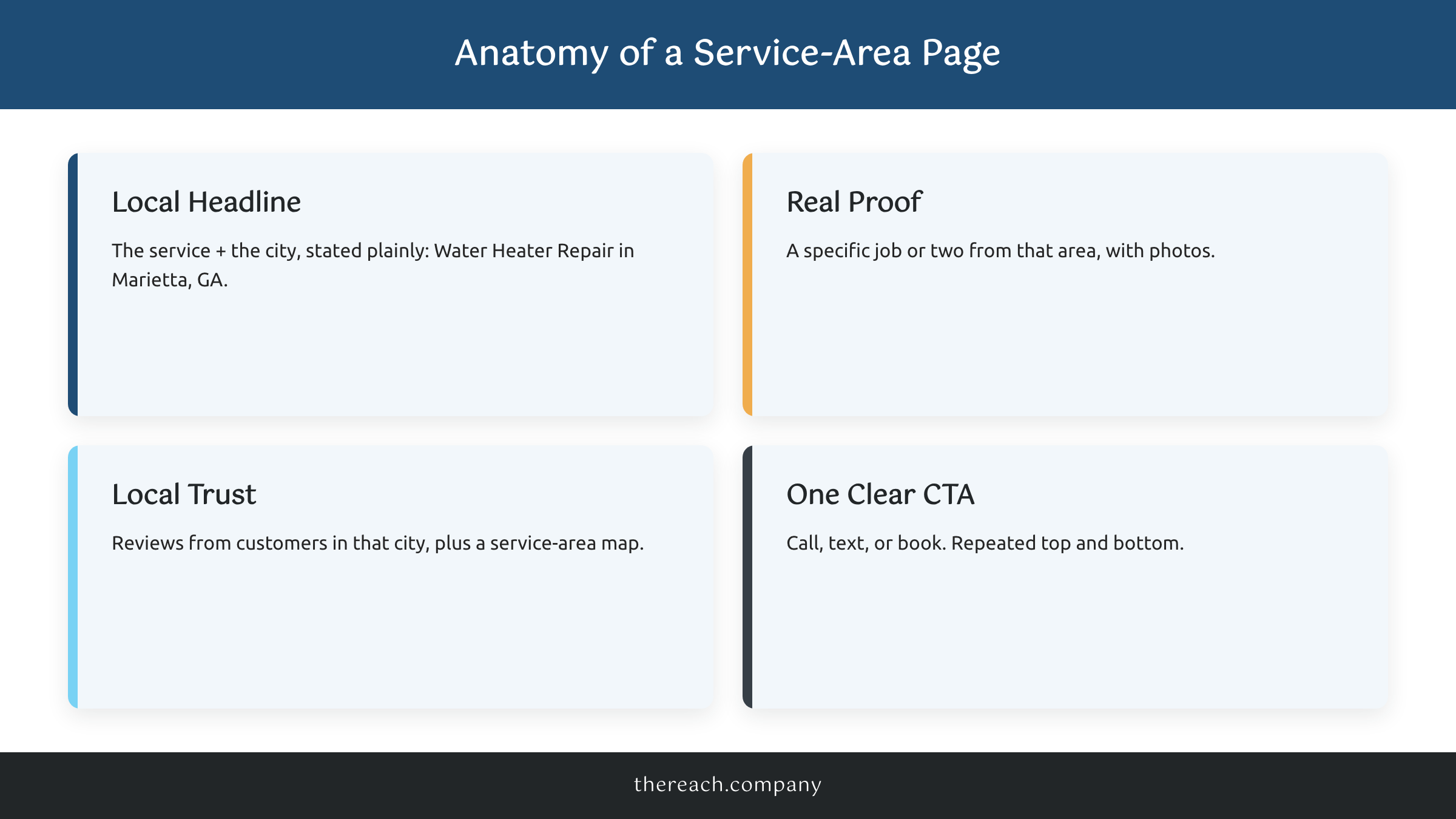
A service-area page that works includes the service and the city right in the headline, a real project or two from that area with photos, a couple of reviews from customers in that town, and one clear call to action. It reads like you actually work there, because you do.
Now the warning, because this is where people get themselves penalized. Do not copy one page, swap the city name, and publish 12 near-identical pages. Google calls those doorway pages and it actively demotes them. Each page has to earn its keep with real, specific content. If you want the deeper version of why this matters now, we broke down what’s actually changed in local SEO and what Google rewards in 2026.
It’s more work than spinning up junk pages. It also actually works, which the junk pages don’t. That tradeoff is the entire job.
Reviews Aren’t Just Social Proof. They’re a Ranking Signal.
Most contractors think of reviews as the thing that makes them look good. They’re that, sure. They’re also one of the strongest local ranking factors Google uses, and a direct line to whether a stranger calls you or your competitor.
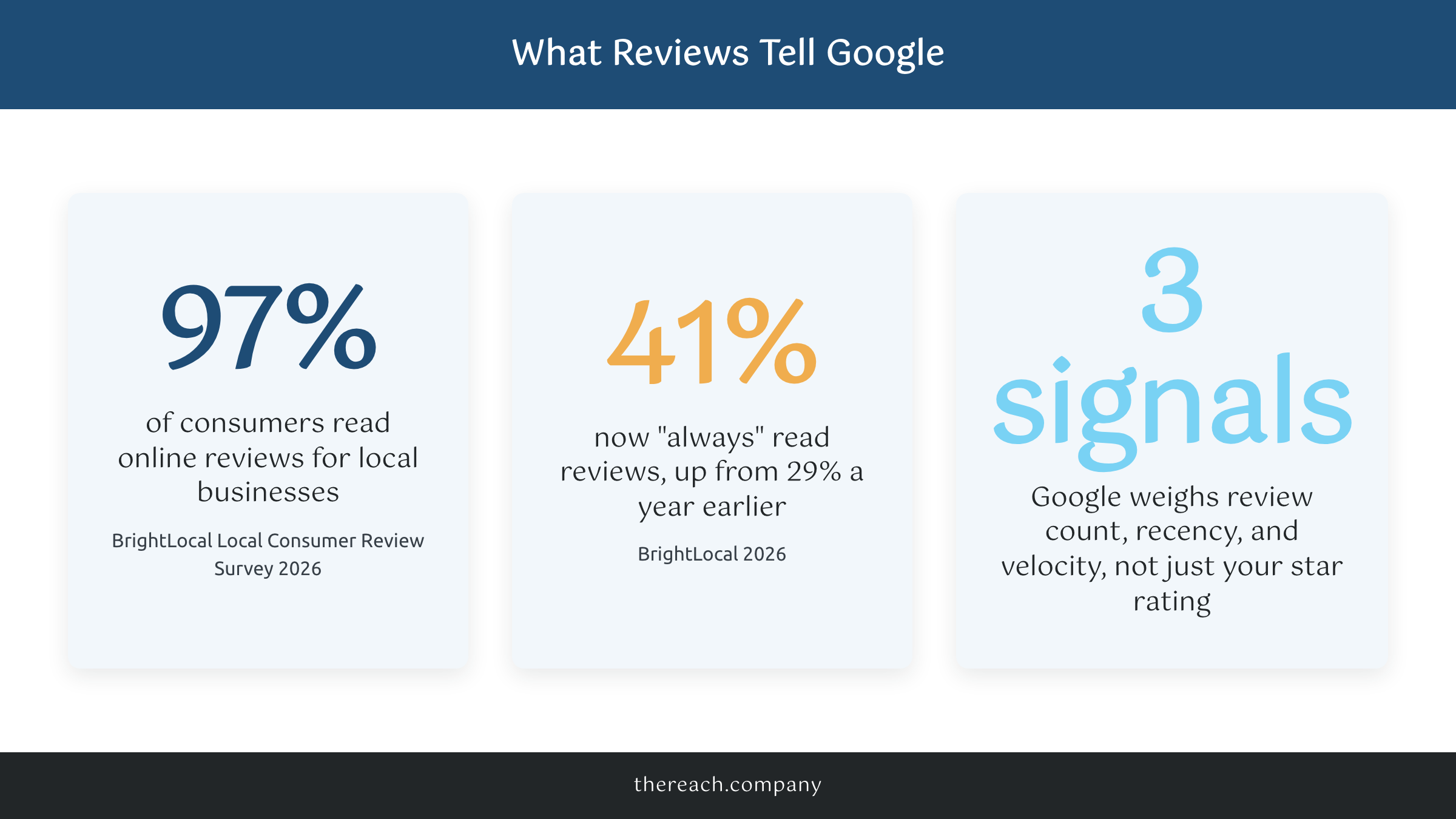
The numbers are not subtle. According to BrightLocal’s Local Consumer Review Survey 2026, 97% of consumers read online reviews for local businesses, and the share who say they “always” read them jumped to 41% from 29% the year before. People are checking. Every time.
Here’s what trips up contractors: it’s not just your star rating or your total count. Google also weighs recency and velocity. Ten fresh reviews this quarter beat fifty reviews from three years ago. A steady drip says you’re busy and trusted right now. A graveyard of old five-stars says you used to be.
So build a system. The easiest version: text the review link to the customer the moment the job’s done, while they still smell the new water heater. We automate this for clients inside GoHighLevel so the request goes out the second a job is marked complete, but even a saved text template on your phone beats hoping people remember. The money is in the follow-up.
Reviews and your Google Business Profile feed each other. More fresh reviews lift your map pack ranking, a higher ranking gets you seen by more people, and more people means more reviews. Get the loop spinning and it compounds.
Here’s the Part Most Contractors Miss. You’re Not Competing With the Internet.
This is the reframe that changes how the whole thing feels. You are not competing with the entire web. You’re competing with the four or five other contractors in your zip code. And here’s the secret: most of them have a half-finished Google Business Profile, eleven reviews from 2021, and zero service-area pages.
That’s your opening. The searches that actually bring you jobs, the “near me” searches and the city-specific ones, are long-tail and low-difficulty. Nobody with a real budget is fighting hard for “gutter cleaning Powder Springs.” You can climb to the top of those in a matter of months, not years.
That’s why, for a local trade, SEO has the best long-run return of any marketing channel you can run. A Google ad stops the second you stop paying. A map pack ranking you earned keeps sending you calls while you sleep. When you get complacent with SEO, your competitors eat your lunch. When you do the basics most of them ignore, you eat theirs.
Track It So You Know It’s Working (Without Drowning in Dashboards)
You don’t need a 40-tab report. You need three simple things to know SEO for contractors is actually paying off.
First, Google Search Console. It’s free, it’s from Google, and it shows you exactly which searches you’re showing up for and how many people clicked. If you start appearing for “water heater repair [your city]” and clicks climb, it’s working.
Second, your Google Business Profile performance tab. It tells you how many people called, asked for directions, or visited your site straight from the map. These are your highest-intent leads. Somebody asking for directions to a roofer is not browsing.
Third, a tracked phone number. Tools like CallRail put a unique number on your site and listings so you can tie a phone call back to the search that drove it. That’s how you stop guessing and know that the page you built for Smyrna actually rang the phone.
What good looks like is simple: more calls from search over time, and a spot in the map pack for the services that pay your bills. Check it monthly, not every morning. SEO is a slow cooker, not a microwave. Staring at it daily just makes you crazy.
What to Do First (and When to Call in Help)
Order matters, because doing this in the wrong sequence wastes weeks. Here’s the order that works:
- Fully optimize your Google Business Profile. Free, fast, biggest immediate lift.
- Build a real review engine so fresh reviews come in every week.
- Create genuine service-area pages for each city you serve.
- Clean up the technical stuff on your site: speed, mobile, and that your name, address, and phone are identical everywhere.
Can I shoot straight with you? You can absolutely DIY the first two this month. The profile and the reviews are mostly elbow grease, and you’ll feel the difference. Where most owners stall is steps three and four. Writing twelve genuinely useful city pages and handling technical SEO is real work, and it’s the part that quietly never gets done because you’re busy running actual jobs.
That’s the honest “it depends.” If you’ve got the time, do it yourself and save the money. If you’d rather keep doing what you do best, this is where a partner earns their keep. Managed local SEO at The Reach Company runs $2,480 a month, and we put what local SEO actually costs right on the website instead of hiding it behind a “contact us for a quote.” It’s also one leg of a bigger machine. Your website converts the visitor, SEO brings the traffic, and ads amplify what’s already working. They’re stronger together than any one of them alone.
You Don’t Need to Be an SEO Nerd
You need to show up when your neighbor’s water heater dies at 11pm. That’s it. That’s the job.
SEO for contractors isn’t about chasing algorithms or publishing four blog posts a week. It’s a complete Google Business Profile, real pages for the cities you serve, and a steady stream of fresh reviews. Do those three things better than the shops around you, which is a low bar most of them never clear, and you’ll own the searches that turn into booked jobs.
The finish line is a lot closer than it feels. Promise. Start with your profile this week, set up the review text next week, and you’ll be ahead of most of your competition by the end of the month.
You got this. And if you’d rather hand the SEO hat to someone who genuinely cares about getting your phone to ring, we got you too. Grab a free audit and we’ll show you exactly which of your service areas you’re invisible in right now.
If you run a roofing crew, the next step is dialing in how to get more roofing leads that actually book inspections.
And if you run a plumbing business, here’s exactly how SEO for plumbers gets you found the moment a pipe bursts.

