
If your website can’t answer the phone, it’s a brochure. And brochures don’t pay the bills.
Can I shoot straight with you? Most small business websites are gorgeous, expensive paperweights. They look pretty on a phone. The fonts are nice. The color palette matches the logo. And then the contact form goes to an inbox nobody checks, the phone number isn’t tracked, and the only call to action is a “Contact Us” link buried in the footer. That’s the website vs digital brochure problem in one paragraph. A brochure looks good. A lead machine actually works.
The difference isn’t taste. It’s machinery. Today I’m going to show you the six pieces of machinery that turn a website from a digital brochure into a system that books appointments while you sleep, plus a real client number that proves the gap is bigger than most owners think.
The brochure problem
Here’s what a brochure website looks like. The visitor lands on the homepage. There’s a hero image of your storefront, a tagline like “Quality You Can Trust,” and a menu of services. They scroll. They read. They feel pretty good about you. Then they leave to compare you to two other companies.
You never hear from them again.
That’s not because your service is bad. It’s because your website handed them an experience and didn’t ask for anything in return. A brochure says “here we are.” A lead machine says “here’s the next step, and here’s exactly how easy it is.” Big difference.
The real cost of running a brochure isn’t the design fee. It’s the leads that never become leads. If you’re spending $2,000/mo on Google Ads and your site converts at 1.2% instead of 5%, you just bought $2,000 worth of traffic and let three quarters of it bounce. That’s not a website problem. That’s a math problem with a website attached.
The 6 pieces of machinery a real website needs
A website that earns its keep has six specific parts. Not “an integrated digital experience.” Six things. You can audit yours in twenty minutes.
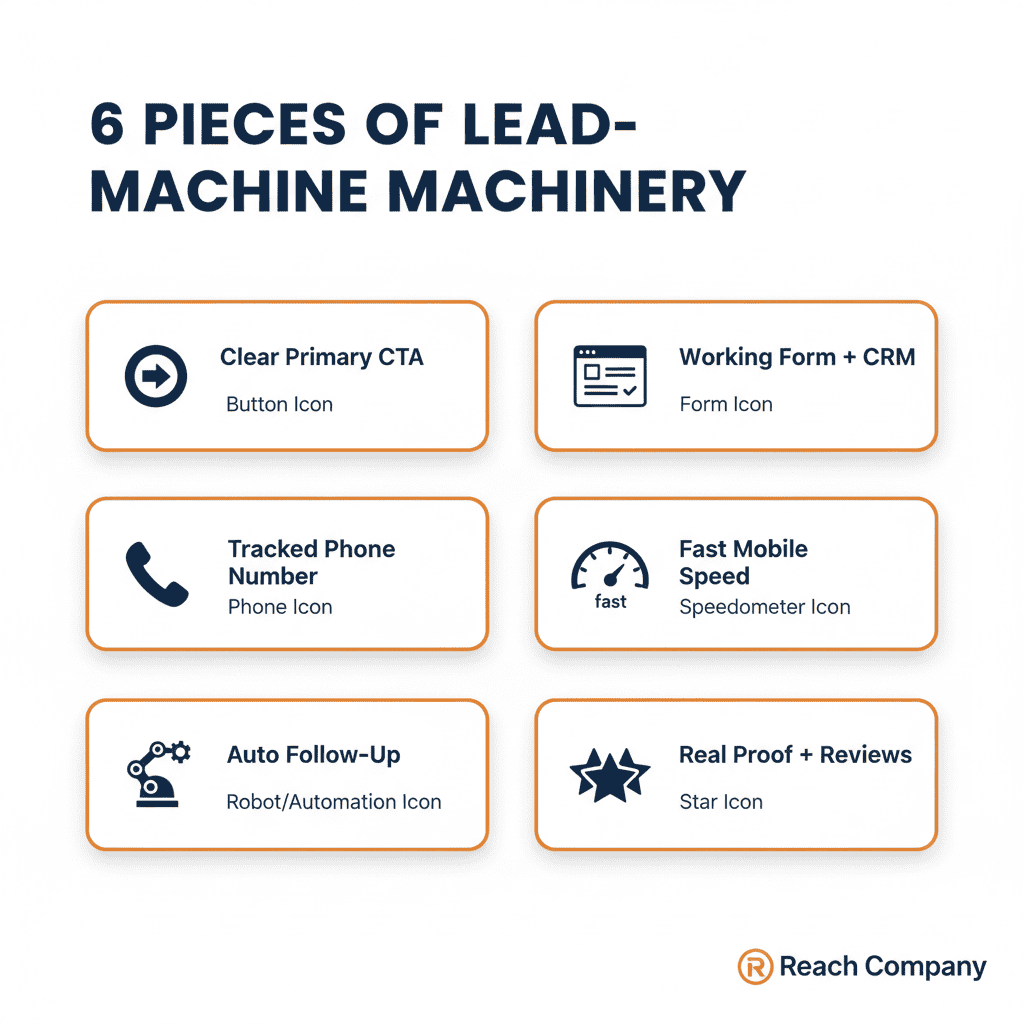
1. A clear primary CTA above the fold. One job per page. Book an appointment. Get a quote. Schedule a call. Not “learn more,” not “explore our services,” not three buttons fighting each other. One button, with the verb the customer would actually use. If a brand-new visitor can’t tell what they’re supposed to do in three seconds, you have a brochure.
2. A working form that goes somewhere real. Not a mailto: link from 2009. A form connected to a CRM like GoHighLevel that texts you when a lead comes in, emails the lead a confirmation in under sixty seconds, and starts a follow-up sequence automatically. We use GoHighLevel for ours and our clients’ setups because it does email, SMS, missed-call text-back, and pipeline tracking in one place. The form filling out is the start of the workflow, not the end.
3. A tracked phone number. Not the cell in your pocket. A tracked number through CallRail or GHL that shows you exactly which page, which ad, and which keyword drove the call. Without this, you’re guessing. With this, you’re managing. Service business owners who switch to tracked numbers usually find out 30 to 50 percent of “leads” they thought came from word of mouth actually came from Google. That changes how you spend money.
4. Speed. Real speed. If your site takes more than 2.5 seconds to load on mobile, your bounce rate is murdering you. We run WP Rocket and Vultr HF servers on every site we build because the cheap shared hosting most owners are on (you know who I’m talking about) is what’s making your site slow. There’s a deeper read on this in our 5 tips to speed up your website post if you want to nerd out.
5. A follow-up automation that runs without you. When that form fires, what happens at minute two? Minute fifteen? Day three? If the answer is “I’ll call them back when I can,” you’re losing 50% of those leads to whoever calls them first. We set every client up with an instant text, a 30-minute follow-up email, and a 7-day nurture sequence. We broke down that exact setup in AI customer service for small business if you want the full picture. The lead doesn’t go cold. You don’t drop the ball. Easy peasy.
6. Proof, in the right places. Reviews, real client photos, real numbers. Not stock photos of a lady in a headset. Not “5-star service since 2009.” A specific quote from a specific person about a specific problem you solved. Customers trust other customers. They don’t trust your tagline.
That’s the machinery. Six parts. If your site is missing more than two of these, you have a brochure with a domain name.
The contrarian truth nobody wants to say
Here’s the rub. A pretty website does not mean a converting website. The two have almost nothing to do with each other.
I’ve seen ugly websites pull thirty leads a week. I’ve seen $15,000 brand-new websites built by award-winning design shops that pull two. The difference is never the design. The difference is whether somebody thought about the customer’s path from “saw the ad” to “booked the appointment” and engineered every step.
Most agencies sell design. Design feels safe. Design has before-and-afters that look great in a portfolio. Design is also the easy part. The conversion machinery is the work that takes a real strategist to wire up, and most agencies don’t want to do it because it’s boring, technical, and you can’t shoot a glamour shot of a working CRM workflow.
This is the part where I’d love to tell you that you can DIY all six pieces with a Wix template and a YouTube tutorial. You probably can’t. Not because you’re not smart. Because you’re busy running your business, and the time it takes to learn this stuff is time you’re not selling your actual service. There’s a reason our 4 crucial pieces of your lead generation system post hammers the same point. The machinery matters more than the marketing.
Proof: 1,928 leads in a year
Let me tell you about Chin Up Aesthetics. They’re a med-spa client of ours in Atlanta. Before we rebuilt their site and wired up the machinery, they had a beautiful brochure site that did roughly what most med-spa sites do. People found them, looked around, and didn’t book.
We rebuilt the site as a lead machine. Clear primary CTA on every page (book a consultation), a real form connected to GoHighLevel, tracked phone numbers, fast hosting, an instant text-back the moment a form fires, a 7-touch follow-up sequence, and real client photos with real reviews on every service page.
In the twelve months after launch, that website generated 1,928 leads.
Not 1,928 visits. Not 1,928 page views. 1,928 humans who filled out a form or called the tracked number. Same business. Same services. Same Atlanta market. New machinery.
That’s the gap between brochure and machine. The pretty version was costing them roughly 1,800 leads a year in opportunity cost they couldn’t even see, because brochures don’t track anything.
What to actually do this month
If you read this and recognized your own site, here’s the plan. Don’t burn it down. Audit it.
- Open your homepage on your phone. Time how long it takes to load. If it’s over 3 seconds, you have a hosting and speed problem. That’s fixable in a day with the right setup.
- Find your primary CTA. Not “find a CTA.” Find the ONE thing every visitor should do. If you can’t point to it in three seconds, your site doesn’t have one. Pick the action and make the button big, bold, and above the fold on every page.
- Submit your own contact form. Time how long it takes to get a confirmation. If it never arrives, or it takes more than two minutes, your machinery is broken. Fix the form, the email confirmation, and the instant text-back before you do anything else.
- Pull your phone records. Count how many calls came from the website last month. Don’t know? Then you don’t have a tracked number. Add one. Without this number you can’t manage anything.
- Look at your follow-up. What happens automatically after a lead fills out the form? If the answer is “I follow up when I get a chance,” install a follow-up automation this week. We’ve written about AI lead follow-up automation in detail and it works on a budget.
Five steps. None of them require a redesign. All of them turn the brochure into a machine.
And before you let an AI tool build the thing, read this first: AI website builders for small business can spin up a pretty homepage in minutes, but they rarely build the machinery that turns visitors into leads.
Your website should be your hardest-working employee
Plain and simple. A brochure costs you money every month. A lead machine pays for itself by Wednesday. The math is not subtle, and the difference is not the design fee. It’s the machinery underneath.
If you’d like a real human to look at your site and tell you exactly which of the six pieces are working and which are leaking money, book a free 30-minute call with us. No pitch. No deck. We’ll pull up your site, run through the audit live, and you’ll walk away with a clear picture whether you hire us or not.
Your website should be your hardest-working employee. If yours is a brochure, let’s promote it. You got this.

