
Can I shoot straight with you? Will AI replace marketers? For a big chunk of the work, the honest answer is yes, and it already has. Not someday. This year. I use AI every single day in my own business, and I watch it do things in twenty minutes that used to take an afternoon and an invoice. Pretending that isn't happening doesn't protect anybody. The people who get hurt are the ones who keep their head down and assume the human touch will save them. The people who win are the ones who pick up the tool. So let's talk about what AI is actually taking, what it can't touch yet, and how to be the marketer it makes more valuable instead of the one it quietly replaces.
The Honest Answer Is "Mostly, Yes"
Most articles on this dance around the question because they want to comfort you. I'd rather be useful. Right now AI writes ad copy, drafts blog posts, builds email sequences, cuts video, summarizes calls, and answers customer questions, often well enough that you can't tell a human didn't do it.
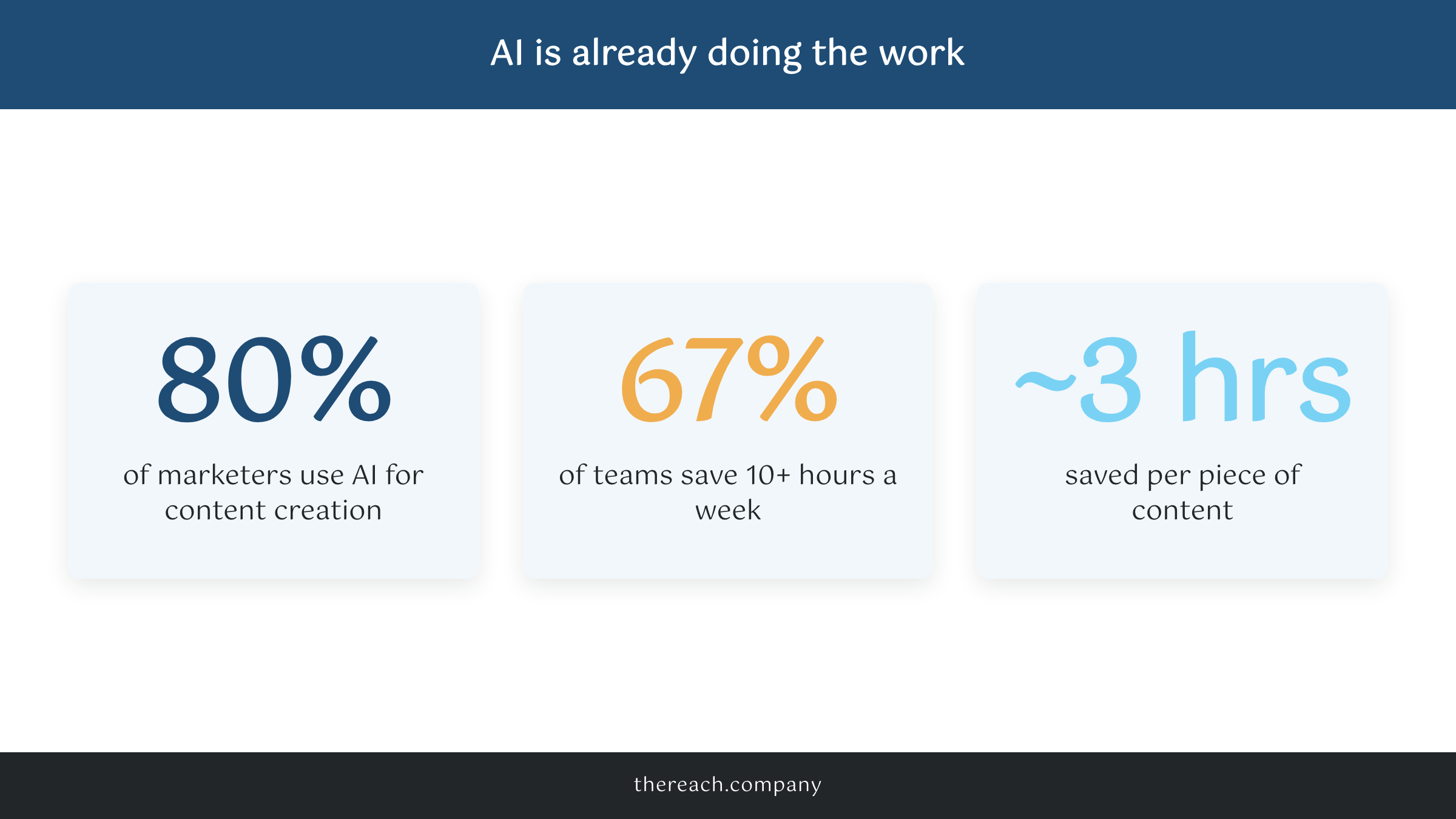
HubSpot's research backs the scale of it: 80% of marketers already use AI for content creation, 75% use it for media production, and 67% of marketing teams say they save 10 or more hours every single week with it. About three hours saved per piece of content, on average. Let that sink in. A junior marketer's whole week of grunt work now fits in part of a day. If that grunt work was the thing you sold, or the thing you were paying someone else to do, the ground already moved under you.
What AI Is Replacing, and What It Isn't (Yet)
Here's the rub. AI is replacing tasks, not outcomes. There's a difference, and your whole career sits in that gap.
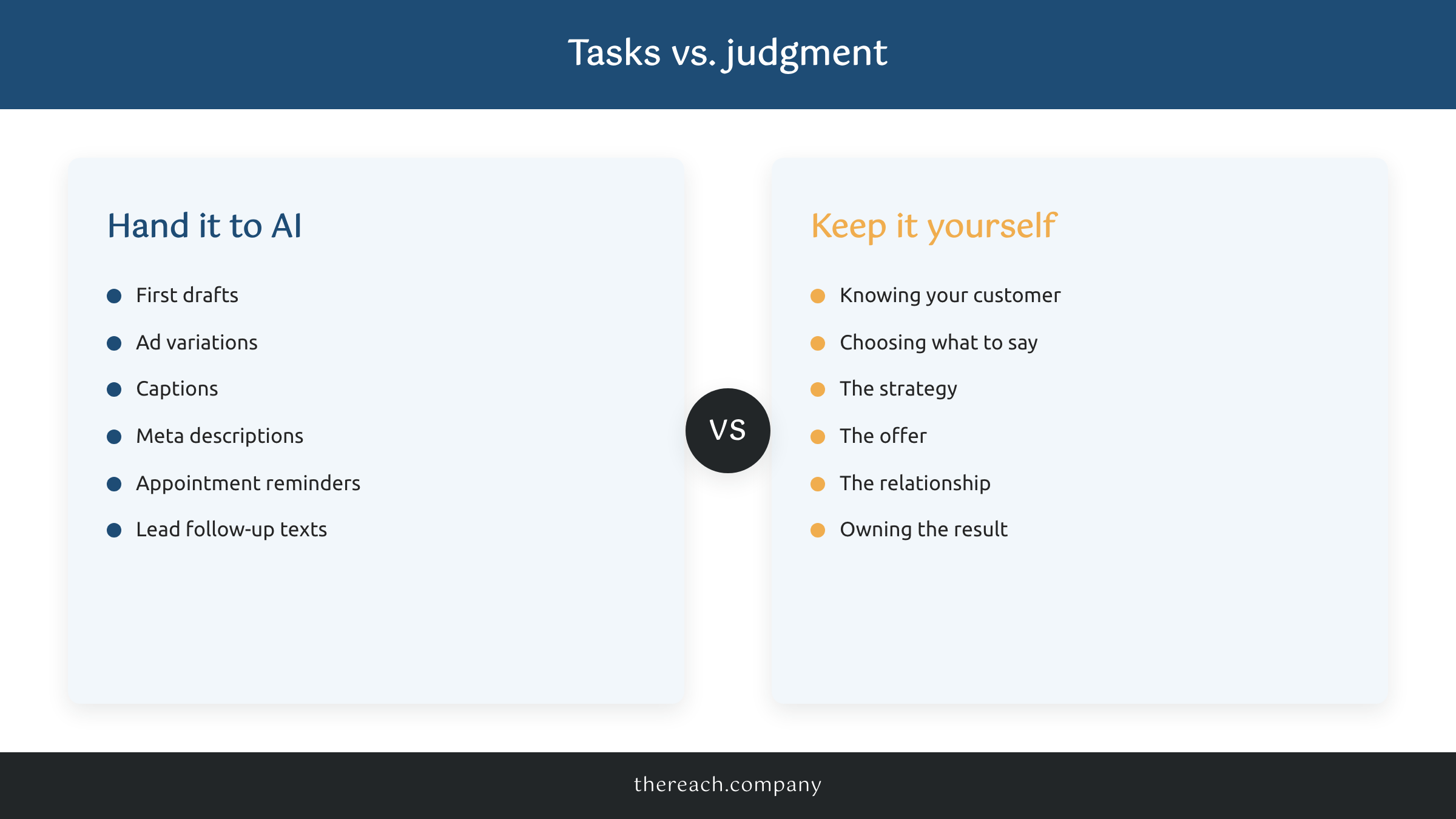
What it's eating right now: first drafts, headline variations, ad creative at volume, social captions, meta descriptions, FAQ answers, appointment reminders, and lead follow-up that used to fall through the cracks at 9pm. That is real work people got paid for. It is gone, or going.
What it can't do well yet: know your customer better than you do, decide what is actually worth saying, build a strategy that fits one specific business, read a room, own a relationship, or take responsibility when a campaign flops. AI will write you 40 ad variations in a minute. It has no idea which angle will land with a 52-year-old homeowner deciding whether to trust your roofing crew. That judgment is still yours.
Think about your own last month of marketing. How much of it was genuine creative judgment, and how much was production line work? Formatting, resizing, rewording the same thing for a fifth platform, chasing a lead you forgot to call back. Be honest. For most owners it is 80% production and 20% thinking. AI is coming for that 80% whether you invite it or not. The real question is whether you let it free you up for the 20% that actually grows the business, or whether you keep doing the 80% by hand and call it a full day.
This is also where a lot of marketing shops get exposed. An agency that only ever sold content production, churning out posts and copy on a retainer, is selling the exact thing that just got cheap. The shops that sold strategy, judgment, and a real relationship are not in the same boat. Same lesson for an in-house marketer: if the only thing you offered was output, the moat is gone. If you offered knowing what to produce, for whom, and why, the moat just got deeper.
The Marketer AI Replaces vs. the One It Doesn't
Picture two marketers. Same tools, same AI subscriptions, same budget.
The first one uses AI to do the same job, faster. Cranks out more posts, more emails, more "content." That's it. They have made themselves a quicker version of a commodity, and a commodity competes on price until it loses. AI will absolutely come for that person, because the only thing they offered was output, and output is now nearly free.
The second one uses AI as leverage. They hand it the drafting, the variations, the busywork, and they spend the reclaimed hours on the stuff AI can't do: talking to customers, finding the angle nobody else is using, building the system, and reading what is actually working so they can adjust. They don't compete on volume. They compete on judgment.
And judgment is the one thing getting more scarce. HubSpot found that 71% of marketers say AI helps them create significantly more content, but 53% now struggle to make any of it stand out in an AI-flooded market. More content, less attention. That is the whole game flipping in a single stat. Plain and simple: AI doesn't replace marketers. It replaces marketers who refused to become operators.
How We Actually Use AI at The Reach Company
I'm not theorizing here. This post you're reading runs through an AI content engine I built. We use AI to draft, to turn one idea into ten, to summarize client calls, and inside GoHighLevel to text a brand-new lead back in 60 seconds instead of three hours later. That speed is usually the whole difference between booking the job and losing it to whoever answered first.
But here is what AI never touches in our shop: the discovery call where we learn how a business actually makes money, the decision about what to say and to whom, the offer itself, and the relationship. One client, a medspa, pulled 1,928 leads from their website in a single year. AI helped us move faster on the build and the follow-up. It did not decide the strategy, write the offer that converted, or care whether they won. We did. The tool made us faster. The judgment made us valuable. That is the entire point.
A normal week looks like this. AI hands me a rough draft of a post in minutes, and I spend my time making it sound like a person instead of a press release. It drafts five follow-up texts, and I pick the one that fits the customer. It pulls the highlights off a sales call, and I decide what we actually do about them. Notice the pattern. The machine handles the first 80%, and I spend my energy on the last 20% that decides whether any of it works.
What to Do This Week
You don't need a degree or a six-month plan. You need to start wielding the thing.
- Pick one task you dread and hand it to AI this week. First drafts, follow-up texts, repurposing a post into a few formats. Just one, to start.
- Learn to edit, not just generate. AI's first draft is a starting point, never a finished product. Your taste is the value-add now, so use it.
- Automate the follow-up that's costing you jobs. Speed-to-lead is where most small businesses quietly bleed money, and it's the easiest win AI gives you. A lead generation system that runs without you babysitting it pays for itself fast.
- Spend the hours you save on the stuff AI can't do. Talk to five customers. Sharpen your offer. Actually look at your numbers.
If you want to go a level deeper, we wrote a companion piece on the honest answer to whether AI replaces marketing itself. And if you would rather hand the whole machine to someone who does this all day, that is exactly what we are here for.
So, will AI replace marketers? It already replaced the ones who only ever sold output. And it made the ones who think, who know their customer, and who use the tool with real taste more valuable than they have ever been. The honest move isn't to panic, and it isn't to pretend you're safe. It's to pick up the tool today and become the marketer AI works for. The finish line is a lot closer than it feels. Promise. And when you want help building a marketing system that uses AI the right way, we got you.
Curious which writing tools pass the human test? See the 4 AI copywriting tools that actually write like a human.
For the longer view, here’s what 3 years of using AI daily taught me about which marketers get replaced.

