

Every ad platform now slaps “AI” on its targeting. Google, Meta, TikTok, all of them. And if you run a small budget, that one word is doing a lot of work to separate you from your money. Can I shoot straight with you? Some of it genuinely changed the game and is worth using. Some of it is a setting you already had in 2022 wearing a new name tag. When you’re figuring out AI ad targeting for small business, the whole game is telling those two apart before you pay for buzzwords.
Here’s the rub: the platforms won’t tell you which is which. They write their own glowing posts. So let’s do it for them.
What’s actually new
The real shift is that the algorithm now picks who sees your ad, not just how much you bid for it. That’s the part that actually changed.
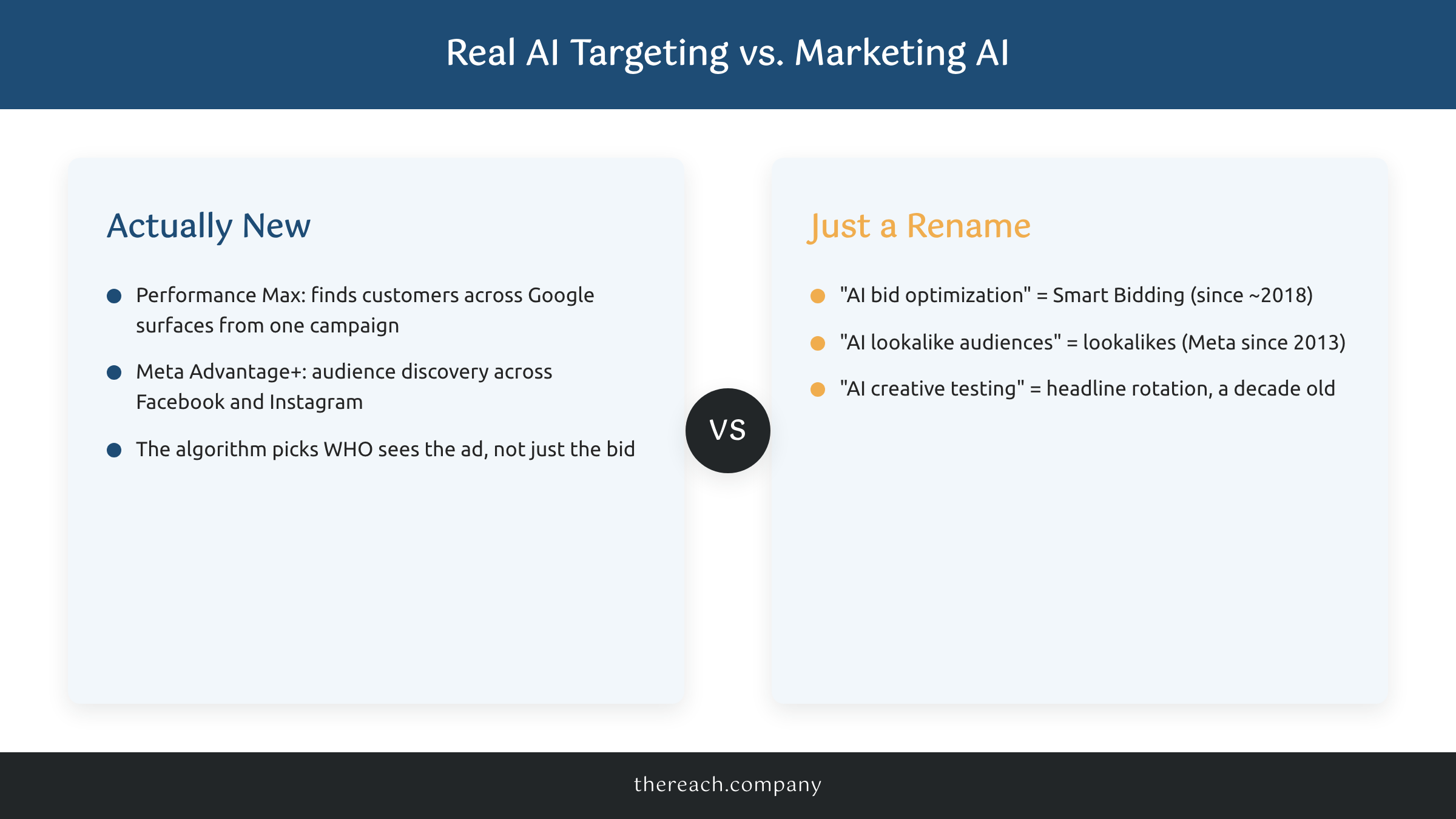
Google’s Performance Max is the clearest example. It uses Google AI across bidding, budget, audiences, creative, and placement to find customers across Search, YouTube, Maps, Gmail, and Display from a single campaign. Google’s own documentation spells that out. You feed it a goal and some audience signals, and it goes hunting across every Google surface for you. Meta’s Advantage+ does the same thing on Facebook and Instagram. That is not a rename. Five years ago you built audiences by hand. Now the system builds and adjusts them in real time. Used right, it works, and it works well.
What’s just marketing
Now the buzzwords. “AI bid optimization”? That’s Smart Bidding, and Google has run it since roughly 2018. “AI-powered lookalike audiences”? Lookalikes have lived on Meta since 2013. Slapping “AI” on a 2013 feature doesn’t make it new. It gives it a fresh coat of paint.
Same story with “AI creative testing.” Rotating a few headlines and letting the platform favor the winner is a decade-old feature. Real, useful, worth doing. But it was doing that long before anyone thought to call it AI. When a platform sells you “AI” and the only thing that changed is the label, you’re paying attention to a word, not a capability.
The test for a small budget
Here’s the one question that matters when you’re spending $500 a month: does the algorithm have enough to learn from?
AI ad targeting runs on conversion data. Meta and Google both want a steady stream of tracked conversions, usually 30 to 50 a month, before the system can find patterns worth trusting. Feed it two leads a week and it’s guessing. That’s not the AI failing you. That’s you asking it to cook without ingredients.
So the honest gate is simple. If you’re tracking real conversions and getting healthy volume, hand the machine the wheel. It will outwork manual targeting all day. If you’re barely getting conversions, tighten your targeting by hand and build up data first. No AI setting fixes an empty funnel.
The bottom line
AI ad targeting for small business is real, and the genuinely new stuff earns its keep once your tracking is solid. The trick is not confusing the label with the capability. Before you trust any platform’s “AI,” ask what actually changed and whether you’re feeding it enough to work with. If you’d rather someone set the tracking up and run the accounts for you, here’s what our ad management costs. And if you’re still deciding whether the spend makes sense at all, we broke down whether Google Ads are worth it for a small business. Plain and simple.

