

Running a one-person business sounds like freedom until you’re answering emails at 9 PM, chasing an invoice at 10, and writing tomorrow’s post at 11. The hustle crowd calls that dedication. I call it a staffing problem. You’re doing three jobs and only getting paid for one of them. AI for solopreneurs is not about squeezing more output from your week. It’s about doing the same work in fewer hours by handing the busywork to tools, so your time goes to the thing clients actually pay you for.
The 80-Hour Week Is a Job Description Problem
Nobody works 80 hours because their trade takes 80 hours. The trade takes 40. The other half is the invisible second job: following up with leads, writing quotes and emails, scheduling, remembering to ask for reviews.
Here’s the rub. That second job used to force a hire. Stripe’s economics team dug into this in June and found that more than twice as many solopreneurs crossed $1 million in 2025 as in 2023, and their read on why is blunt: AI is filling the capability gaps that once made hiring necessary. One-person businesses are scaling without staff because the busywork finally has somewhere to go.
The ceiling on a solo business used to be headcount. Now it’s how many hours you insist on spending on jobs a $20 tool can carry.
The Three Jobs to Hand Off First
Don’t automate everything. Hand off these three and you’ll feel it within a week.
1. Lead follow-up. The only job on this list that directly makes you money. When you’re with a client and a call goes to voicemail, that lead dials the next name on Google. Missed-call text-back, instant replies to form fills, and appointment reminders run all day without you. This is the lead generation system we build on GoHighLevel for $299/mo. A medspa in Atlanta we work with gets 1,928 website leads a year, and every single one gets answered in seconds whether a human is free or not. Hours back: about 4 a week, plus the jobs you stop losing.
2. First drafts. Claude or ChatGPT at $20 a month writes the first pass of your emails, quotes, service pages, and follow-up sequences. You edit for judgment and voice, which was never the time problem anyway. We wrote up how to use ChatGPT for marketing without sounding like a robot if you want the exact approach. Hours back: about 3 a week.
3. Admin. Meeting notes, review requests, reminder texts. Check the tools you already pay for before buying anything new. Most CRMs and even your phone handle this today. Hours back: about 2 a week.
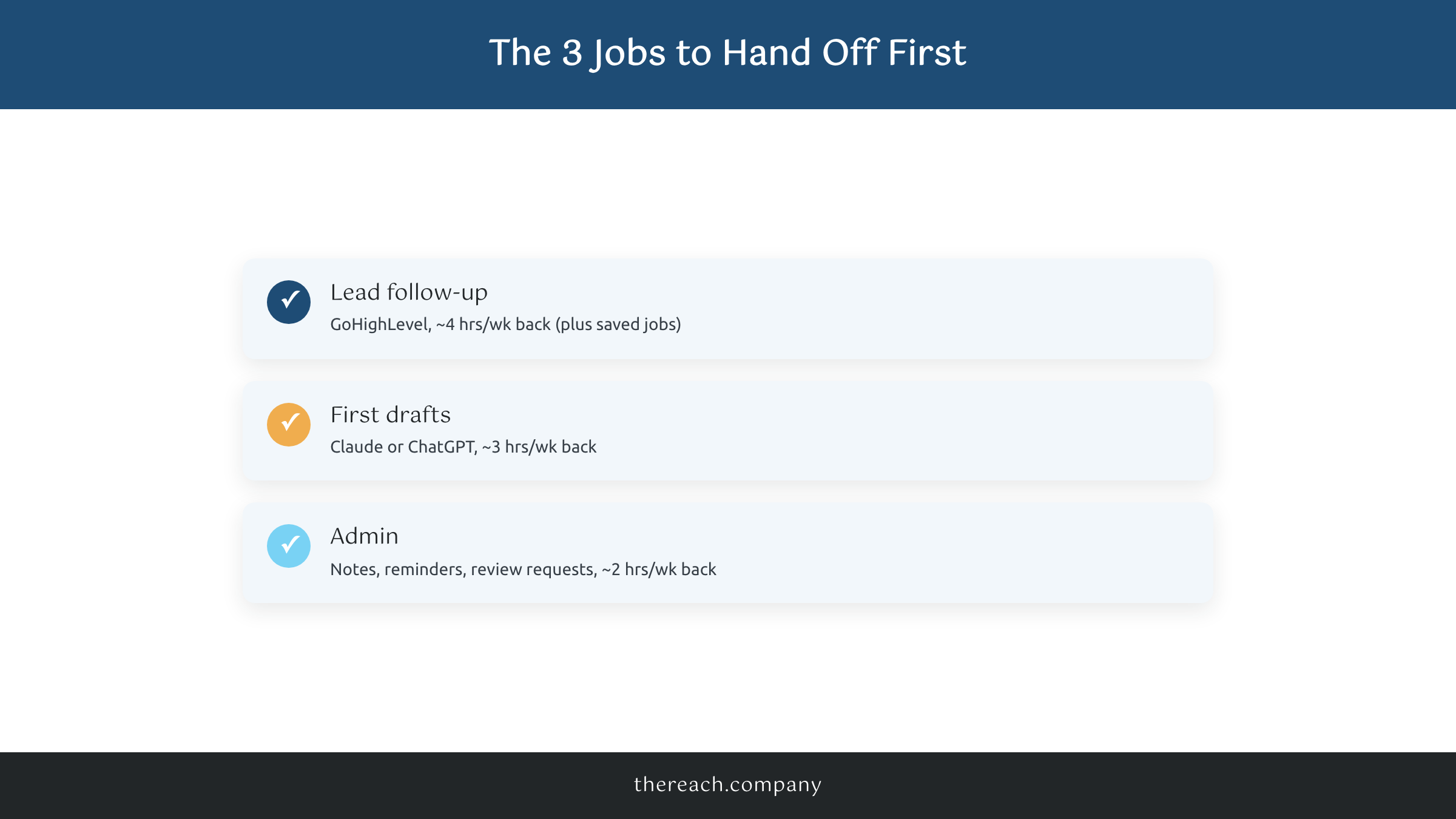
That’s roughly nine hours a week. And you didn’t touch the work only you can do.
The Rule That Keeps the Hours Off
Here’s where most solopreneurs blow it. They win nine hours back and immediately refill them with a content calendar some guru said they need. The hype merchants sell AI as a way to do five times more. Do that and you’ll be right back at 80, just with more subscriptions.
Use the rule we give clients: same output, fewer hours. AI for solopreneurs works when the reclaimed time goes to billable work, better clients, or the gym at 5 PM. Not more busywork with a robot’s name on it.
You started a one-person business to own your time. This is the first point in business history where one person plus a few well-chosen tools runs like a small team. Take the hours. You earned them.
And if lead follow-up is the job you want off your plate first, that’s the one we build every day. You got this.

