
If you feel behind on AI, let me take some pressure off first: you’re not behind. The AI overwhelm small business owners feel right now is real, but most of it is manufactured. There are thousands of AI tools out there and an entire industry built on convincing you that you need all of them by Friday. You don’t. You run a business. You have customers to serve, jobs to finish, and a phone that keeps ringing. You do not have time to test 50 apps to find the three that matter. So let’s cut the noise. This is a plain guide to what actually matters for a business doing under $5 million, what to ignore for now, and the short stack of tools that covers about 90% of the upside without turning you into a full-time AI tester.
The AI Overwhelm Is Being Manufactured
Here’s the rub. AI is genuinely good now. It writes, it summarizes, it answers customers, it drafts your emails in your voice if you teach it how. That part is not hype. It does real work today.
According to HubSpot’s 2026 State of Marketing data, 80% of marketers already use AI for content creation, yet fewer than half, about 47%, say they actually understand how to work it into their strategy. Read that again. Most of the people using AI every day still feel like they’re winging it. So if you feel a step behind, you are in the exact same boat as the professionals who do this for a living.
The overwhelm is not a sign you’re bad at this. It’s a sign the market is loud. Every week there’s a new must-have tool, a new thread promising 37 apps that will 10x your revenue, a new guru selling a course on prompts. That is not the technology talking. That is marketing. The tools are real and useful. The panic around them is a product being sold to you, and once you see that, it gets a lot quieter.
You Don’t Have a Tool Problem. You Have a Filter Problem.
The reason AI feels impossible is that you’re evaluating tools instead of jobs. Flip it. Don’t ask “should I be using this tool?” Ask “what job in my business is slow, expensive, or falling through the cracks, and can AI do it?” Jobs first. Tools second.
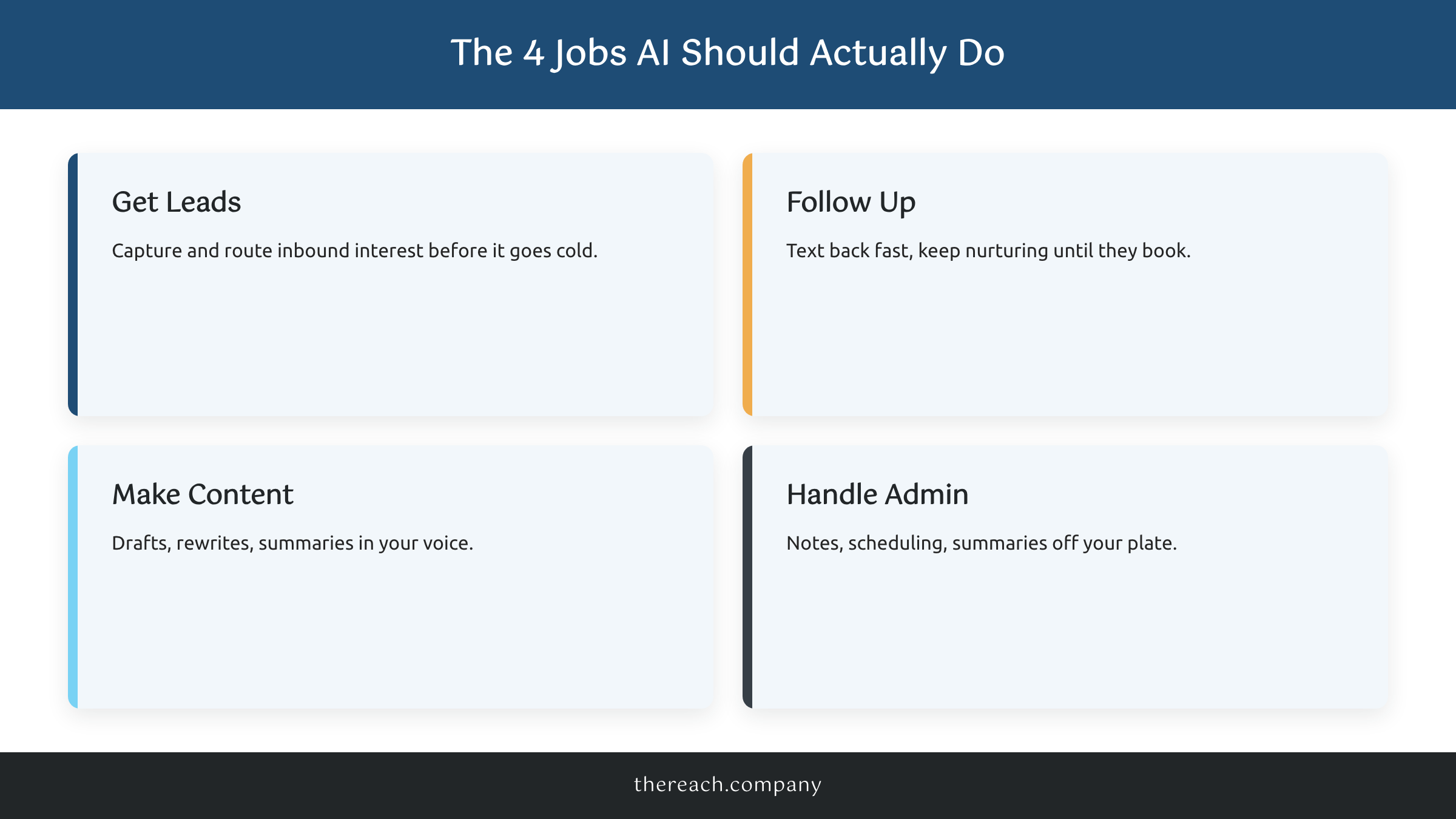
For most service businesses there are only four jobs AI is worth touching right now: getting leads, following up with leads, making content, and handling admin like notes, scheduling, and summaries. That’s the whole list. If a tool doesn’t map to one of those four jobs, you can ignore it today with zero guilt.
This one filter kills 95% of the noise. Say you see an app that auto-generates AI avatars for your ads. Cool. Which of the four jobs does it do? None you’re struggling with. Skip it. An app that texts every new lead back in under five minutes? That’s the follow-up job, and follow-up is where most owners bleed money. That one earns a look. The question is always the same: is this making me money or buying back my time? If the answer isn’t obvious in one sentence, it’s a no for now.
The 3-Tool Stack That Covers 90% of the Upside
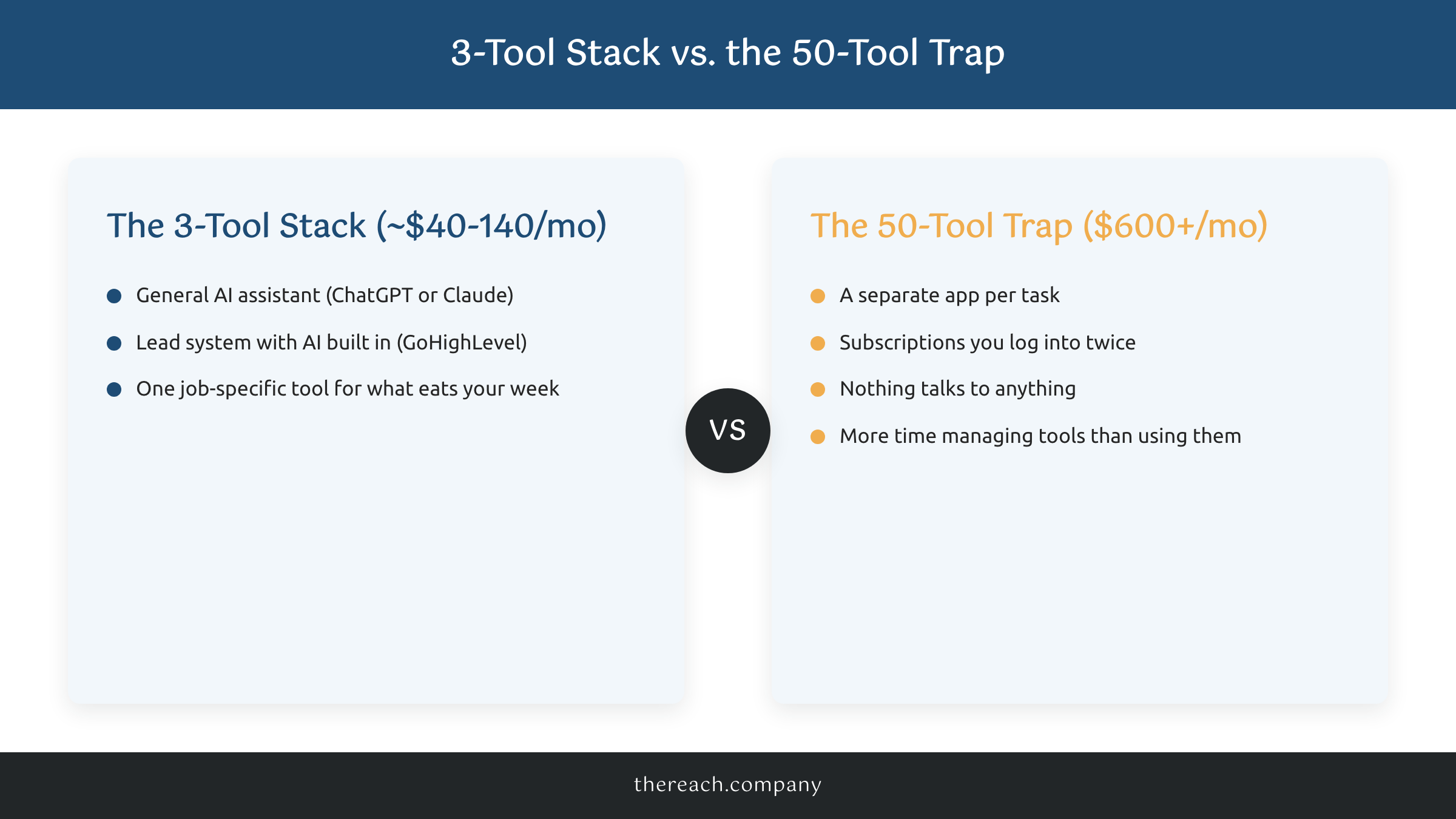
You don’t need 50 tools. You need 3. Here’s the stack I’d hand a service business owner today.
One, a general AI assistant. ChatGPT or Claude, around $20 a month. This is your thinking partner. It writes first drafts, answers “how do I,” turns your rough email into something clean, and summarizes the 40-page document you didn’t want to read. One subscription quietly replaces a dozen single-purpose “AI writer” apps. If you want the honest shortlist of what’s worth paying for beyond this, I broke down the AI tools that actually earned their subscription.
Two, your lead system with AI built in. This is the one most owners miss. You don’t need a separate AI follow-up app bolted onto a separate CRM bolted onto a separate texting tool. That’s how you end up with three subscriptions that don’t talk to each other and leads falling through the gaps. You need one system that captures the lead, texts them back in under five minutes, and keeps following up until they book. At The Reach Company we build this on GoHighLevel as part of the Reach Co Lead System, and the AI handles the missed-call text-backs and follow-up sequences owners never get around to. That is where AI actually pays for itself in a service business. If you want to see that piece on its own, here’s how we automate your lead follow-up.
Three, one job-specific tool for whatever eats your week. For a lot of owners that’s an AI notetaker that joins calls and writes the summary and the follow-up tasks for you. For others it’s a scheduling assistant that stops the back-and-forth email. Pick the single job that steals the most hours and hand it to one tool. Not five. Add the fourth tool only when the first three are running and you can name exactly what the fourth one does for you.
What to Ignore (For Now)
Now the freeing part: what you get to skip. Ignore the autonomous “AI agents” that promise to run your whole business while you sleep. The technology is real and it’s improving fast, but right now most of them need more babysitting than they save, especially for a small team. Let the enterprises beta-test them.
Ignore the niche generators, the AI that only writes Instagram captions or the AI that only makes logos, when your general assistant already does a good-enough version for free. Ignore anything you’d have to build a whole workflow around before it pays off. And ignore the FOMO entirely. None of this is “you’re missing out forever.” It’s “not your first move.” You can adopt the fancy stuff later, from a position of calm, once the three tools above are actually earning their keep. Being deliberate is not falling behind. It’s how you avoid spending $600 a month on subscriptions you log into twice.
What This Looks Like When It Works
Here’s a real example. A medspa in Atlanta we work with pulled in 1,928 leads from their website in a single year. They did not do it with 50 AI tools. They did it with one system that caught every lead and followed up fast, with AI handling the texts and reminders so nobody slipped through the cracks.
That’s the whole game. One assistant to think with, one system to catch and follow up on leads, one tool for the job that eats your time. The owner who beats AI overwhelm isn’t the one with the most apps. It’s the one who picked the few that do real work and ignored the rest. Plain and simple.
If you’re staring at a browser full of AI tabs wondering which ones matter, start here: pick the four jobs, grab the three tools, and ignore the rest until the basics are running. That’s how you get past AI overwhelm without burning a weekend or a budget on it. And if you’d rather have someone set up the lead-capture-and-follow-up piece so it just runs, that’s exactly what we do at The Reach Company. You keep doing what you do best. We’ll handle the system that turns AI from a source of stress into leads on your calendar. The finish line is a lot closer than it feels. Promise.

