
Almost every list of the best AI tools for small business is written by someone who never opened the apps. You know the ones. Forty tools, four sentences each, an affiliate link tucked under every “try it free” button. You read 3,000 words and walk away with a longer shopping list and no idea what to actually buy.
So I did it the expensive way. Over the past year I paid for 12 AI subscriptions and ran them inside a real business: mine. The Reach Company is a marketing agency for service businesses, which means every tool got tested twice. Once on our own work, and once on real client work, where a bad tool costs somebody leads.
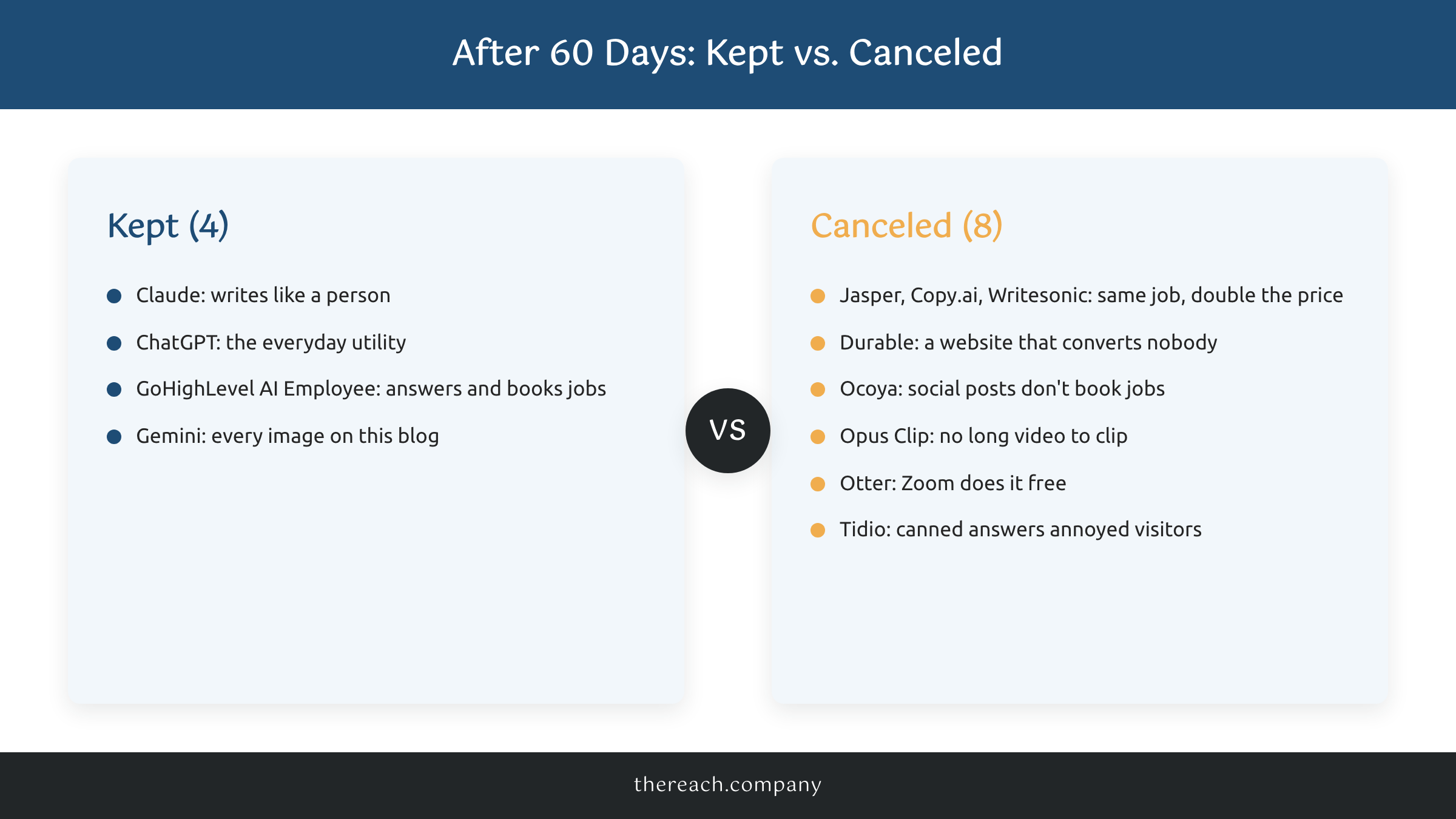
Four earned a permanent spot. Eight got canceled, most inside 60 days.
This post is the cancellation log. What each tool is for, what it costs, why the winners won, and the exact reason each loser got cut. There are no affiliate links anywhere in this post. Nobody paid to be on this list, and nobody paid to be kept off it.
Here’s the plan: why most tool lists steer you wrong, how I tested, the four keepers, the eight cancellations, and the exact order I’d buy in if I were starting from zero today.
The Real Problem With Every “Best AI Tools” List
Follow the money. Most tool roundups earn a commission every time you click through and subscribe. That one incentive quietly rearranges the whole list. The tool with the 40 percent recurring payout floats to the top. The free tool that solves your problem in ten minutes doesn’t make the list at all, because free doesn’t pay the writer.
That’s why the lists keep getting longer. A 40-tool listicle isn’t research, it’s inventory. Nobody has 40 tools wired into their business. Nobody has 15. The writer is stocking shelves, not making a recommendation.
And it’s working on all of us. McKinsey’s latest State of AI survey found 88 percent of companies now use AI regularly in at least one business function, up from 78 percent a year earlier. But only 29 percent of companies under $100 million in revenue have started scaling AI past the pilot stage. Read those two numbers together and the picture is clear: almost everybody is paying for AI, and most small businesses haven’t wired it into how work actually gets done.
That gap is not an access problem. The tools are $20 a month and sign-up takes four minutes. The gap is that tools get bought off a listicle, poked at twice, and left running on a credit card. A tool you don’t use every week isn’t an investment. It’s a donation to a software company.
So this list of the best AI tools for small business works differently. It’s short, it’s priced, and every verdict comes with the reason.
How I Tested: Real Money, Real Work, One Question
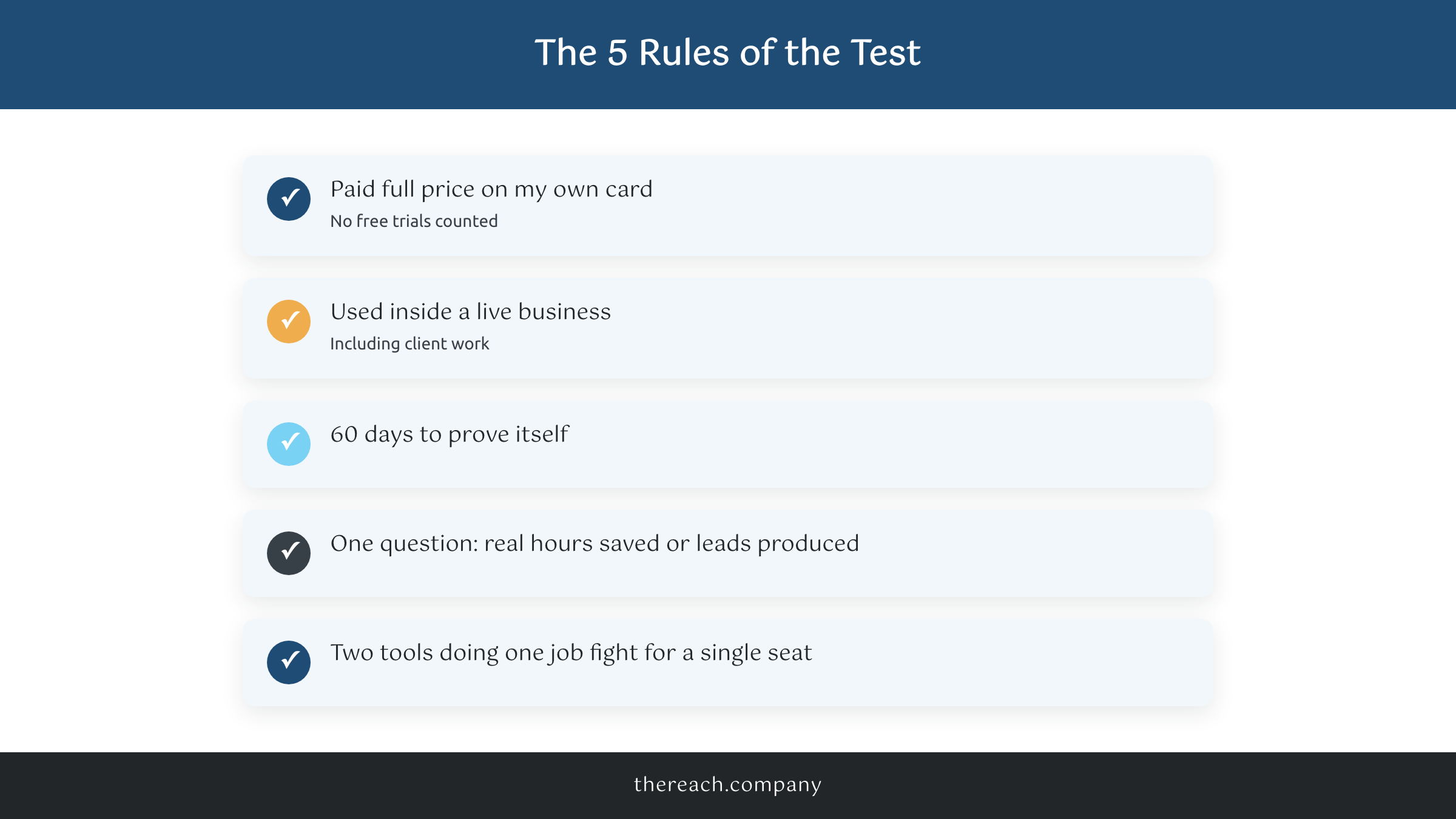
Five rules, applied to all 12 tools:
- I paid full price on my own card. Free trials don’t count. You learn nothing about a tool’s value until canceling it costs you actual money.
- Every tool ran inside a live business. Our own marketing at The Reach Company, plus client work: medspas, contractors, consultants, non-profits. Real deadlines, real leads on the line.
- 60 days to prove itself. Long enough to get past the honeymoon, short enough that a dud doesn’t drain the account for a year.
- One question decided everything: did this tool save real hours or produce real leads? Not “is it impressive.” Impressive is everywhere in AI right now. Paid-for-itself is rare.
- Duplicates fight for one seat. If two tools do the same job, they go head to head and the loser gets canceled. No collecting.
At the peak I was paying just under $400 a month across the 12. That number matters, because subscription bloat is the quietest leak in a small business. $29 here, $49 there, and suddenly you’re spending real money on apps nobody has opened since March.
One more thing before the verdicts. I went into this pro-AI and came out more pro-AI. Every cancellation below is a fit problem or a duplication problem. Not one of these tools got cut because “AI doesn’t work.” It works. That’s exactly why paying for the wrong five tools is such a waste: the right three are sitting right there at the same price.
The 4 AI Tools That Earned a Permanent Spot
1. Claude ($20/month): the writer
Claude is where the long-form work happens at The Reach Company. Blog posts, client strategy docs, service page copy, research summaries. It won the writing seat for one reason: the output reads like a person wrote it, and with enough of your own writing pasted in, it reads like you wrote it.
The workflow that makes it earn the $20: feed it your real details. Your services, your cities, your prices, samples of how you actually talk. Generic prompt, generic output. Specific input, output you can publish after one editing pass. That rule holds for every writing tool on this list, but Claude handles long documents and full context better than anything else I tested.
2. ChatGPT ($20/month): the everything utility
ChatGPT is the junk-drawer tool, and I mean that as a compliment. Quick email drafts, brainstorming a promotion, untangling a spreadsheet formula, summarizing a contract before a call, first-pass job ads. It’s fast, it’s everywhere, and it does 100 small jobs well.
Yes, it overlaps with Claude. They fought for one seat and both survived, because the jobs split cleanly: Claude owns long-form writing in our voice, ChatGPT owns the daily quick hits. If you’re buying your first AI tool and you only want one, pick either and you’ll be fine. The $20 pays for itself the first week you stop writing every email from scratch.
3. GoHighLevel AI Employee ($97/month): the only one that books jobs
Here’s the tool that separates a service business from everyone else’s tool list. GoHighLevel’s AI Employee answers the phone when you can’t. Voice AI picks up missed calls, answers questions about your services, and books the appointment. Conversation AI does the same job over web chat and text, trained on your business. Reviews AI drafts responses to every Google review.
Run the math on one missed call. An HVAC repair averages a few hundred dollars; a roof replacement runs five figures. If Voice AI catches one missed call a month, the $97 already paid for itself several times over. Nothing else on this list touches revenue that directly.
Full disclosure: this is the lead generation system we build on GoHighLevel for clients at $299 a month, so we use these features daily across dozens of businesses. That’s exactly why it’s on the keep list. We’ve watched it catch leads that used to hit voicemail and die. We also broke down which GoHighLevel AI features are actually useful if you want the honest feature-by-feature take.
4. Gemini ($20/month): the image machine
Every image on this blog, and most of the social graphics, come out of Google’s Gemini. Featured photos, infographics, ad creative drafts. Before AI image generation, a small business had two options: $500+ for custom graphics or the same stock photo of a handshake everyone else uses. Now it’s $20 a month and a well-written prompt.
It earned the seat because images were a real bottleneck. Posts sat unpublished waiting on graphics. Now they don’t.
The 8 That Got Canceled (With the Real Reasons)
The duplicates: Jasper ($49/month), Copy.ai ($49/month), Writesonic ($39/month)
All three are AI writing tools. All three got canceled for the same reason: they do the job Claude and ChatGPT already do, at roughly double the price, wrapped in templates. Jasper’s marketing templates are polished, and none of them wrote anything our two keepers couldn’t. Copy.ai lasted two weeks. Writesonic’s SEO-article generator produced exactly the kind of keyword mush Google has spent three years learning to ignore.
The lesson isn’t that these are bad products. It’s that the writing seat was already taken. Two tools doing one job means one of them is a donation.
The magic buttons: Durable ($12/month), Ocoya ($39/month), Opus Clip ($15/month)
Durable builds you a website in 30 seconds, and that’s the problem. A service business site earns leads with service pages, city pages, real job photos, reviews, and a booking path. A 30-second site has none of that. It’s a brochure with your name on it, and a website that converts nobody is expensive at any price.
Ocoya schedules AI-written social posts. The tech worked fine. It got cut because social posts are not what books jobs for a service business. Search does that. We treat social as education, not lead gen, and paying $39 a month to automate a channel that doesn’t drive revenue is optimizing the wrong thing.
Opus Clip turns long videos into short clips, and it’s legitimately clever. We didn’t have a weekly long-video pipeline, so it was a clip factory with no raw material. If you already record hours of video every month, keep it. If not, you’re paying to slice footage that doesn’t exist.
The redundant utilities: Otter ($16.99/month), Tidio ($29/month)
Otter transcribes meetings well. Zoom and Google Meet now do it free, built in. Canceled.
Tidio put an AI chatbot on our test site. Visitors got canned answers that missed the point, and every miss is a lead walking away. GoHighLevel’s Conversation AI was already doing the same job trained on our actual services and prices. Duplicate seat, weaker player, canceled.
“But Don’t I Need More AI Than This?”
Right about here is where the doubt creeps in. Your feed shows you a new “game over” AI tool every single week. Twelve tested and only four kept? Surely the other eight seats should be filled with something.
Can I shoot straight with you? The job list for a service business is short. Answer every lead fast. Follow up until they book. Write things: emails, pages, posts. Show up when people search. Put decent images on what you publish. That’s the whole list, and four tools cover it.
The feeling that you’re missing out is manufactured. It’s the same feeling that sells kitchen gadgets: the avocado slicer feels essential in the store, and the chef’s knife you already own does everything. New AI tools are mostly avocado slicers right now. The knife is a frontier model like Claude or ChatGPT plus a system that touches your leads.
More subscriptions don’t make you more automated. They make you the owner of more logins. When a genuinely new job shows up in your business, a tool for it will be there. Buy it that day, not before.
The Part Nobody Tells You: Stop Buying Tools, Start Assigning Jobs
Here’s the reframe that made the whole test make sense, and it’s the one thing I’d tattoo on every tool listicle on the internet.
You would never hire an employee without a job description. No owner says “this guy seemed impressive at a conference, let’s add him to payroll and see what happens.” But that’s exactly how most of us buy software. The demo was slick, the listicle said essential, the card got charged, and the “employee” has been sitting in the break room since February.
Flip the order. Write the job description first. “Answer calls I miss and book the appointment.” “Draft the follow-up emails I keep forgetting to send.” “Turn each blog post into a graphic.” Then, and only then, audition tools for the seat, and let exactly one win it.
Do this and something satisfying happens: your subscription list maps one-to-one to jobs that used to leak time or leads. Every line on the credit card statement has a name and a paycheck it earns. Cancellation decisions stop being agonizing, because a tool without a job isn’t a tough call. It’s an empty desk you’re paying rent on.
That’s the whole secret behind the keep list above. Claude has a job. ChatGPT has a job. The AI Employee has a job. Gemini has a job. The other eight were impressive strangers on the payroll.
What This Looks Like in a Real Business
Theory is cheap, so here are receipts.
Chin Up Aesthetics, a medspa client, pulled 1,928 leads from their website in one year and ranks first in the Map Pack for more than 8 services. The machine behind that is the exact stack this post recommends: a site built to convert, and the follow-up system catching every inquiry instantly, at 2 pm or 2 am. When a lead texts at night, the system answers and books. Nobody on staff wakes up.
The Reach Company itself runs on the keep list. The blog you’re reading is drafted with Claude, illustrated with Gemini, and published on a schedule a two-person marketing team couldn’t have touched five years ago. That’s not a projection about what AI will do someday. That’s this Tuesday.
And the missed-call math shows up everywhere we install the AI Employee. Service businesses miss calls because they’re on ladders, under sinks, and in consult rooms. Each missed call used to be a coin flip between “they’ll call back” and “they called the next company on the list.” Now the coin flip is gone: the call gets answered, the question gets handled, the job gets booked.
None of that required 12 subscriptions. It required four, each with a job.
If I Were Starting Over: The Order to Buy In
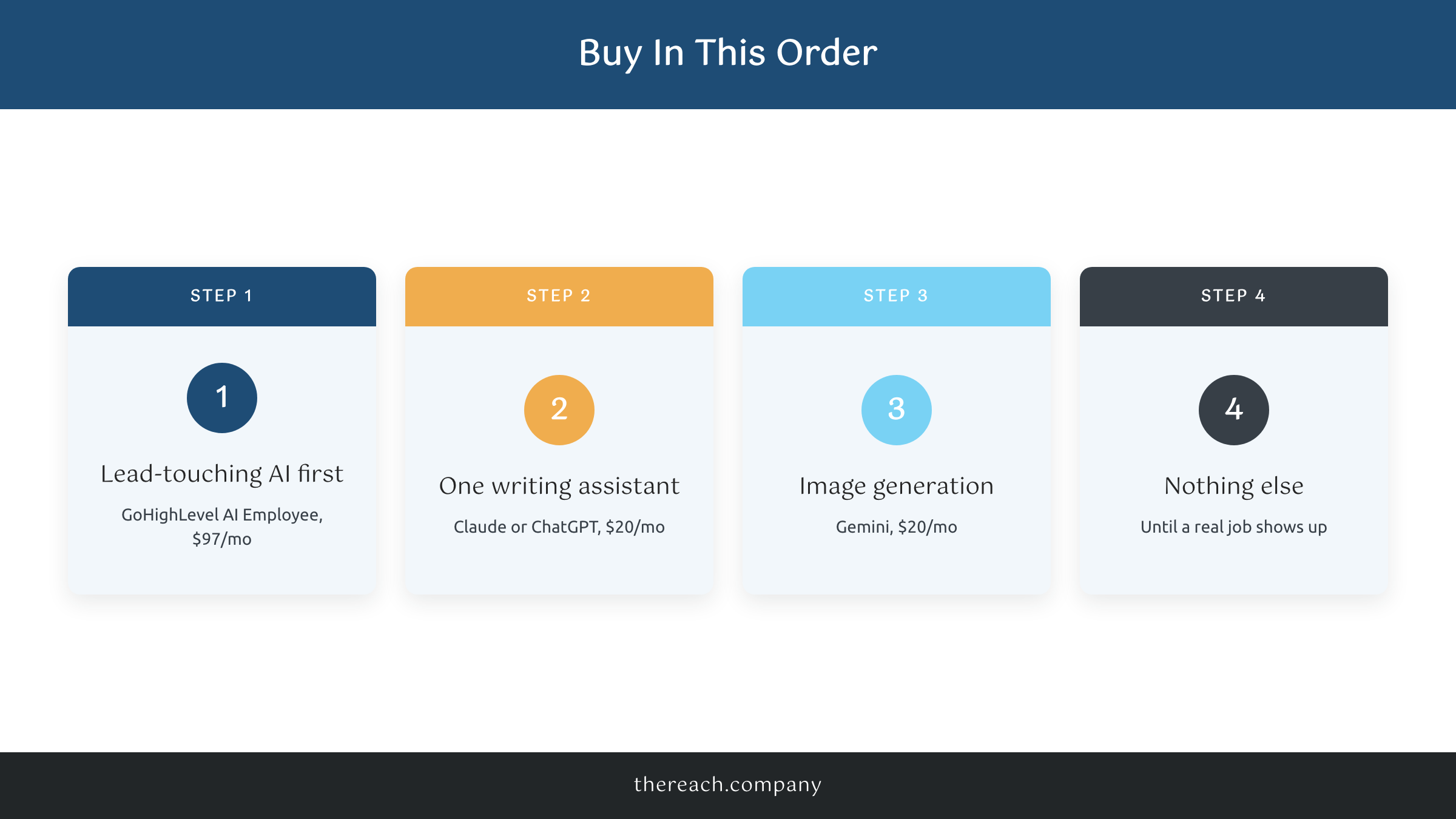
If you’re standing at zero with the best AI tools for small business open in ten tabs, here’s the sequence. It’s ordered by how directly each dollar touches revenue.
Step 1: Lead-touching AI first. GoHighLevel’s AI Employee, or having it set up for you as part of a lead system. This is the only purchase on the list that directly answers customers and books jobs, which makes it the only one that funds the rest.
Step 2: One writing assistant. Claude or ChatGPT at $20 a month. Feed it your real business details and take back the hours you spend staring at blank emails.
Step 3: Images. Gemini at $20 a month, the day you notice content sitting unpublished because it needs a graphic.
Step 4: Nothing. Seriously. Run those three for 90 days. When a new job shows up that none of them covers, audition tools for that job and hire one.
Total: around $140 a month for the stack that survived, versus the $400 I was bleeding at peak. If you’re weighing this stack against broader platforms like CRMs and email systems, we wrote our no-hype guide to the best marketing automation tools for small business that covers that layer the same way: real prices, no affiliate links.
The Tools Are the Easy Part
Twelve subscriptions, one year, and the conclusion fits on an index card: the best AI tools for small business are the ones still open in your tabs 60 days later, doing a job you can name. Four of twelve made it. Your ratio will look similar, and that’s not failure. That’s the test working.
Buy the job, not the tool. Start with the AI that touches your leads, because that’s the one that pays for the others. And skip every list where the writer earns a commission on your click, including the 40-tool monsters. An index card beats inventory.
If you’d rather have the lead-touching layer built for you, that’s literally what we do all day: website, SEO, follow-up system, and the AI wired in, all working as one machine. You keep doing what you do best. We’ll help you scale it.

