
Can I shoot straight with you? You don’t need both. Every ChatGPT vs Claude roundup out there wants you subscribed to everything “just in case,” the same way the “best AI tools 2026” listicles do. But if you’re a service business owner paying $20 a month for ChatGPT Plus and another $20 a month for Claude Pro because you’re not sure which one you actually need, you’re spending $480 a year to solve a problem you could solve for $240.
I run a marketing agency, and I use AI every single day: client proposals, ad copy, blog drafts like this one, customer emails I don’t have time to write from scratch at 9pm. After two years of actually using both models for real client work, not a five-minute demo, here’s the honest answer. ChatGPT and Claude are genuinely different tools that happen to cost the same, and most small business owners are either paying for the wrong one or paying for both when one would do the job. This isn’t a spec-sheet comparison. It’s what each one is actually like to work with when you’re drafting a proposal against a deadline, and which one earns its $20 a month for a business like yours.
The Real Problem With How Everyone Compares These Two
Most “ChatGPT vs Claude” content online is a spec-sheet fight. Parameter counts. Benchmark scores on tests you’ll never run. Context window size measured in tokens, which means nothing to someone who just wants their Google review responses to sound less like a robot wrote them.
Here’s a real number that actually matters: according to Zapier’s own head-to-head comparison, both platforms now offer a context window up to 1 million tokens, which is plenty for anything a service business will ever paste in, a whole client contract, a year of blog posts, your entire brand voice guide. That race is basically over. Nobody’s losing business because their AI tool “only” remembers 500,000 words instead of a million.
Pricing is nearly identical too. Claude Pro runs $20/month. ChatGPT Plus runs $20/month, with a cheaper $8/month “Go” tier that includes ads if you want to test the waters. At the top end, both offer $100 and $200/month tiers for heavier usage, and honestly, if you’re a $1-7M service business, you’re not getting there unless you’ve built a real AI workflow across your whole team.
So the subscription price isn’t the real cost. The real cost is the hours you spend every month switching between two tools because you never decided which one is actually yours. That’s the $240 a year you’re wasting, not on the second subscription, on the indecision.
Here’s a comparison that actually matters to a service business owner: a freelance copywriter charges somewhere between $50 and $150 for a single blog post, and a decent proposal writer isn’t cheap either. Twenty dollars a month buys you an unlimited number of first drafts. That math is lopsided in AI’s favor even before you factor in how fast it is. The subscription was never the expensive part. Not knowing which tool to open for which job, that’s what’s actually costing you time and money.
What Each One Actually Does Well
Here’s where they actually split, and it’s not close.
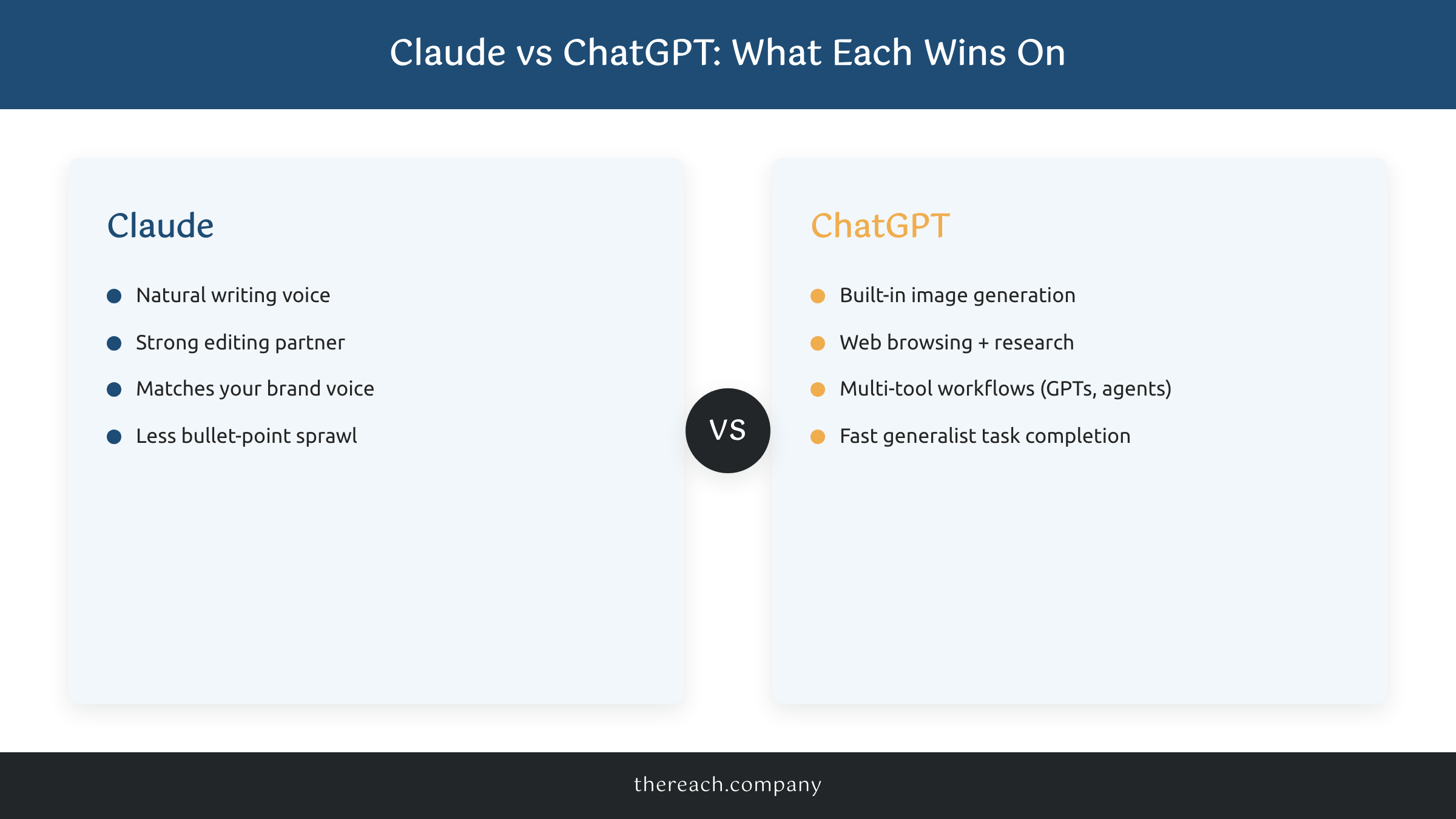
Claude is the better writing and editing partner. Per Zapier’s comparison, Claude’s newer model “sounds more natural” than OpenAI’s default output, and in my own experience that tracks: Claude’s first drafts read less like a corporate memo and more like something a person actually wrote. It’s also a genuinely better collaborator for iterating on a piece of writing, you can hand it a rough draft and a note like “make this sound more like me” and it holds onto that instruction better across a long editing session.
ChatGPT wins on breadth. It has image generation built directly into the chat (no separate tool, no separate subscription), it can browse the web for current information, and it plugs into a much wider ecosystem of custom GPTs and multi-step workflows. If your week looks like “pull competitor pricing, draft three ad variations, and mock up a quick graphic for Instagram,” ChatGPT is doing all three without you leaving the tab.
There’s also a practical difference in how each one handles a long-running project. Claude’s Projects feature lets you load your brand voice guide, past posts, and client notes once, then keep pulling from that same context across weeks of content without re-explaining yourself every time. ChatGPT’s custom GPTs work more like reusable mini-tools: build one for drafting client onboarding emails, another for turning a call transcript into a follow-up summary, and you’ve built yourself a small team of specialists you can hand off repeatable tasks to. Both are genuinely useful. They just solve different problems, one keeps your voice consistent over time, the other builds you a stable of narrow, repeatable helpers.
Neither one is “smarter.” They’re built for different jobs.
The Take a “Best AI Tool” Listicle Won’t Say
Here’s the rub. Every comparison piece treats this like a horse race with one winner, because a definitive “Claude wins” or “ChatGPT wins” headline gets more clicks than the honest answer. The honest answer is boring: the right tool depends entirely on which task eats the most of your actual week, not which one scores higher on a benchmark you’ll never see the results of.
If your business runs on proposals, blog content, and client-facing copy that has to sound like you and not like a template, the model that “wins more benchmarks” is irrelevant if its output needs a 40-minute rewrite every time. If your business runs on fast research and quick visual assets, the “more natural writer” is irrelevant if you’re stuck exporting to a separate image tool every time you need a graphic.
Most of the content ranking for “ChatGPT vs Claude” right now is written by people who use both tools to write about AI tools. It’s not written by a plumber, a med spa owner, or a consultant deciding where their actual $20 goes.
We see the same pattern everywhere else in marketing content, honestly. It’s the same reason “is SEO worth it” articles rarely name a real dollar figure, and “how much should I spend on ads” pieces rarely commit to an actual number. Vague answers are safer to write. They’re just not useful to you. If a piece of content can’t tell you which one to buy, it hasn’t actually helped you make a decision, it’s just given you more to read before you make the same decision you were going to make anyway.
The AHA Moment: Stop Thinking “Model,” Start Thinking “Employee”
Let that sink in. Let it really sink in: you’re not choosing between two versions of the same employee. You’re choosing between two different job descriptions.
Claude is the meticulous editor. Think of the person on your team who takes your rambling voice memo and turns it into a proposal that actually sounds like your business, who catches the sentence that reads a little stiff and fixes it without you asking. That’s the role Claude plays well.
ChatGPT is the fast generalist assistant. Think of the person who can jump from “research this competitor” to “draft five ad headlines” to “make me a quick graphic for the Facebook post” in the same 20-minute block, without needing to specialize in any one of those. That’s ChatGPT’s lane.
You wouldn’t hire one person to do both jobs at a real company, and you wouldn’t expect your best copywriter to also be your fastest researcher and your in-house designer. Stop expecting one $20/month subscription to be both.
It really depends on your business, and that’s not a cop-out, it’s the honest answer. A contractor who spends most of the week bidding jobs and writing follow-up texts has a very different “employee” need than a consultant who spends the week researching prospects and building slide decks. Neither is wrong. They just need a different hire.
The Objection: “I Don’t Have Time to Test Two AI Subscriptions”
Can I be honest? I fall short here all the time too, chasing the “better” tool instead of just picking one and getting to work. So here’s the shortcut, a two-minute self-audit instead of a month of A/B testing.
Ask yourself: in an average week, do you spend more hours writing and editing (proposals, blog posts, emails, brand voice work), or more hours researching and juggling different task types (competitor research, quick visuals, pulling information from the web)?
If it’s writing and editing, start with Claude. If it’s research and task-juggling, start with ChatGPT. Use the free tier of whichever one you didn’t pick for the occasional task that needs it. You don’t need a spreadsheet comparing every feature. You need to know your own week, and most business owners already do, they just haven’t matched it to the right tool yet.
Here’s the fastest version of the audit: pull up last week’s calendar. Count how many hours went into anything that ended in a document, a proposal, an email sequence, a blog draft, a set of ad headlines. Then count how many hours went into anything that started with a question you didn’t know the answer to yet, competitor research, market questions, “what does this even cost.” Whichever number is bigger tells you which employee to hire first. It takes five minutes and it’s more useful than any comparison chart.
Proof: What Happened When We Ran the Same Brief Through Both
Here’s the number that convinced me, and it’s not a case study from someone else, it’s from our own content pipeline at The Reach Company.
Last month, we ran the exact same client blog brief through both models: same prompt, same brand voice notes, same word count target. ChatGPT’s first draft needed roughly 40% of it rewritten before it matched the client’s actual voice, mostly killing the aggressively-bulleted, over-formatted output it defaults to and smoothing out sentences that read like a press release. Claude’s first draft needed closer to 15%, mostly trimming length and tightening a couple of transitions.
That’s the difference between a 20-minute edit and an hour-long one. Multiply that across every piece of content you write in a month, every proposal, every email sequence, every blog post, and that’s the real cost difference between the two tools. It’s not in the subscription price. It’s in the hours you get back or don’t.
We ran a second test on shorter-form work, a batch of Facebook ad headlines for the same client. This time the gap flipped. ChatGPT’s headline options were more varied and it generated five solid variations in one pass, useful when you want breadth fast. Claude’s headlines were more consistent in tone but less willing to swing for something punchy or unexpected. That’s the pattern worth remembering: Claude wins when the piece needs to sound like a specific person. ChatGPT wins when you need volume and variety fast and you’ll pick the best one yourself.

What to Do Instead: The Decision Matrix
Stop overthinking it. Here’s the actual matrix:
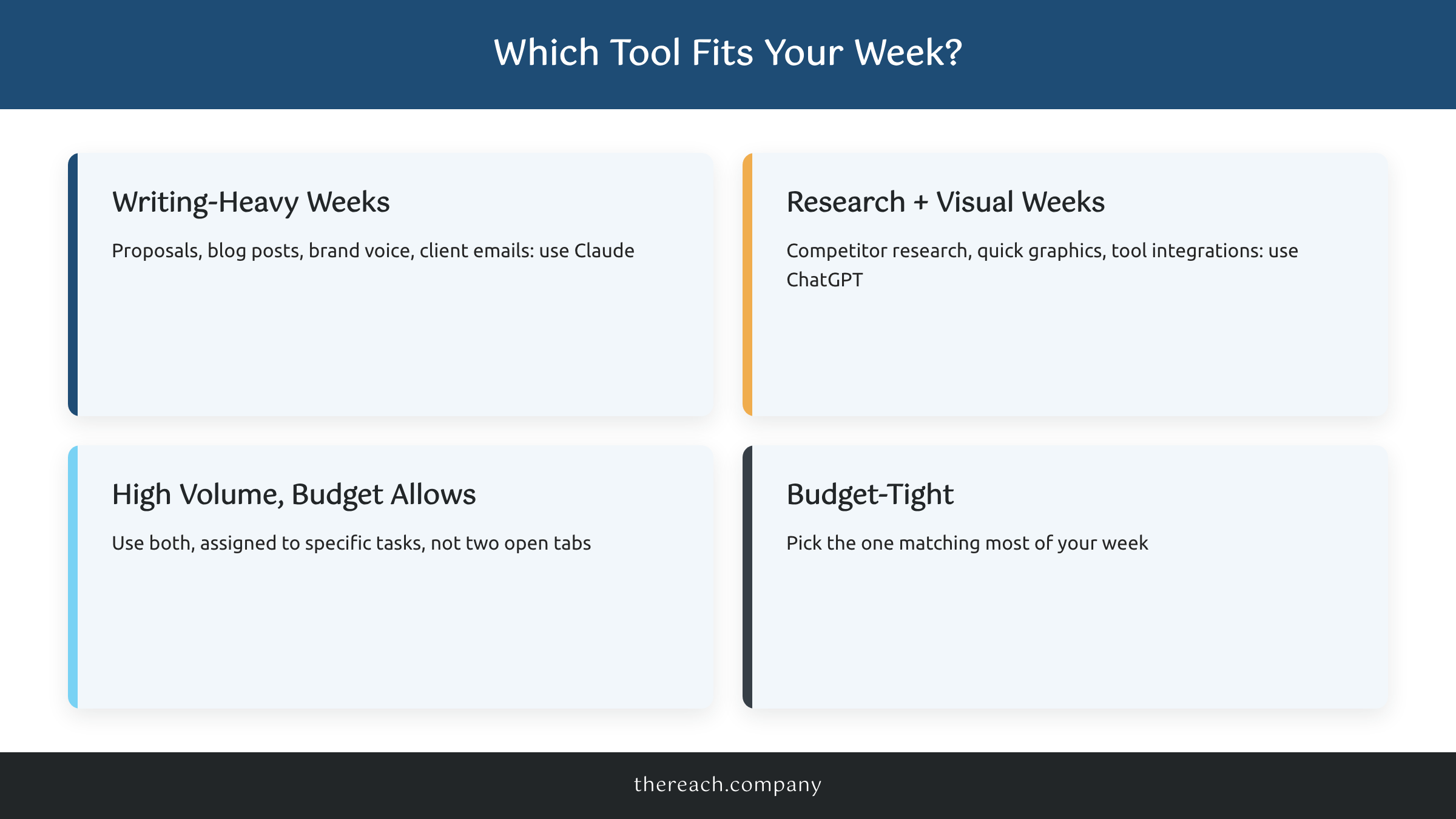
Writing-heavy weeks (proposals, blog posts, brand voice work, client emails) → Claude. It’s the better editor, and editing time is what you’re actually paying to save.
Research-heavy or visual-heavy weeks (competitor research, quick graphics, tool integrations, multi-step tasks) → ChatGPT. Its breadth wins here, and you’re not stitching together three separate tools.
High content volume and the budget allows it → Both, assigned to specific tasks, not both open in two browser tabs “just in case.” Draft in Claude, research and visuals in ChatGPT.
Budget is genuinely tight → Pick the one that matches the majority of your week and use the free tier of the other for the occasional outlier task.
One more thing worth saying plainly: neither tool replaces an actual marketing system. We build GoHighLevel automations for clients that handle lead follow-up, review requests, and appointment reminders, and AI drafts the messages inside that system, it doesn’t replace having the system in the first place. If you’re using ChatGPT or Claude to write emails that then sit in a spreadsheet nobody follows up on, the tool isn’t the problem. The missing system is.
If you’re trying to figure out where $20 a month, or a real marketing budget, should actually go this year, that’s exactly the kind of decision we walk through with clients, and we publish real numbers instead of “contact us for a quote” on our pricing page. And if you land on ChatGPT for your writing tasks, we’ve already covered the prompts and the paste-your-own-writing trick that fix ChatGPT’s robotic tone, so it doesn’t need that 40% rewrite in the first place.
FAQ
Do I need to pay for both? Only if your week genuinely splits between heavy writing and heavy research/visual work. Most service businesses lean one direction and can start with a single $20/month subscription.
Which one is better for SEO content specifically? Claude, in our experience, because SEO content still has to sound human to rank and convert, and Claude’s default output needs less de-robotifying before it’s ready to publish.
Can the free tiers actually work for a small business? For occasional use, yes. If you’re using AI daily as part of how you run your marketing, the $20/month tier pays for itself in saved editing time within the first week, based on the numbers above.
Can I switch later if I pick wrong? Yes, and you probably will end up switching at least once. Neither subscription locks you in, and most people land on the right tool only after a few weeks of noticing which one they keep reaching for. Don’t treat this as a permanent decision, treat it as a starting point.
What about other AI tools like Gemini or Perplexity? Worth knowing about, not worth starting with. For a service business just getting an AI workflow off the ground, ChatGPT and Claude cover the two jobs that matter most, writing and research/task-juggling. Add a specialist tool later once you know where the gaps actually are.
Conclusion
Same $20. Genuinely different jobs. Claude is the editor who makes your writing sound like you. ChatGPT is the generalist who juggles research, quick visuals, and fast tasks. The “best” one isn’t a benchmark score, it’s whichever job description matches your actual week.
Pick based on where your hours actually go, not on which app got the better headline this month. And if you want a second opinion on your ChatGPT prompting, or you want to see our full ChatGPT vs Claude breakdown alongside the other 11 tools we tested for small business marketing, that’s a good next stop. You got this.

