

Search for AI workflow automation small business advice and you’ll drown in webinars about “transforming your operations.” Skip all of it. You don’t need a transformation. You need six boring workflows that quietly hand you back eight or nine hours a week.
Can I shoot straight with you? The owners winning with AI right now aren’t the ones buying courses about it. They’re the ones who set up a text message that fires the second they miss a call, then went back to work. That’s it. That’s the whole trick.
This post walks through the six workflows we set up most often for service businesses: what each one does, the tools that run it, roughly how much time it hands back, and the order to build them in. No hype and no “AI strategy roadmap.” Just the stuff that pays for itself before your next invoice goes out.
The Real Problem: The Busywork Is Eating Your Week
You already know the list because you live it. Chasing leads who filled out a form three days ago. Answering the same five questions in your inbox. Texting appointment reminders from the truck. Meaning to ask that happy customer for a review and forgetting by dinner. Writing estimates at 9 PM because that’s the only quiet hour you get.
None of those tasks need you. Every one of them needs someone reliable. That distinction is the entire case for automation.
Here’s the rub: your competitors are already acting on it. Zapier’s business automation statistics roundup shows almost 60% of businesses have already implemented automation, and 9 out of 10 small businesses say they’re weighing AI and automation to stay competitive. The shops beating you to jobs aren’t smarter. They just stopped doing robot work by hand.
Run your own math. If busywork takes 90 minutes of your day, that’s over 8 hours a week. If your working hour is worth $75, you’re burning roughly $600 a week on tasks a $299/mo system handles without complaint. That’s the payback window this post’s title is talking about. Not a year. A week.
The 6 Workflows That Pay for Themselves in a Week
These are ranked by how fast they pay off. The first two touch leads directly, and leads are money.
1. Instant lead follow-up. Someone fills out your website form and gets a text back in under a minute: “Hey, this is Mike’s Plumbing. Got your request. What’s the best time to call?” We build this in GoHighLevel and it’s the single highest-ROI workflow on this list, because the first business to respond usually wins the job. If you only build one thing this week, build this. We wrote our full guide to automating your lead follow-up with AI if you want the step-by-step. Hands back about 2 hours a week and books jobs you were silently losing.
2. Missed-call text-back. You’re up a ladder, the phone rings, the caller gets voicemail and dials the next company. This workflow fires an automatic text the moment a call goes unanswered: “Sorry we missed you! How can we help?” Most callers reply, and now it’s a conversation instead of a lost job. About 1.5 hours a week saved on callback roulette, plus the jobs themselves.
3. Review requests on autopilot. Job marked complete, invoice paid, and 30 minutes later the customer gets a text with your Google review link. Reviews drive the Map Pack, and the Map Pack drives calls. Owners always plan to ask manually and almost never do. The robot never forgets. Roughly an hour a week, and the compounding SEO payoff is worth far more.
4. Appointment reminders. A text 24 hours out and another an hour out. No-shows drop immediately, and a single saved appointment covers a month of software. About an hour a week of confirmation texting, gone.
5. A chat widget that answers and books. Modern AI chat, trained on your actual services, prices, and service area, answers questions at 11 PM and books the caller straight into your calendar. This is not the useless “please hold for an agent” chat bubble of 2019. Set up well, it’s often indistinguishable from a sharp office manager. Around 2 hours a week of repeated Q&A, handled.
6. First drafts from Claude or ChatGPT. Estimates, follow-up emails, service descriptions, the works. Feed the tool your real details: services, prices, city, the way you actually talk. Then do a 15-minute editing pass so it sounds like you. Drafting from a solid first pass instead of a blank page saves about 1.5 hours a week, more if you write proposals.
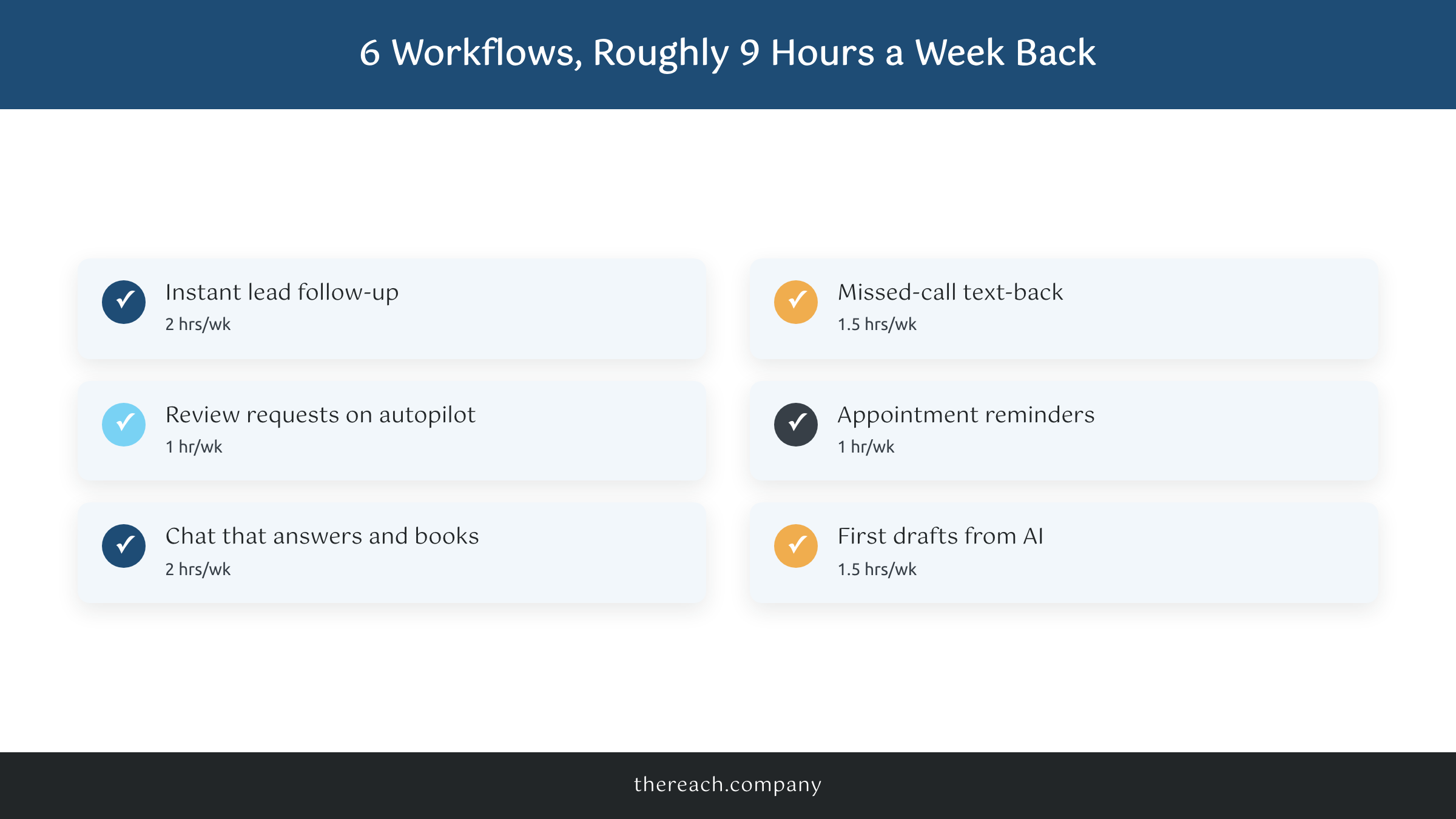
Add it up and you get roughly 9 hours a week back. That’s a full working day, every week, for less than the cost of one small job.
The Contrarian Truth: Boring Beats Impressive
The AI content you see online is obsessed with transformation. Agents running your whole company. “10x your business overnight.” Meanwhile the workflows above look almost embarrassingly simple, and that’s exactly why they work.
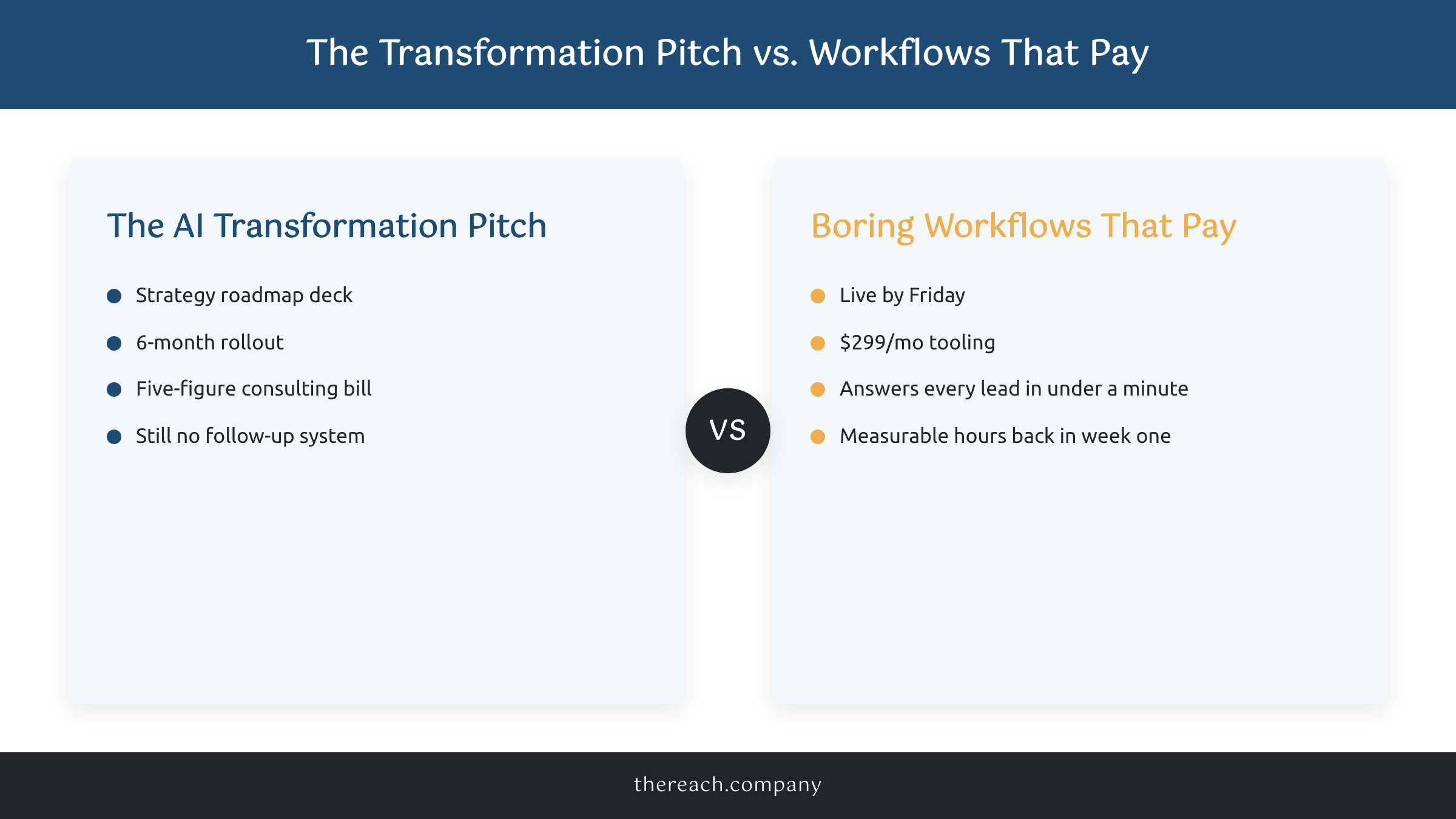
Think about the most profitable machine in any shop. It’s never the impressive one. It’s the one that runs every single day without complaint. Automation is the same. A text that fires in 60 seconds beats a five-figure “AI strategy engagement” that never ships.
To be clear, the technology is the real deal. We use AI every day and it does serious work. The problem is the sales pitch wrapped around it: hype merchants selling transformation roadmaps to owners who don’t yet have a follow-up system. That’s the whole point of AI workflow automation small business owners can actually run. It works while you’re up a ladder, and it was live by Friday.
Proof: What This Looks Like in a Real Business
Chin Up Aesthetics, a medspa client of ours, pulled 1,928 leads from their website in a single year. Every one of those leads got an instant, automatic reply. Nobody at the front desk was copy-pasting texts at midnight. The same engine handled the 1,300+ leads their Facebook ads generated. The staff’s job was showing up to conversations the system had already started.
And it’s not just clients. This business runs on the same playbook: AI-drafted content with a human editing pass, automated lead follow-up, automated review requests. We sell what we use. Plain and simple.
How to Set This Up Without Losing a Weekend
Build in this order: workflows 1 and 2 first, because they touch leads and pay off the same week. Then 3 and 4, the retention pair. Then 5 and 6 once the basics hum.
On tools: GoHighLevel runs workflows 1 through 5 from one dashboard, which is why it’s the backbone of the lead generation system we build on GoHighLevel for clients at $299/mo. Claude or ChatGPT covers workflow 6 for about $20/mo. If you’re stitching other apps together, Zapier or n8n handles the in-between glue. And if you want the honest tool-shopping rundown first, read our no-hype buyer’s guide to marketing automation tools.
You can absolutely DIY this over a couple of evenings. Or we set the whole thing up, tailored to how your business actually operates, and you just watch the follow-ups go out. Either way, stop doing robot work by hand. You got this. And if you’d rather hand this hat to someone else, we got you too.
Curious where “workflow” ends and “agent” begins? We demystified AI agents for business, what they actually are, and why you probably want a workflow first anyway.

