
Nobody opens Facebook to find a plumber.
That's the standard argument against Facebook ads for home services, and honestly, it's half right. When a pipe bursts at 9 PM, your customer is on Google, not scrolling Reels. So why do some home service businesses pull hundreds of leads a month off Facebook while others torch $2,000 and swear off the platform forever?
The difference is math. Not vibes, not "brand awareness." Math.
I run ads for service businesses every week at The Reach Company, and I've watched Facebook print money for one company and burn it for the next one in the same trade. The variable is almost never the platform. It's whether the numbers were ever going to work in the first place, and whether anybody was answering the leads.
So let's do the real math on Facebook ads for home services: what a lead actually costs right now, what the platform is genuinely good at, where the money leaks out, and how to know if it's the right move for your business this year.
Nobody Searches Facebook for a Plumber (And That's the Point)
Google and Facebook do two completely different jobs.
Google captures demand. Someone types "water heater replacement near me," sees your ad, and calls. The intent already exists; you're just standing where it's pointed. That's also why search clicks cost so much. You're paying a premium for someone who already wants the thing.
Facebook creates demand. Nobody's searching, but your ideal customer is there 30 minutes a day, scrolling past photos of their kid's soccer game. Your ad interrupts. Which means Facebook is terrible at emergencies and surprisingly good at everything people put off: the roof that's 22 years old, the AC limping through one more summer, the bathroom remodel they've been "planning" since 2023.
Think of it like fishing. Google is casting where the fish are already biting. Facebook is chumming the water. Both can fill the boat. They just don't work the same way, and the budget math is different for each. If you're deciding where your first ad dollar should go, I broke down that exact decision in SEO vs Google Ads: which one deserves your first dollar.
Here's the rub: most home service businesses run Facebook ads like they're Google ads. Same "call now" messaging, same expectation of ready-to-buy leads, then disappointment when the leads need warming up. The platform didn't fail. The plan did.
The Actual Numbers: What a Facebook Lead Costs in Home Services
Let's put real figures on the table.
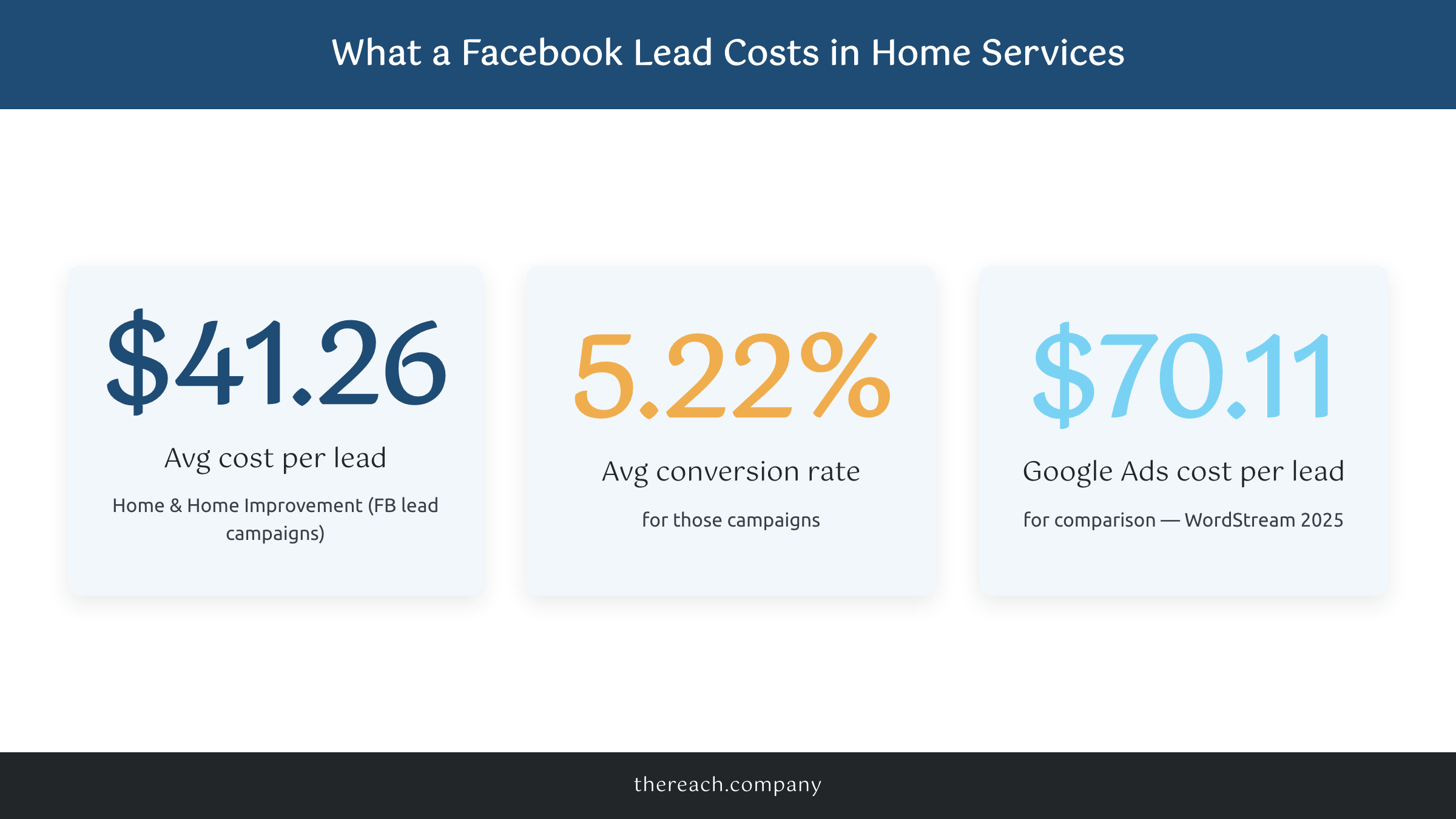
WordStream's Facebook ads benchmarks report, built from over 1,000 US campaigns, puts the average cost per lead for Home & Home Improvement lead campaigns at $41.26, with a 5.22% conversion rate and a $2.23 cost per click. The all-industry average is $27.66, so home services runs pricier than most. And that number jumped about 21% year over year. The "Facebook leads are basically free" era is over.
Before you wince at $41, look at the comparison: the same dataset puts the average Google Ads cost per lead at $70.11. Facebook is still the cheaper place to manufacture a lead. The catch is lead quality, and we'll get to that.
Now the math that actually matters. Say you spend $1,000 a month:
$1,000 divided by a $41.26 cost per lead gets you roughly 24 leads. Close 1 in 5, which is realistic with decent follow-up, and that's about 5 jobs. You paid roughly $200 in ad cost per job.
If your average job is a $350 drain cleaning, that math is tight and probably not worth the headache. If your average ticket is a $9,000 roof or a $6,500 HVAC replacement, $200 to acquire a job is a steal. Plain and simple.
That's the secret nobody puts in the pitch deck: Facebook ads work when your job value covers your true cost per JOB, not cost per lead. Run your own numbers before you spend a dollar. Average ticket, realistic close rate, $41-ish per lead. Five minutes with a calculator beats three months of "testing."
The Leads Aren't the Problem. The First 5 Minutes Are.
Can I shoot straight with you? Most "Facebook ads don't work" stories I hear aren't ad problems. They're follow-up problems.
A Facebook lead is not a Google lead. The Google caller has a flooded basement and a phone in their hand. The Facebook lead tapped a form during a commercial break and went back to their show. They're interested, not desperate. Which means they cool off fast. Reach them in 5 minutes and you'll probably book the estimate. Reach them tomorrow and they barely remember filling out the form.
I've watched this kill more campaigns than bad targeting, bad creative, and bad budgets combined. The owner spends $1,500, gets 35 leads, calls them back "when things slow down," books 2 jobs, and concludes Facebook is garbage. The ads did their job. The leads sat in an inbox and died.
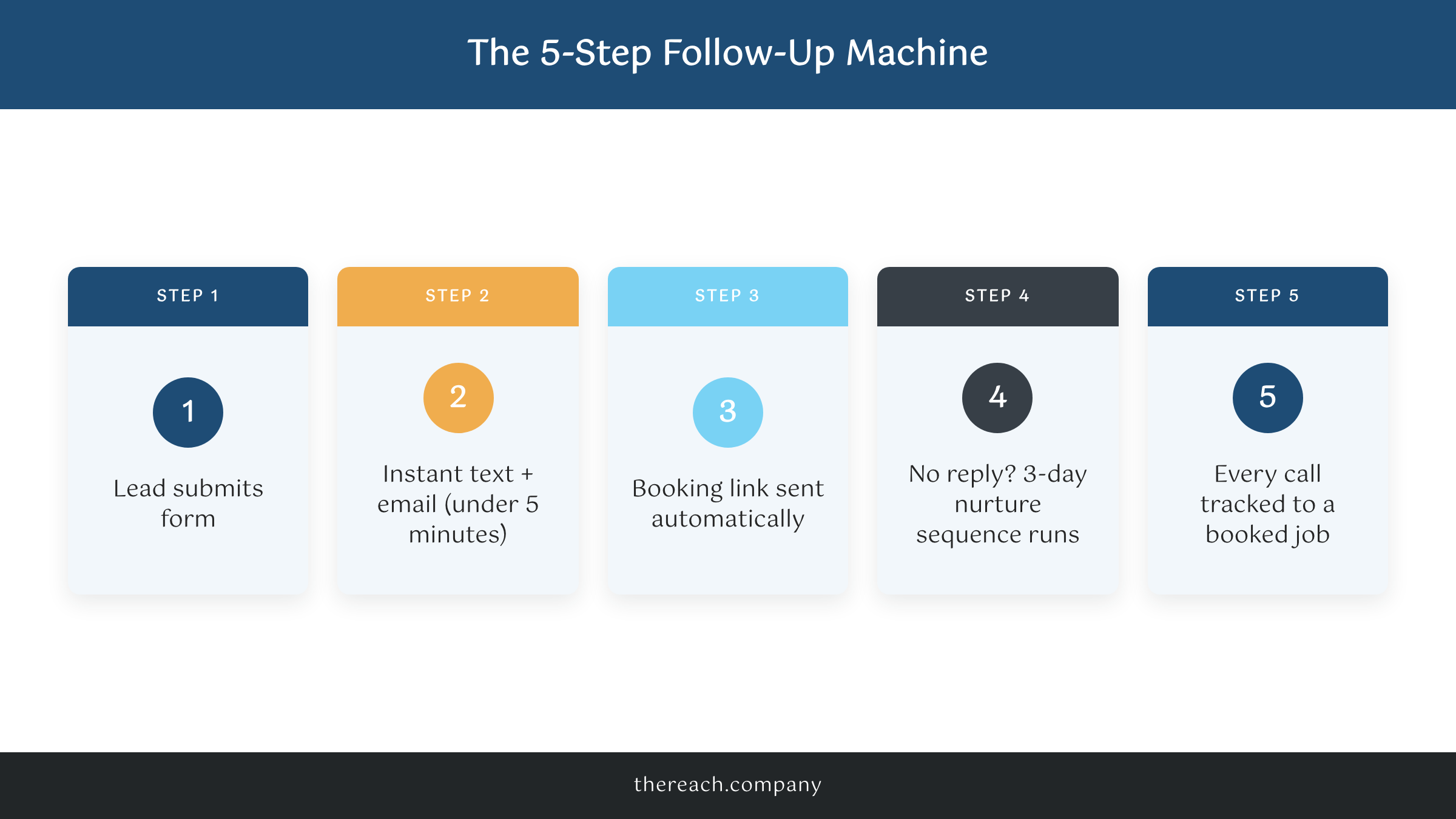
This is exactly why we build follow-up automation into every lead campaign we run at The Reach Company. The second a form comes in, the lead gets a text and an email with a booking link, the office gets pinged, and if there's no reply, a short nurture sequence runs over the next few days. GoHighLevel handles all of it automatically. Nobody has to "remember" anything.
If you fix nothing else about your marketing this quarter, fix speed-to-lead. It's the highest-ROI repair in this entire industry, and it costs less than one wasted ad campaign.
What This Looks Like When It Works
We ran Facebook ads for Chin Up Aesthetics, an Atlanta-area medspa. Not a home service business, but the exact same playbook: local service area, real ticket values, automated follow-up. The result was 1,300+ leads from Facebook ads, feeding a website system that generated 1,928 leads in a single year.
Another client, The Unstuck Group, saw qualified leads come in under $2 each and a 29:1 return on one Facebook campaign. Different industry, same math: a clear offer, a matched audience, and follow-up that never let a lead rot.
And here's the encouraging part for the trades: roofers, HVAC companies, and remodelers have an easier version of this math than a medspa selling $300 treatments. Your jobs are worth thousands. You can afford a $41 lead. What you can't afford is ignoring 24 of them a month.
How to Make the Math Work (5 Moves)
If you're going to run Facebook ads for your home service business, here's the setup, in order:
1. Run the math first. Average ticket times a realistic close rate, against roughly $41 per lead. If the cost per job doesn't clear comfortably, fix your offer or your prices before you touch Ads Manager.
2. Lead with an offer, not your logo. "$89 AC tune-up before summer" stops a thumb. "Smith & Sons HVAC, serving the metro since 1987" does not. Facebook is an interruption platform; give people a reason to be interrupted.
3. Use lead forms, but add a little friction. Instant forms convert cheap, sometimes too cheap. One qualifying question ("Is this for a repair or a replacement?") filters the tire kickers and raises the quality of everything that comes through.
4. Build the follow-up machine before you launch. Instant text plus email, a booking link, and an automated nurture for non-responders. This is the third leg of the lead generation system we build for service businesses, and it's the difference between 24 leads and 5 booked jobs versus 24 leads and an awkward spreadsheet.
5. Track to jobs, not leads. Leads are a vanity metric until they close. Call tracking plus a simple pipeline (we use CallRail feeding GoHighLevel) tells you which campaign produced revenue, not just form fills.
So, Should You Run Them?
Facebook ads for home services work when the math works: a job value that covers roughly $200 per acquired job, an offer worth stopping for, and follow-up measured in minutes, not days. They fail when any one of those three is missing, and no amount of "better targeting" rescues a campaign with a broken back end.
Run your numbers. If they clear, Facebook is still the cheapest demand machine available to a local service business in 2026. If you'd rather have the whole system built for you, the ads, the follow-up, and the tracking, that's literally what we do. The finish line is a lot closer than it feels. Promise.
Running Meta specifically? Here are 3 guardrails to put on Facebook Ads before you let the AI run wide.
If you’re weighing paid channels against building your own pipeline, here’s our full guide to lead generation for HVAC companies.

