

You finally looked at the numbers. 500 people visited your website last month, and 10 of them reached out. That’s 2%. And now you’re standing there wondering if that’s a win or a slow leak.
Can I shoot straight with you? Most of the answers you’ll find online are useless. They quote “industry averages” from surveys older than your work truck. So let’s do this right. What is a good website conversion rate for a small business? The honest answer starts with “it really depends,” but that’s not a dodge. By the end of this post you’ll know the real benchmarks from 57 million actual conversions, where your number sits, and the five fixes that move it the most.
And here’s the part nobody tells you: the number itself matters less than what you do about it. We’ll get there.
Most Owners Are Guessing (Here’s the Math)
Before we talk benchmarks, let’s make sure we’re measuring the same thing. Your conversion rate is simple division:
Conversions divided by visitors equals your conversion rate.
If 500 people visit and 10 fill out your form, that’s 10 divided by 500, which is 2%. Easy peasy.
The tricky part is deciding what counts as a conversion. For a service business, count the actions that put a real human in your pipeline: a phone call, a form fill, a web chat started, an appointment booked. That’s it. Time on site is not a conversion. Traffic is not a conversion. A thousand visitors who never call you is just a crowd walking past your shop window.
When I audit sites, most owners can tell me their traffic and almost none can tell me their conversion rate. That’s backwards. Traffic tells you how many people showed up. Conversion tells you whether the website did its job. If yours is collecting visitors but not leads, we wrote a whole diagnosis on why your small business website isn’t getting leads.
The Real Benchmarks (From 57 Million Conversions)
Now the numbers. Unbounce, the landing page software company, analyzed 41,000 landing pages, 464 million visitors, and 57 million conversions in its Conversion Benchmark Report. The median conversion rate across all industries: 6.6%. Their general rule: 10% or above is a good conversion rate.
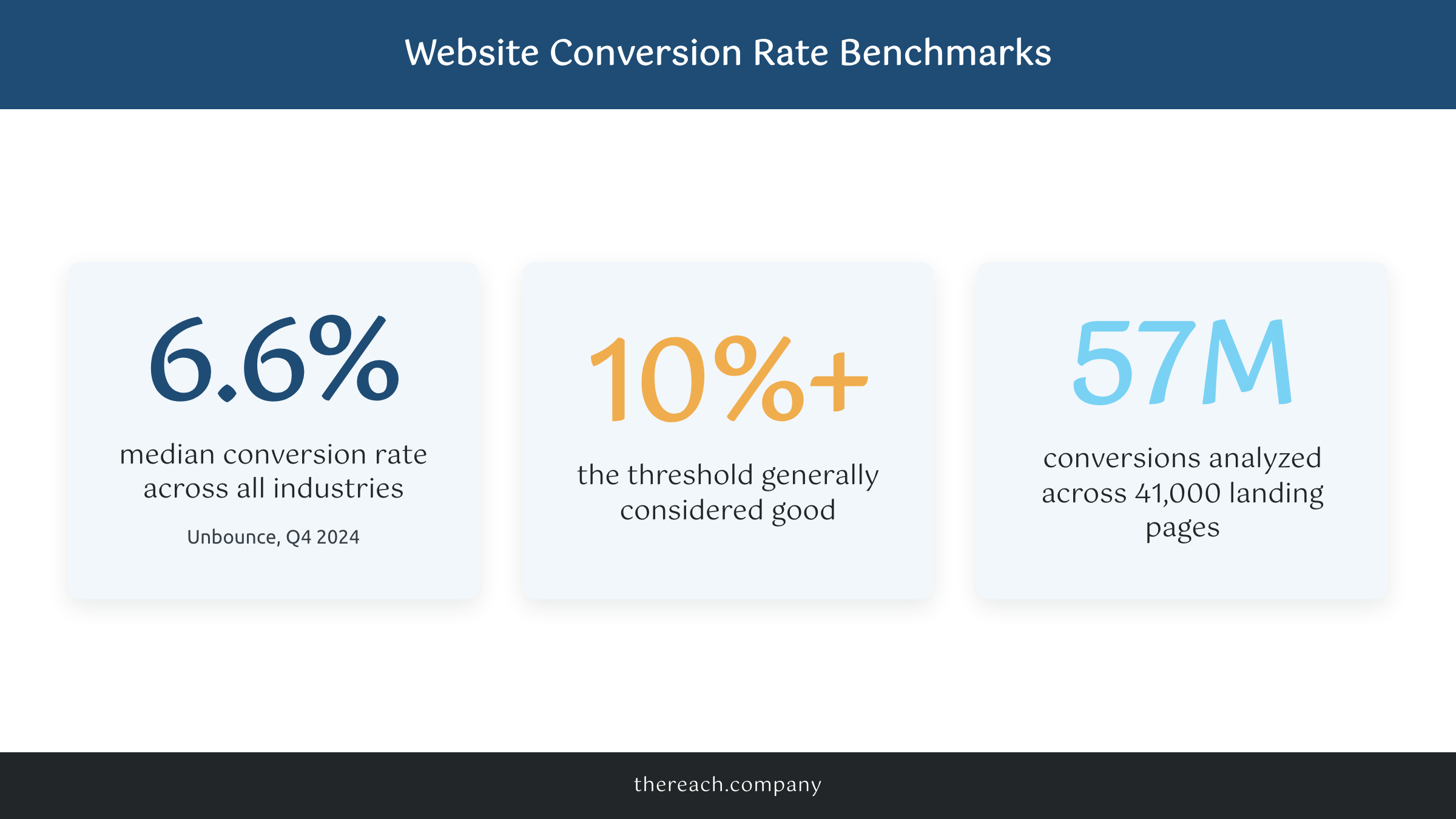
Before you panic about your 2%, read the fine print. Those numbers come from dedicated landing pages: single pages built for one offer, usually with paid traffic behind them. Your full website is a different animal. It catches everything from “plumber near me” emergencies to your cousin checking if your site looks nice. Whole-site conversion rates run meaningfully lower than landing page rates, and for most service businesses, a site converting between 2% and 5% is in the normal band, not broken.
Context changes the verdict too, and Unbounce’s own data makes the point: the same 5% rate is weak for a newsletter signup page and excellent for a page selling a $10,000 service. A kitchen remodeler converting 3% of visitors into estimate requests is doing great math, because one job pays for the whole year of marketing. A gym converting 3% into trial signups has work to do.
So what is a good website conversion rate? For a service business site: 2% to 5% is normal, 5% to 10% is strong, and above 10% means your website is doing sales-team work while you sleep. Nerdy bliss.
Your Conversion Rate Is Worth More Than Your Traffic
Here’s the rub. When owners see weak lead numbers, their first instinct is almost always “I need more traffic.” More SEO, more ads, more posts. And they skip right past the cheaper, faster lever.
Your website is a bucket. Traffic is the water. If the bucket leaks 98 of every 100 gallons, pouring faster is an expensive way to stay thirsty.
Run the math with me. Say you get 500 visitors a month:
- At 2%, that’s 10 leads.
- At 6%, that’s 30 leads. Same traffic. Same ad spend. Three times the leads.
Getting to 30 leads the other way means tripling your traffic, and tripling traffic means tripling your ad budget or waiting most of a year for SEO to compound. Fixing the page is a one-time project that pays you every single month after.
This is why we keep saying your website should be a lead machine instead of a digital brochure. A brochure gets admired. A machine gets you paid. Improving conversion is the highest-ROI project most small businesses never get around to.
Let that sink in. Let it really sink in.
What This Looks Like When It Works
These aren’t hypotheticals. Chin Up Aesthetics, a medspa we work with in Atlanta, pulled 1,928 leads from their website in one year. Not visits. Leads: real people with names and phone numbers asking about treatments.
The Jewish Education Loan Fund, a client of nearly five years, saw a 54% conversion increase after we rebuilt how their site captured interest, and their first online event converted 52% of registrants.
Neither of those results came from a lucky template. Both sites give every page one clear job, make contact stupid-easy, and answer new leads fast enough that nobody wanders off to a competitor. Which brings us to the fixes.
The Fixes That Actually Move the Number
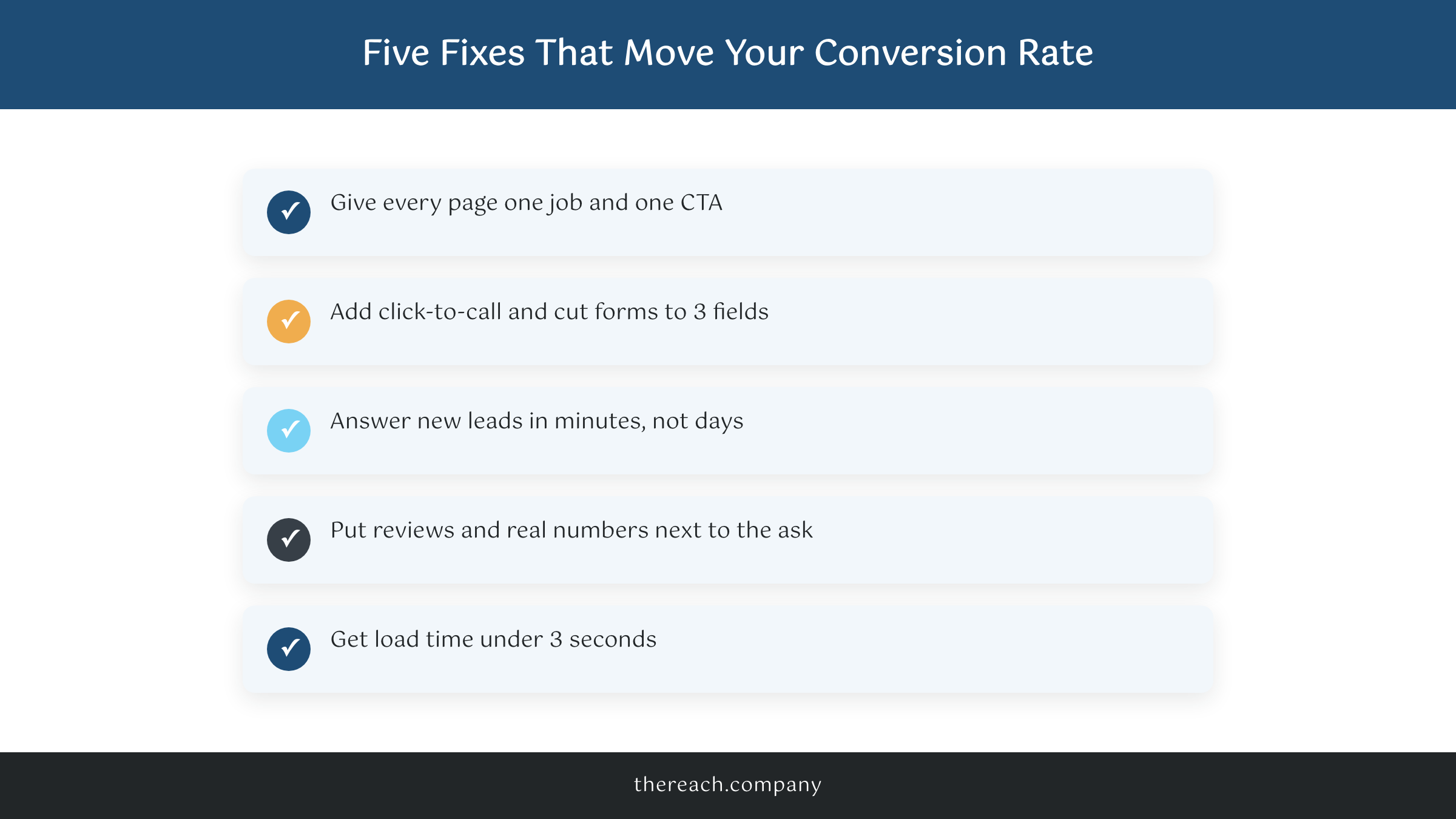
You don’t need a full redesign to move from 2% to 5%. You need these five things, in this order.
- Give every page one job. Your homepage has one goal: get the visitor to reach out. Kill the wall of links, pick one primary call to action, and repeat it down the page. When a page asks for five things, it gets zero.
- Make contact stupid-easy. Click-to-call button visible on mobile. Forms cut to three fields: name, phone, what do you need. Every field you add is a percentage of leads you volunteer to lose.
- Answer in minutes, not days. This is the one nobody talks about in benchmark articles. A form fill at 2 PM that gets a reply at 2 PM Thursday is not a lead, it’s a missed call. This is exactly why the lead generation system we build on GoHighLevel answers web chats and form fills automatically within seconds, then texts the owner. It runs $299/mo and it’s the difference between capturing demand and renting a pretty brochure.
- Put proof next to the ask. Reviews, before-and-afters, real numbers, right beside the form. Just like you can spot BS a mile away, so can your visitors. Proof closes the gap between interested and convinced.
- Get your load time under 3 seconds. Slow pages bleed visitors before your headline loads. A caching plugin like WP Rocket plus compressed images fixes most of it in an afternoon.
Do those five and re-measure in 30 days. Every point of conversion you gain is pure margin: same traffic bill, more booked work.
Measure It This Week
Here’s your homework, and it takes ten minutes. Pull last month’s visitors from your analytics. Count last month’s calls, forms, and chats. Divide. That’s your number.
So in the end, what is a good website conversion rate? One you actually know, and one that beat last month. If you’re at 2% to 5%, you’re normal, and the five fixes above will push you toward strong. If you’re under 1%, your website is costing you jobs every single week, and that’s worth fixing before you spend another dollar on ads.
And if you’d rather have someone who does this every day look at it with you, that’s literally what we do. We’ll tell you what’s working, what’s leaking, and what we’d fix first. No pressure, no slicked-back-hair sales pitch. You got this. And if you want a hand, we got you too.

