
If you’ve spent more than 10 minutes Googling this question, you already know the answer everyone gives. “5 to 20% of revenue.” HubSpot says it. Neil Patel says it. Every agency blog says it. The SBA says it. Your buddy who took a marketing class in 2014 says it.
Can I shoot straight with you? That answer is useless.
It’s useless because a $500,000-a-year plumber and a $500,000-a-year bookkeeper don’t need the same marketing. It’s useless because “10% of revenue” for a roofer doing storm-restoration work and “10% of revenue” for a wedding photographer are doing two completely different jobs. And it’s useless because nobody — not one of those blogs — tells you what those dollars actually buy. They give you a percentage and then send you to a Calendly link with a sales rep.
That’s not what we do. So in this post, I’m going to do something almost nobody else does: name real dollar amounts for every piece of a service business’s marketing budget in 2026. Website. SEO. Ads. CRM. The whole stack. With real prices, real ranges, and what each tier of spending actually gets you.
This is for the service business owner — the contractor, the dentist, the consultant, the studio owner, the accountant, the medspa, the law firm, the home-services pro — who’s tired of being told “it depends” by people who get paid more when you spend more.
Let’s get into it.
Why “Percent of Revenue” Is the Lazy Answer
The 5-to-20% rule isn’t wrong, exactly. It’s just shaped like a useful answer without being one.
Here’s what’s missing when somebody throws a percentage at you:
- It doesn’t tell you which channels to spend on.
- It doesn’t tell you what each channel actually costs to do well.
- It doesn’t tell you whether you’re early-stage (need leads now) or established (need a moat).
- It doesn’t tell you if you’re in a high-CPC industry where Google Ads costs $40 a click or a low-CPC one where it’s $4.
- It doesn’t tell you what the ceiling is — when more spending is just lighting money on fire.
A roofer in Atlanta competing for “roof replacement” might spend $8,000 a month on Google Ads alone and still be underspending. A bookkeeper in a small town might spend $500 a month total and have all the leads they can handle. Both might do $750K in revenue. The “percent of revenue” answer is the same. The actual right move is wildly different.
The honest version of the question isn’t “what percent of my revenue should I spend.” It’s:
What does it cost to get in front of the right people, get them on my website, convert them into a lead, and follow up until they buy?
That’s an actual question. And it has actual numbers behind it.
The Real Question: What Are You Trying to Buy?
Before we name dollar amounts, let me give you the framework I use with every client we audit at The Reach Company. Every dollar of digital marketing spend buys you one of four things:
- A platform that converts — your website. The thing prospects land on when they’re considering you.
- Visibility on Google — SEO. Showing up when somebody searches your service in your city.
- Paid attention — ads. Google, Meta, sometimes LinkedIn. Buying eyeballs you can’t earn fast enough.
- Follow-up that closes — your CRM, your email/SMS, your automation. Turning leads into appointments and appointments into clients.
That’s it. That’s the whole stack for a service business. Caveats: Ya, truck wraps for foundation companies and business cards and signage are marketing, but that’s not my lane. We are talking about digital marketing on an ongoing basis.
If a marketing dollar isn’t paying for one of those four things, you’re either spending on something that doesn’t move the needle (logo refresh, “brand awareness” billboards, the boost button) or you’re spending on something that’s not your bottleneck.
So when we talk about “how much should I spend,” what we’re really doing is pricing each of those four things. Then we’re stacking them in a tier that matches your stage of business.
Here’s the gist: every service business needs all four. The only question is what tier you can afford to run each at this year.
What Each Bucket Actually Costs in 2026
Let me name real dollar ranges. These are the prices I see every day — what we charge, what our competitors charge, what the major platforms cost. No “it depends” answers.
Bucket 1: Your Website
A website is the single piece of your marketing that has to work even when you’re sleeping. It’s also the piece most service businesses underinvest in and then wonder why their ads don’t convert.
Here’s what I see in 2026:
- DIY on Wix, Squarespace, or GoDaddy: $20-$40/mo. You’ll build it yourself in a weekend. It will look fine. It will not be built to convert leads. It won’t be fast. It won’t rank. It’s a digital business card. Fine if you’re a side hustle. Not fine if marketing has to pay your mortgage.
- DIY WordPress with a theme: $20-$50/mo for hosting plus your time. Slightly more flexible. Same fundamental problem — you’re trying to build a sales asset using tools meant for hobbyists.
- A done-for-you template site from a freelancer: $1,500-$4,000 one-time. This is where most small businesses land. Looks decent. Has the basic pages. The freelancer is gone the day after you pay the final invoice. No conversion strategy baked in. Updates? Speed? Security? On you.
- A custom-built conversion-focused website from an agency: $5,000-$25,000+ one-time, plus $99-$500/mo for hosting + maintenance + updates. This is what your actual competitors are running if they’re closing real volume.
- The Reach Co model — custom site built for conversion, hosted/maintained on enterprise infrastructure, ongoing optimization: Starts at $299/mo. Yeah, the number’s right. We rolled site, hosting, security, speed, and ongoing tweaks into one number because every other model in the market punishes you for needing things to keep working.
The reason a website matters this much: every other dollar you spend points to it. If your website doesn’t convert, your ads don’t pay back, your SEO traffic bounces, and your CRM has nothing to follow up on. Plain and simple.
Bucket 2: SEO
SEO is the most over-promised, under-delivered marketing channel in small business. It’s also the one with the highest long-term ROI when you actually do it right.
Here’s the real cost picture:
- DIY SEO with free tools: $0/mo plus 10-15 hours of your time per month. You can rank a small local business doing this if you’re patient and disciplined. Most people aren’t. Six months in, they quit.
- SEO software stack (Ahrefs, Semrush, Surfer): $200-$500/mo. Tools alone do nothing. You still need to use them. They’re expensive paperweights without strategy and execution.
- A “$300/mo SEO package” from a Pakistan/India shop: $300/mo. I’m being polite. This is almost always trash. Spam links, keyword-stuffed garbage, and a monthly report full of metrics that don’t matter. You’ll get worse, not better.
- A real local SEO retainer with a U.S. agency: $1,500-$5,000/mo. This is where the work actually gets done — content, on-page optimization, Google Business Profile management, review strategy, link building, technical SEO.
- The Reach Co local SEO model: $2,480/mo. Specific number because we built it backwards from “what does it actually take to rank a service business in their city.” That’s the real cost. We’re not the cheapest. We’re not even close to the most expensive. We’re the number that actually works.
If you’re paying less than $1,500/mo and you’re not doing it yourself, you’re not really doing SEO. You’re paying somebody to look like they’re doing SEO. There’s a difference, and the SERPs will tell on them eventually.
Bucket 3: Paid Ads
Ads are where the most money gets wasted, fastest. They’re also where the most leads get created, fastest. Both are true.
Here’s what 2026 looks like:
- Boosting Facebook posts with no strategy: $200-$2,000/mo. Heck naw. The boost button is the single biggest waste of marketing dollars in small business. It optimizes for engagement, not leads. You will get likes from people who will never buy from you.
- Google Ads, DIY, run from your phone: $500-$5,000/mo. The CPC depends entirely on your industry. Plumbing emergencies in Atlanta? $40+ a click. Bookkeeping in a small town? $4-$8. Either way, DIY Google Ads almost always loses money in the first 90 days because you’re paying for clicks while you’re learning.
- Meta Ads (Facebook + Instagram), DIY: $500-$3,000/mo. Lower CPC, harder to attribute, easier to waste money on creative that doesn’t convert.
- Local Services Ads (LSAs) for eligible categories: $50-$300 per lead, paid only when somebody contacts you. If you’re a plumber, electrician, HVAC, lawyer, real estate, locksmith, or one of the other LSA-eligible categories, this is the cheapest “show up at the top of Google” play right now.
- Ad management retainer from an agency: $500-$2,500/mo on top of your ad spend. This is the management fee. Your ad spend is separate. So a “$1,000/mo ad management” client might be spending $3,000 on ads + $1,000 on management = $4,000/mo total.
- The Reach Co ad management: starts at $500/mo management on $1,500+/mo ad spend. Total monthly investment for ads done right typically lands at $2,000-$5,000/mo depending on your market.
Here’s the rub: ads work the day you turn them on, and they stop working the day you turn them off. They’re rented attention. SEO is owned attention. You need both, but only one builds equity in the long run. That’s why the smartest spend is ads-while-SEO-cooks, then ads-as-acceleration-not-foundation.
Bucket 4: CRM, Follow-Up, and Automation
This is the bucket nobody talks about and it’s the one that actually decides whether your other spend pays back.
Here’s the math: if your website generates 100 leads a month and you only follow up with 30 of them — because the other 70 came in at 9pm and your front desk closes at 5 — you just lit 70% of your marketing spend on fire. Doesn’t matter how good your ads are. Doesn’t matter how high you rank. The money is in the list, and the list only matters if you’re working it.
What it costs in 2026:
- Free options (Google Forms + Gmail + a calendar): $0/mo. Works if you have 10 leads a month. Falls apart at 30. By 50, you’re losing real revenue.
- Mailchimp + Calendly + a manual handoff: $50-$150/mo. Better than nothing. Still mostly manual. The team has to remember to follow up.
- HubSpot, ActiveCampaign, or Keap: $100-$1,000+/mo. Real CRM. Real automation. Steep learning curve. Often over-built for a service business under $5M.
- GoHighLevel (what we run): $99-$497/mo direct from GHL. This is the all-in-one we use for The Lead System. It rolls CRM, SMS, email, calendar, automation, pipelines, and a customer dashboard into one tool.
- The Reach Co Lead System (GHL + setup + automation built for your business): $299/mo plus setup. Same number as our website tier. Specific because that’s the price point that pays for itself the moment you stop losing leads to “I’ll call them tomorrow.”
If you’re spending money on ads and SEO and your CRM is “I check my email when I have time,” you’re not running a marketing system. You’re running a marketing experiment.
The Four Real Tiers of Small Business Marketing Spend
Now we can stack the buckets and look at what each tier actually costs per month. These aren’t theoretical. These are the four conversations I have with new prospects every week.
Tier 1: Survival — $500/mo total
For: brand-new business, side hustle, sub-$100K revenue, zero marketing in place.
- Website: DIY Wix or Squarespace ($30/mo)
- SEO: DIY using free Google Business Profile + writing one blog post a month ($0)
- Ads: $300-$400/mo on Google Ads or LSAs in your service area
- CRM: Free Google Forms + Gmail follow-up ($0)
- Tools: Canva free, that’s about it
What this buys: A handful of leads. A web presence that exists. You’ll book some work. You will hit a ceiling fast — usually around the point where you can’t follow up with everything that comes in, or your DIY site stops converting because it was built without a conversion strategy.
This tier is fine if you’re under $100K revenue and figuring out if the business even has demand. Don’t try to scale a business at this tier. You can’t.
Tier 2: Foundation — $1,500/mo total
For: established service business doing $100K-$500K, ready to actually get serious.
- Website: $299/mo for a custom conversion-focused site with hosting + maintenance bundled
- SEO: $0 — you’re not doing it yet, focus your dollars on ads and CRM first
- Ads: $1,000/mo on Google or LSAs (or $500 ads + $500 management)
- CRM: $200/mo on a basic GHL plan or ActiveCampaign
- Tools: Canva Pro ($15)
What this buys: A site that actually converts. Steady lead flow from ads. Real follow-up that doesn’t depend on you remembering. You can start to predict your month. You can take a vacation without the leads stopping.
This is the floor for a real marketing system. Below this, you’re guessing. At this tier, you can scale.
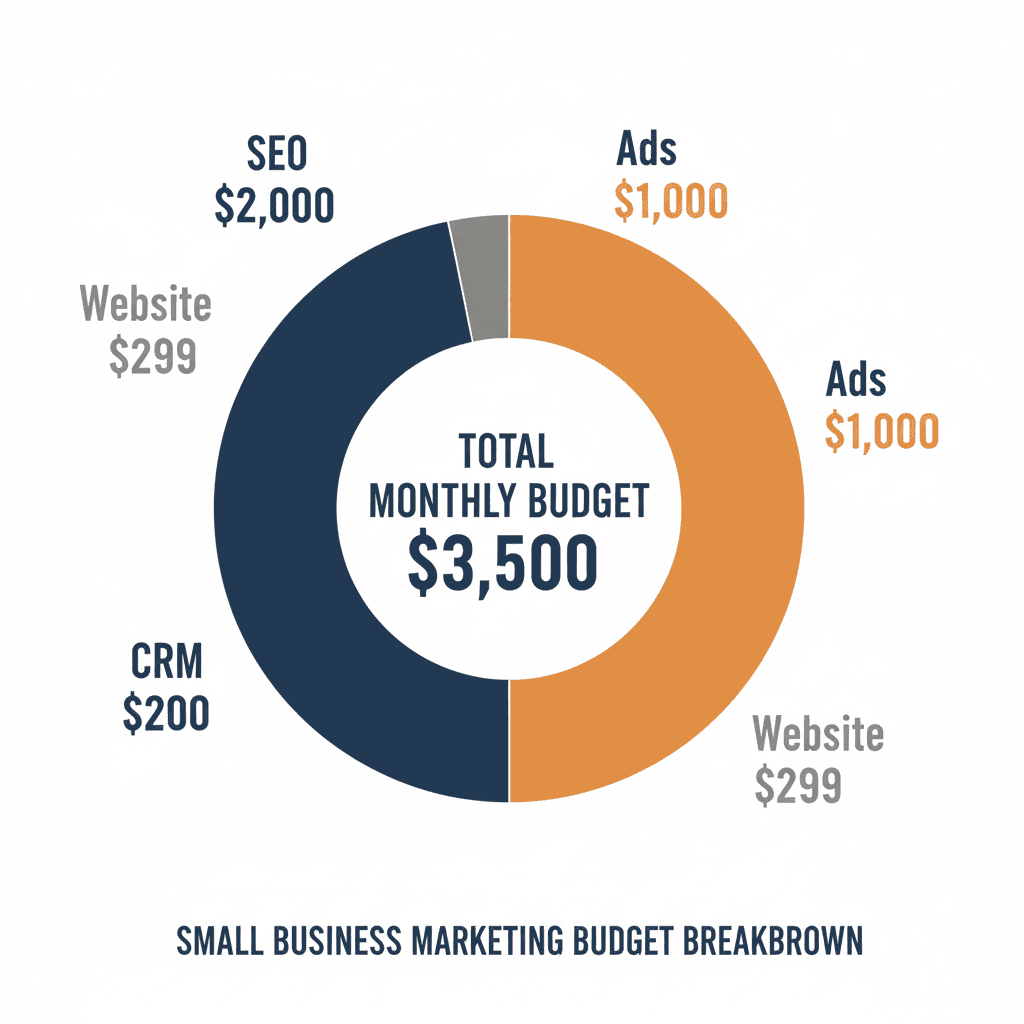
Tier 3: Working — $3,500/mo total
For: $500K-$1.5M revenue, marketing is the biggest growth lever, you’re tired of “it should pick up next quarter.”
- Website: $299/mo (or one-time $5,000+ custom build, then $99-$199/mo maintenance)
- SEO: $1,500-$2,500/mo for real local SEO — content, GBP, citations, on-page work
- Ads: $1,000-$1,500/mo ad spend + management
- CRM: $299/mo for The Lead System or $400/mo for HubSpot Starter
- Tools: $50-$150/mo (Ahrefs lite, Loom, Calendly Pro)
What this buys: Predictable lead flow from multiple channels. Ranking improvements you can see in the data. Ads that pay for themselves in the first 60 days. A pipeline that runs even when you’re on vacation.
This is where most service businesses should land if they want consistent year-over-year growth. The math gets honest at this tier — you can finally see what’s working and what isn’t.
Tier 4: Growth — $7,500/mo total
For: $1.5M+ revenue, established team, ready to take real market share, or expanding into new service areas/cities.
- Website: $299-$500/mo + custom landing pages for each ad campaign and city
- SEO: $2,480-$5,000/mo for full local SEO across multiple service areas
- Ads: $3,000-$4,000/mo ad spend + management across Google, Meta, and LSAs
- CRM + automation: $497/mo for full GHL agency tier or HubSpot Pro
- Content: $500-$1,000/mo for video, blog, and social
- Tools: $200/mo
What this buys: A marketing engine. You’re not doing marketing — you’re running a marketing department, just with us as the bench. New leads daily. New rankings monthly. Compounding equity in your search visibility. Your competition starts to feel you.
Above $7,500/mo, you’re either expanding to new markets, running enterprise-level paid acquisition, or you have a comms team and we’re the strategy partner. That’s a different conversation.
What Most Small Businesses Are Actually Spending (And Why It’s Wrong)
Here’s what I see across the audits we run.
The average small service business is spending $800-$1,800/mo on marketing — but it’s spread across 8 different tools, 3 freelancers, the boost button, a domain renewal nobody remembers buying, and a half-used Mailchimp account. The total is real money. The result is nothing.
The problem isn’t the amount. The problem is fragmentation. Every dollar is doing 30% of a job because none of them are connected. The freelancer who built the site doesn’t talk to the agency running the ads, who doesn’t know about the CRM the office manager set up, who has no idea SEO is happening because the previous freelancer did it and ghosted.
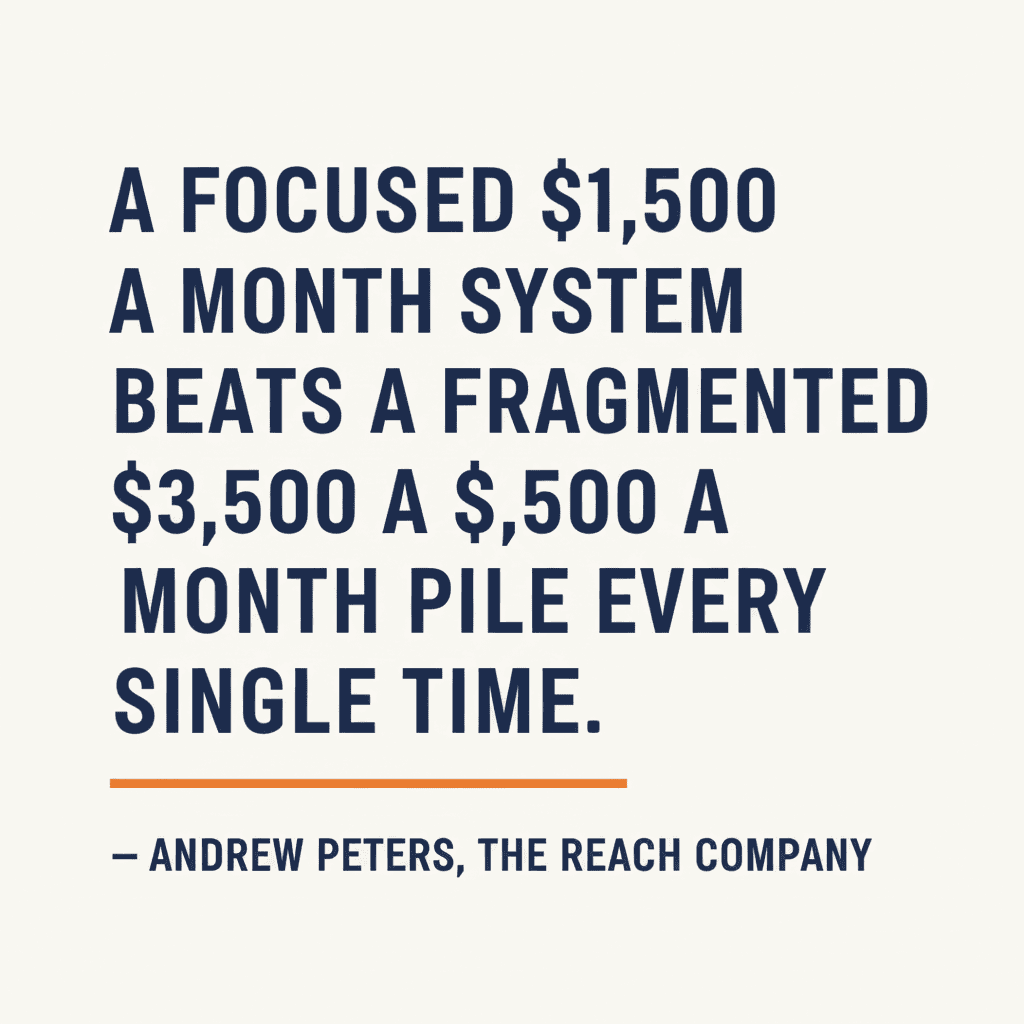
That’s why “5-20% of revenue” is the wrong frame. The real question is whether your spend is buying a working system or a pile of disconnected tools. A focused $1,500/mo system beats a fragmented $3,500/mo pile every single time.
When we audit, the first thing we ask is: where’s the leak? Almost always it’s one of three places.
- The website doesn’t convert. Money flows in (ads, SEO, social), nothing flows out (no leads).
- Leads don’t get followed up with. The system catches them; nobody works them.
- The owner is the system. When you take a day off, marketing stops.
You can fix any of those three for less money than you’re currently spending. You just have to spend it on the right things.
What You Should Not Spend Money On in 2026
Let me get this outta the way. There’s stuff that looks like marketing and isn’t.
- The boost button on Facebook. Optimizes for likes. You’ll feel productive. You’ll get nothing.
- Cheap “SEO packages” under $500/mo. Spam links, keyword stuffing, and a monthly PDF that means nothing. You’ll get worse.
- A fancy logo refresh before you have product-market fit. Logos don’t sell. Offers sell. Funnels sell.
- Print advertising in industries that aren’t built for it. Local magazines for a B2B SaaS? No. Yellow Pages for anything in 2026? Heck naw.
- Influencer marketing for service businesses with under $2M in revenue. Almost never pays back. The math is brutal.
- Most “branding” agencies. “Branding” is what big companies do because they’ve already won. You don’t need branding. You need leads. Branding catches up to you when the cash flow’s right.
- Generic content marketing without distribution. Writing 4 blog posts a month nobody reads is a hobby, not marketing. SEO and content only work when paired with a real distribution and ranking strategy.
This isn’t dogma. There are exceptions. But if you’re under $1M revenue and not sure where to spend, every dollar that goes into the seven things above is a dollar that’s not buying you leads.
How to Know If Your Spend Is Working
The marketing budget conversation has to end with measurement. Otherwise you’re spending blind.
Here are the four numbers that matter for a service business:
- Leads per month. Not “engagement.” Not “impressions.” Actual people contacting you. Track it. Yes, in a spreadsheet if you have to. Better, in your CRM.
- Cost per lead. Total marketing spend ÷ leads per month. If you’re spending $3,500/mo and getting 35 leads, that’s $100 per lead. Healthy or not depends on your average client value.
- Lead-to-client conversion rate. Of those leads, how many become paying clients? 20% is healthy for most service businesses. 5% means your sales process or lead quality is broken.
- ROAS (Return on Ad Spend) or LTV/CAC. For every dollar you spent on marketing, how many dollars came back? Healthy service businesses run at 3-5x. Below 2x and something’s broken.
If you don’t know these four numbers, you don’t have a marketing budget. You have a marketing wish.
The good news: every one of these is calculable. You don’t need a fancy dashboard. You need a CRM that captures lead source, a calendar that tracks closed deals, and 30 minutes a month with a spreadsheet.
The Mistake That Wastes the Most Money
Of every audit we run, this is the most common pattern:
The owner has bought the tools. They have a website. They have GoHighLevel. They have Google Ads running. They have Mailchimp. They might even have a content writer. They’ve spent the money.
What they haven’t bought is the system that makes those tools talk to each other.
The website captures a lead. It does not pass to the CRM. The CRM has automation built but nobody set the triggers. The ads run but lead source isn’t being tracked, so nobody knows which campaign produced the booking. The content writer publishes blog posts that aren’t optimized for the keywords the SEO setup is targeting.
Every tool is doing 30% of its job. The owner is paying 100% of the price.
This is why we built The Reach Co Lead System the way we did — website plus SEO plus ads plus CRM working as one unit, set up correctly the first time. Not because tools are bad. Tools are great. But a tool without a system is just a recurring charge on your card.
The single highest-ROI move most small businesses can make is not adding more spend. It’s connecting the spend they already have. We’ve seen audits where the budget literally didn’t change but leads doubled within 90 days because the existing pieces finally started talking to each other.
A Simple 90-Day Plan If You’re Starting from Scratch
If you’re reading this and thinking “I have no idea where I am on these tiers,” here’s the move.
Month 1: Audit. What are you currently paying for? List every recurring charge. Every freelancer. Every tool. Every domain. Every ad account. Total it. Almost every business owner I do this with discovers $200-$600/mo of forgotten spend. Cancel that first.
Month 2: Pick a tier. Based on your revenue and your goals, pick Survival, Foundation, Working, or Growth. Don’t try to skip a tier. Don’t try to spend Tier 4 dollars on a Tier 1 problem. Match the spend to the stage.
Month 3: Build the system, not the pile. Whatever you’re spending, make sure every dollar is connected to the next. Website talks to CRM. CRM talks to email/SMS. Ads pass lead source. SEO targets the same keywords your money pages convert on.
In 90 days you can go from “I have no idea what I’m spending or getting” to “I know my cost per lead and where every dollar is going.” That’s the leap. That’s what unlocks everything after.
Wrapping Up
So how much should a small business spend on marketing in 2026?
Not 5%. Not 20%. Not “it depends.”
If you’re early stage, $500/mo to keep the lights on. If you’re serious about growth, $1,500-$3,500/mo for a foundation that compounds. If you’re scaling and the math is working, $7,500/mo and up because every dollar is producing a return you can measure.
The percentage doesn’t matter. The system does. Four buckets — website, SEO, ads, CRM — connected to each other and pointed at one outcome: leads that turn into clients.
That’s the whole answer. The agencies hide it behind “synergies” and “holistic strategies” because the moment you see the actual number, you realize how much you’ve been overpaying for stuff that doesn’t move.
You keep doing what you do best. We’ll help you scale it.
If you want a real read on where your current spend is working and where it’s leaking, schedule a free call and we’ll walk through it. No pitch. Just a clear picture of what your money is actually buying and what it isn’t. We do this every week. It’s the most useful 30 minutes you’ll spend on marketing this quarter. Promise.
P.S. — If you’ve been told “you need a bigger budget” by an agency that couldn’t tell you what your last month’s leads cost, that’s the conversation to have. Not “more spend.” Right spend. The finish line is a lot closer than it feels.

