

Most business owners hear “how to use AI for lead generation” and picture the worst version of it. A bot firing off “Hey [FIRST NAME], hope this finds you well!” at 2 a.m. The kind of message you delete on sight. So they decide AI is not for them, and they go back to letting new leads sit in an inbox for two days.
Here is the part nobody tells you. The robot voice is not an AI problem. It is a setup problem. Used right, AI does the one thing almost every service business is bad at: answering a new lead fast, in plain language, before that person calls the next name on their list. I use it every day in my own business and for our clients. Let me show you the exact jobs to hand it, and how to keep it from sounding like a machine.
The Real Problem Isn’t AI. It’s How Slow You Answer.
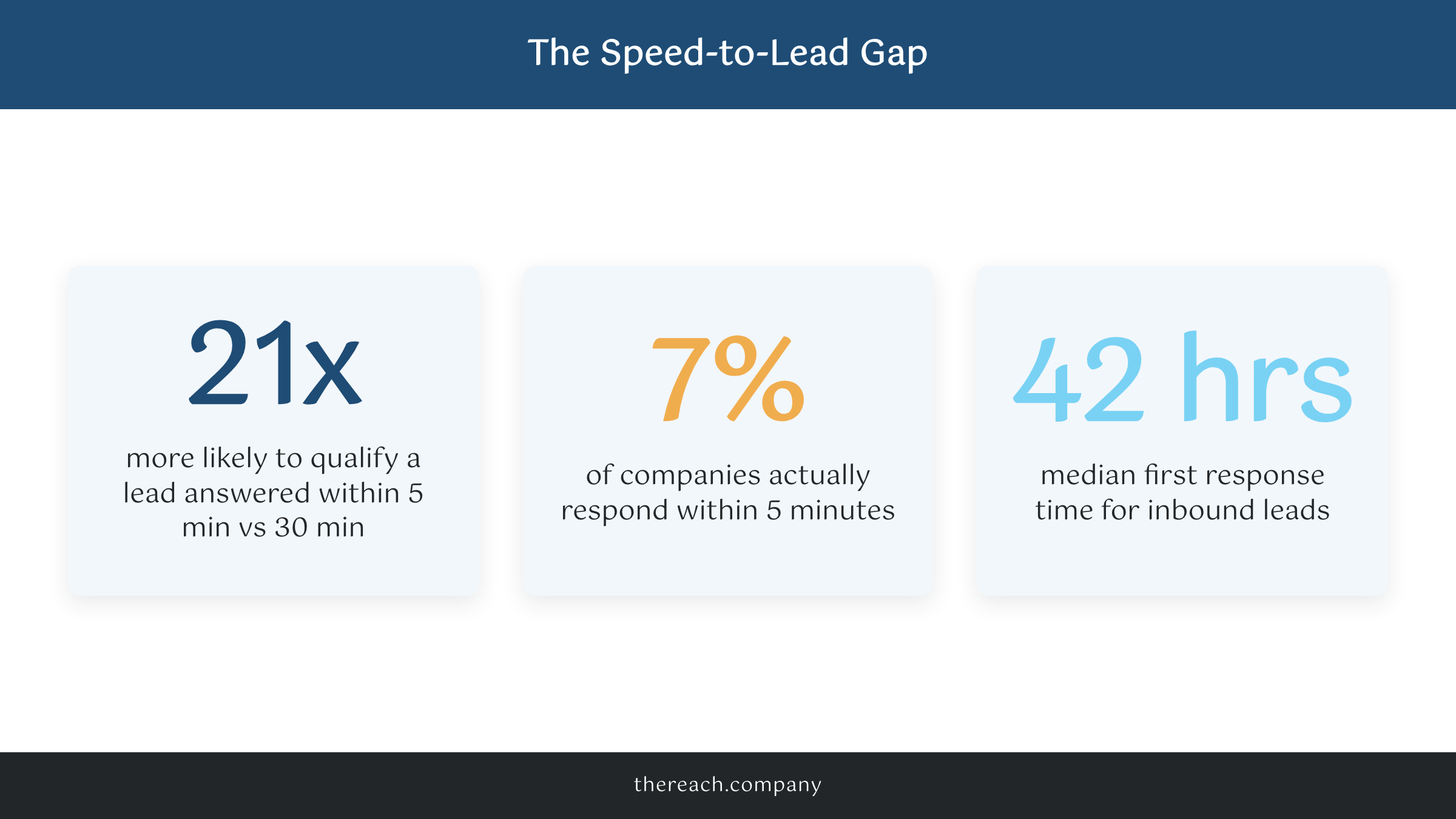
Before we talk about AI at all, look at the number that should keep you up at night. A lead who gets a response within five minutes is 21 times more likely to be qualified than one you answer 30 minutes later, according to the MIT and InsideSales Lead Response Management study. Yet only about 7% of companies actually respond within five minutes, and the median first response time for an inbound lead is 42 hours.
Forty-two hours. That is almost two full days. By then your prospect has filled out three other forms and booked with whoever texted back first. GoHighLevel, the platform we run our clients’ lead systems on, says it plainly in their own breakdown: getting the lead is only half the battle, and the sooner a conversation starts, the more likely it turns into a customer, instead of relying on a delayed follow-up that never happens.
That gap, the dead air between a form submission and an actual conversation, is exactly where AI earns its keep. Not by being clever. By being awake at 9 p.m. on a Saturday when your best lead of the month fills out your contact form.
The Specific Jobs to Hand AI Today
Knowing how to use AI for lead generation starts with naming the jobs, because “use AI” by itself is too vague to act on. Nobody has a task on their to-do list called “do AI.” So here are the specific jobs, in the order they actually move the needle.
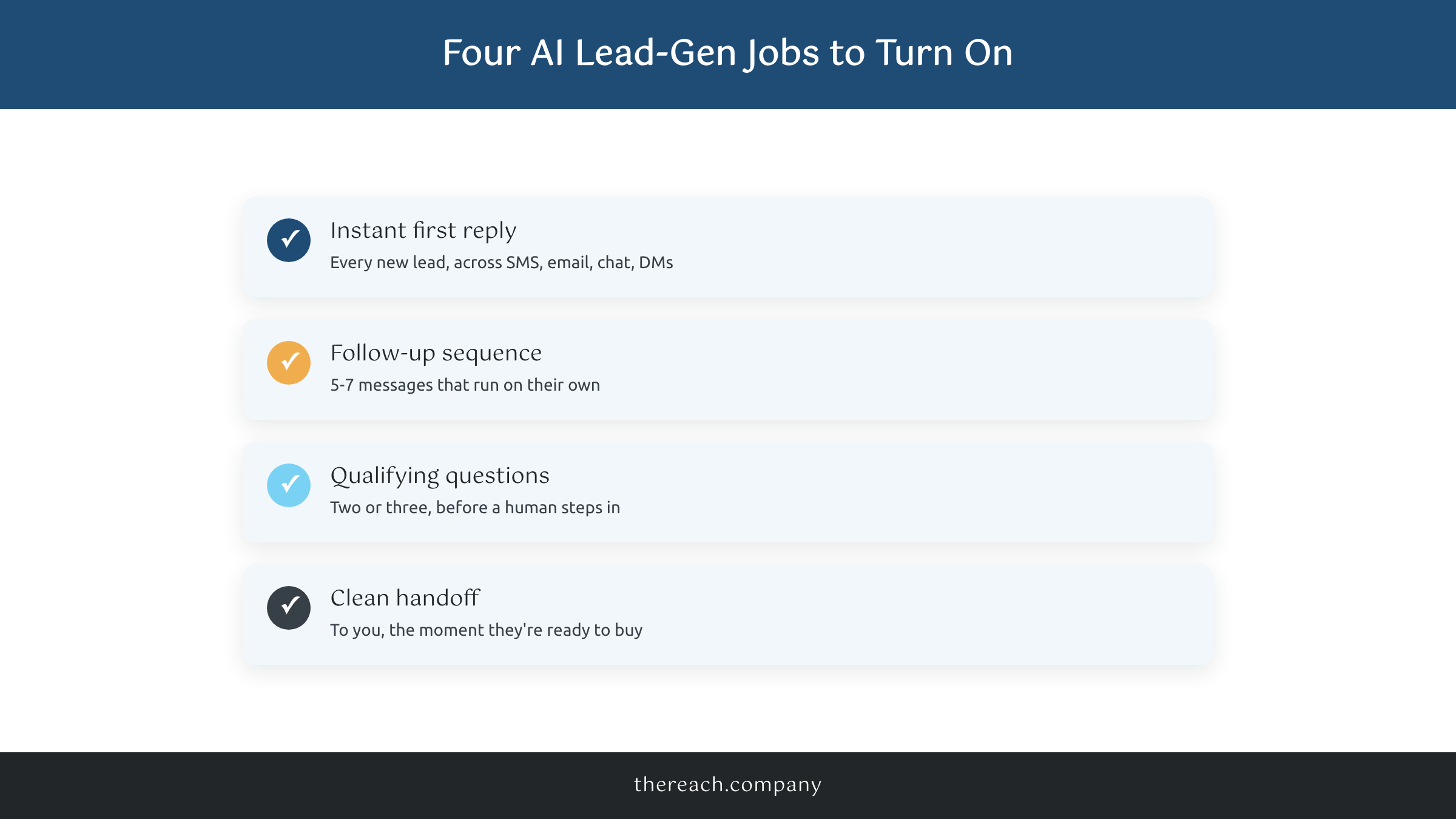
Speed to lead. The second a form comes in, a call is missed, or a web chat opens, AI sends the first reply. A real answer to their actual question, not a canned “we will get back to you soon.” Tools like GoHighLevel’s Conversation AI do this across text, email, web chat, and Facebook or Instagram messages from one setup, and they do it in seconds at any hour. This one job alone puts you ahead of almost every competitor in your zip code.
Follow-up sequences. Most leads need five to seven touches before they buy. Almost nobody sends more than one. That is not laziness, it is a person running a business who got pulled onto a job site. AI handles the polite, spaced-out nudges so a lead never goes cold because you were busy. This is the piece worth going deep on, and I wrote a full walkthrough on how to automate your lead follow-up with AI that shows the exact cadence.
Qualifying. Before a human spends a minute, AI can ask the two or three questions that separate a real buyer from a tire-kicker. Budget range, timeline, what they actually need done. Now the appointments hitting your calendar are people worth talking to, not “just checking prices” browsers who were never going to book.
The handoff to a human. This is the job most people skip, and it is the most important one. AI’s role is to start the conversation and warm it up while intent is high. The moment someone is ready to buy, get a quote, or talk real numbers, a person takes over. AI opens the door. You walk through it and close.
Why It Sounds Like a Robot (and How to Fix It in an Afternoon)
Here is the rub. AI sounds robotic when you feed it robotic instructions. Type “generate a follow-up message” and you get a generic follow-up message. Garbage in, garbage out. That is not the tool failing you. That is the tool doing exactly what it was told to do by a bored prompt.
The fix takes an afternoon, not a developer and not a five-figure retainer. Three moves.
Feed it your voice. Paste in five texts or emails you have actually sent a client. Tell it to match that tone. It will drop the “I hope this email finds you well” stiffness in about ten seconds and start sounding like a human who owns a business.
Feed it your answers. Load the ten questions every lead asks and the exact way you answer them. Now the AI is not inventing anything. It is repeating you, in your words, at a speed you could never hit by hand.
Set the guardrails. Tell it what it does not touch: pricing arguments, upset customers, anything past a booked call. When it hits one of those, it stops and hands off to you. A good setup knows the edge of its own lane.
Do those three things and the messages stop reading like a mail merge and start reading like your sharpest front-desk person on their best day. If you want the deeper version of this for your marketing and email, I broke down the prompting workflow to make AI write in your actual voice step by step.
Proof: What This Looks Like When It’s Wired Up Right
This is not theory. One of our clients, a medspa, pulled 1,928 leads from their website in a single year. A number that size is not a traffic story. It is a follow-up story. Leads that get answered fast and nurtured consistently turn into booked appointments. Leads that sit untouched in a form turn into nothing.
The businesses winning right now are not the ones with the most leads. They are the ones who answer first and follow up without dropping the ball. AI is what makes that possible for a shop with three employees and no dedicated sales team. It is the same math the big spenders use to stay on top, minus the payroll for a full-time front desk.
How to Actually Set This Up
You do not need six tools bolted together with duct tape. You need one system that captures the lead, answers instantly, follows up on its own, and hands off to you at the right moment. That is the whole point of the lead generation system we build on GoHighLevel: the website, the follow-up, and the tracking working as one machine instead of four disconnected apps that never talk to each other.
You can start smaller than that. This week, turn on a single instant auto-reply to every new lead. Train it on your voice. Add a three-message follow-up sequence behind it. That alone will beat the roughly 93% of your competitors who are still answering leads two days late, if they answer at all. That is what learning how to use AI for lead generation really comes down to: answer first, follow up every time, and sound like a person while you do it.
AI is not going to run your business. It is not going to build the relationship that actually closes the deal or shake a customer’s hand. That part is still you, and it always will be. What AI will do is make sure no lead ever again slips through the cracks because you were up a ladder when the phone rang. Used well, it is the difference between a lead you lost and a customer you kept. Plain and simple.
Want the follow-up piece done right, without hiring anyone to babysit it? That is exactly what we build. Book a call and we will show you what it looks like for your business.

