

Can I shoot straight with you? If someone quoted you four figures for “keyword research” on a local service business, you got hosed a little. Doing keyword research for a local business doesn’t take an $1,200 agency line item or a $199/mo subscription to Ahrefs or Semrush. It takes about 90 minutes, two tools that are already free, and a method most agencies won’t hand you because it’s not complicated enough to justify the invoice.
Here’s the rub: most of the “keyword research” content out there is written for national brands chasing 50,000-searches-a-month terms. You’re not that business. You’re a plumber, a contractor, a medspa, a consultant with a service area of maybe 20 miles. Your keyword research looks completely different from a national brand’s, and honestly, it’s easier.
The Real Problem
Most local business owners handle keyword research one of two ways, and both cost them money. Either they skip it entirely, guess, slap “Best Plumber in [City]” across a homepage, and wonder six months later why nothing ranks. Or they get talked into a “keyword research package” from an agency that charges $800-$1,200 for a PDF built off tools designed for national campaigns.
Here’s what’s actually happening behind that invoice: the agency is running your service names through Google Keyword Planner, pairing them with your service area, and formatting the output into a report with your logo on it. Ahrefs runs $129-249/mo. Semrush is close behind. Those are genuinely good tools, built to help enterprise SEO teams outmaneuver each other across thousands of pages. You don’t have that problem. You need to know what your next 50 customers are typing into Google before they pick up the phone. That’s a much smaller, much cheaper job than the one you’re being billed for, and the “guess and hope” version costs you just as much in wasted time and pages nobody searches for.
The Service + City Method
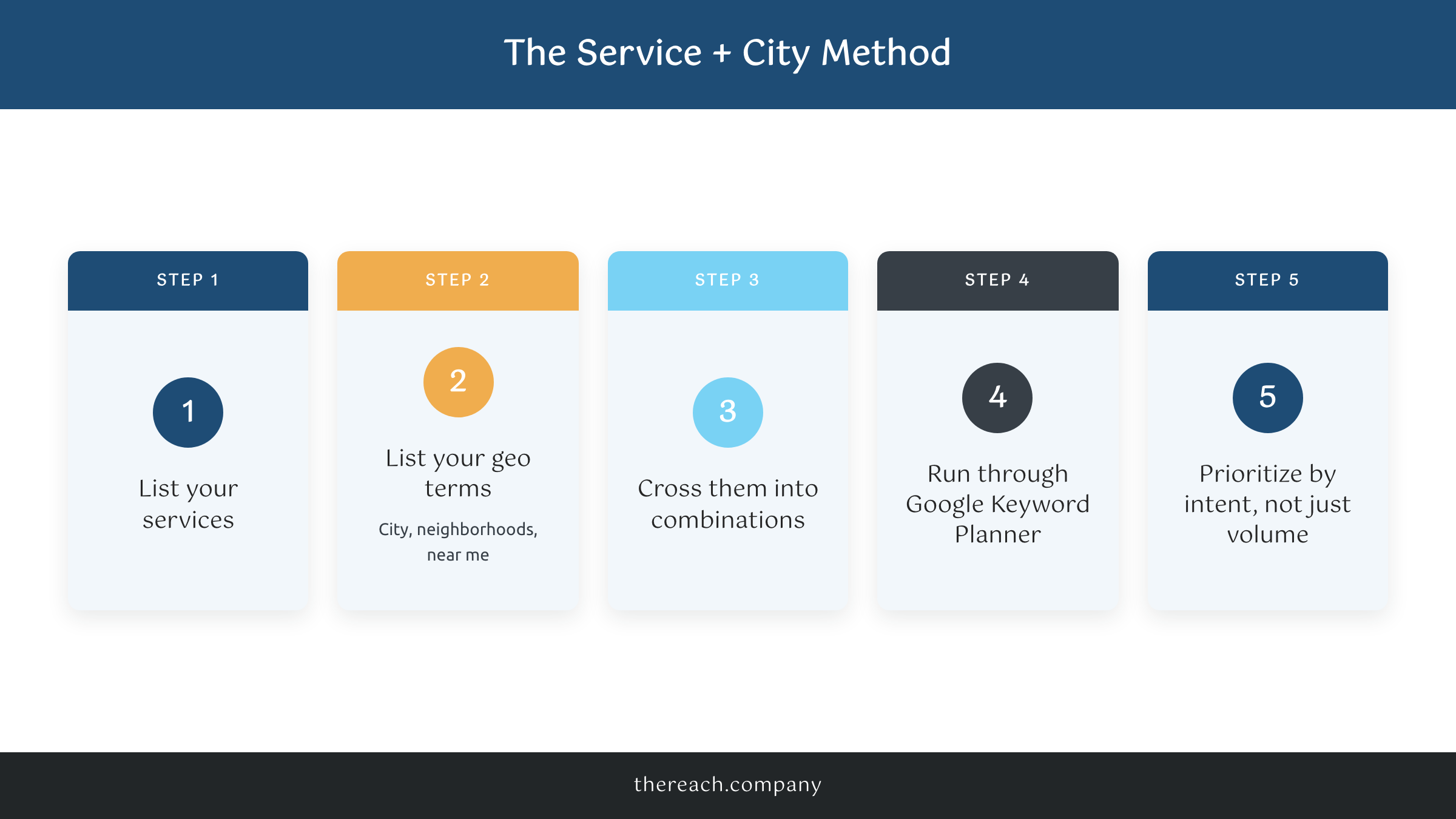
Here’s the actual method, and it’s stupid simple: take every service you offer and pair it with every geographic term a real customer would use for you. Your city. The neighborhoods you serve. “Near me.” The county, if that’s how people talk locally. That’s the whole system.
A plumber in Marietta, Georgia would build a list like this:
- “water heater repair Marietta”
- “emergency plumber near me”
- “tankless water heater installation Cobb County”
- “drain cleaning East Cobb”
- “24 hour plumber Marietta GA”
To turn that list into real data, you need exactly two free tools.
Google Keyword Planner: Free with a Google Ads account. You do have to complete billing setup to unlock full results, but you don’t have to spend a dollar on ads to use it. Drop in your service + city combos and it hands back monthly search volume estimates and competition level for each one, straight from Google itself, not a third-party estimate someone’s guessing at.
Google Autocomplete + “People also ask”: Type “plumber near” into the Google search bar and don’t hit enter. Read what autocomplete suggests, that’s real, current customer behavior. Then search your main term and scroll to “People also ask” for the exact questions your customers are typing. This is free, live customer research nobody’s paid SEO tool can fake.
One more free layer worth adding: Google Trends. It won’t give you a volume number, but it’ll show you whether a term is climbing, flat, or seasonal, “gutter cleaning” spikes every fall, “AC repair” spikes every July, and knowing that changes when you publish and when you bid.
Run every service + city pairing through Keyword Planner, note the volume, and you’ll have a real, defensible keyword list in under two hours. No subscription required.
The Contrarian Truth
Here’s what nobody selling keyword research packages wants you to know: for a local business, high search volume is often the wrong metric to chase. “Plumber” pulls 40,000 searches a month nationally, but that number means almost nothing to you. It’s not localized, the intent is mixed (some of those searchers are looking for a job, not hiring one), and you’re competing against every plumber in the country for a ranking you’ll never actually get.
What converts is the boring, specific, lower-volume stuff. “Tankless water heater installation cost Marietta” pulls maybe 20 searches a month. But every one of those 20 searches is a homeowner who already knows what they want and is close to calling someone. Ten long-tail, service-plus-city terms like that will bring you more paying customers than one broad term with zero local qualifier ever will. Volume is a vanity metric. Intent is the money metric, and it’s the one most keyword research reports never mention because “20 searches a month” doesn’t look impressive on a slide.
It really depends on the service, but most local businesses convert better chasing 30 low-volume, high-intent terms than one competitive head term. And don’t sleep on your Google Business Profile in this process, the same service + city terms you’re researching for your website are exactly what should show up in your GBP services list and posts too. It’s the same list doing double duty.
Proof
We ran this exact method for Chin Up Aesthetics, a medspa client, before we ever touched their service pages. Instead of chasing “medspa” or “botox,” we mapped every treatment they offer against every neighborhood and service term their actual patients search for, then built pages around the combinations that had real, if modest, volume and clear buying intent. The result: 1st in the Map Pack for 8+ services and 1,928 leads from the website in a single year. Not because we out-researched a national competitor with a bigger tool budget. Because we researched the 40 or so specific things their actual patients were typing into Google before they booked.
What to Do Instead
Block 90 minutes this week. Here’s the whole process:
- List every service you offer, in plain customer language, not internal jargon.
- List every city, neighborhood, and “near me” variant a real customer near you would actually type.
- Cross the two lists into combinations, service + geo term.
- Run the full list through Google Keyword Planner (free) and note the volume and competition on each.
- Check autocomplete and “People also ask” for the exact phrasing customers use, and add anything you missed.
- Prioritize the low-volume, high-intent combinations first, not the biggest number on the page.
Once you’ve got your list, the next move is tracking where you actually rank for those terms so you know whether the work is paying off, or whether it’s time to adjust.
If you’d rather hand the whole thing off, that’s exactly what our Local SEO service is built for. We run this research, build it into your Google Business Profile and service pages, and track it every month so you’re never guessing whether it’s working.
It really depends on your market how fast this moves. Some owners see movement in a few weeks, some take a couple months. But the finish line is a lot closer than it feels. Promise. You got this.

