
You can be busy in HVAC and still be broke. July fills itself. When it’s 96 degrees in Atlanta, nobody price-shops a dead AC for three days. The real test is October. And February. If the shoulder seasons scare you, your problem isn’t demand. Your problem is that you don’t own the machine that produces your jobs.
Most advice about lead generation for HVAC companies starts and ends with “buy leads.” Angi, Thumbtack, Networx, a dozen lookalikes. You pay $50 to $100 for a homeowner’s phone number, and so do four other companies. Five trucks race to the same kitchen, and the winner is usually whoever quoted cheapest.
Can I shoot straight with you? That’s not a lead system. That’s renting scraps from someone else’s lead system, and they charge you for the privilege.
Here’s what we’ll cover: why shared leads keep you on the hamster wheel, the number inside your own shop that’s quietly costing you six figures, and the system that keeps the schedule full year-round.
Shared Leads Are a Race to the Bottom
Run the math on a shared lead. You pay, say, $75 for the contact. The platform sells that same homeowner to three or four other HVAC companies at the same time. Best case, you close one in five. That’s $375 in lead cost per booked job before you count the hour your office manager spent chasing callbacks. And the homeowner you finally reach has been trained by the platform to collect quotes and pick the cheapest one.
It gets worse. The platform owns the relationship, not you. The homeowner remembers “I found a guy on Thumbtack,” not your company name. No review lands on your Google profile. No referral comes from it. No maintenance plan gets sold. You bought a transaction, not a customer.
And you have zero pricing power. When the platform raises lead prices, and they do, every season, you either pay up or watch your board empty out. You built your schedule on rented land, and the landlord knows it.
Shared leads aren’t evil. As a bridge while you build something you own? Fine. As the whole plan? It’s a race to the bottom, and somebody is always willing to lose money longer than you are.
The Leak Nobody Checks: Your Booked-Call Rate
Before you spend another dollar on leads, look at what happens to the calls you already get.
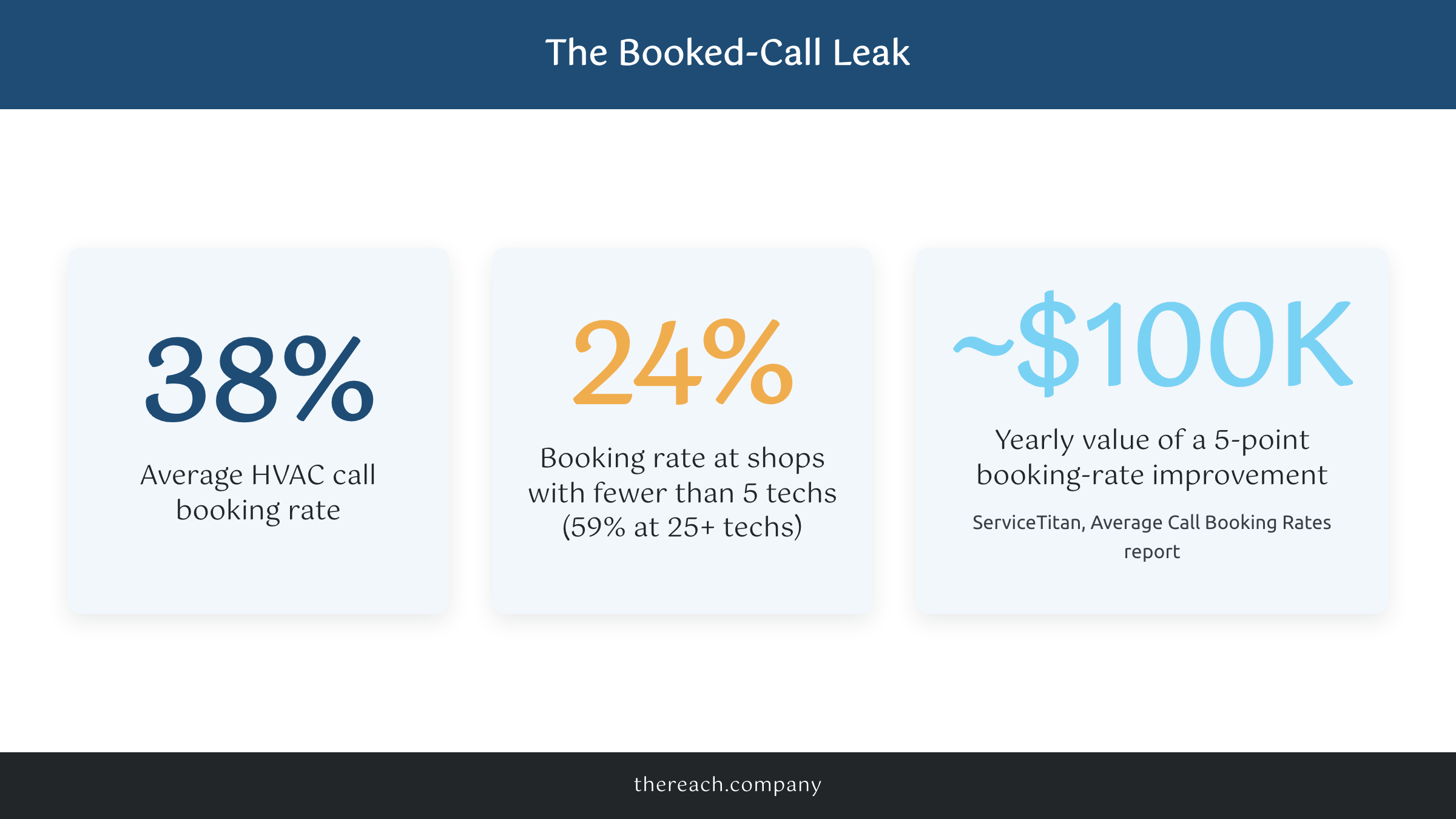
ServiceTitan pulled call data across thousands of trade businesses, and the numbers are rough. The typical shop books just 42% of its inbound calls. HVAC specifically came in at 38% in their June data. And the smaller you are, the worse it gets: shops with fewer than five techs booked 24% of calls, while shops with 25 or more techs booked 59%.
Read that again. The average small HVAC shop lets three out of four callers get away. These are people who found your number and dialed it. The hardest part of marketing already happened. Then the call hit a voicemail box at 6:40 on a Tuesday and the homeowner just called the next name on the list.
ServiceTitan’s team also ran the revenue math: improving your booking rate by five points is worth roughly $100,000 a year for a typical shop, and it takes less than one extra booked call per weekday to get there.
This is why “buy more leads” is usually the wrong first move. Pour more water into a leaky bucket and you get a bigger puddle, not a fuller schedule.
You Don’t Have a Leads Problem. You Have a System Problem.
Here’s the rub. The HVAC companies with full schedules in February aren’t better at buying leads. They own three assets that produce jobs on repeat:
1. A loaded Google Business Profile. When somebody searches “AC repair near me,” the map pack is the phone book now. Your profile needs the right primary category, every service listed, weekly photos of real jobs, and a steady stream of reviews. This is the highest-leverage free asset in lead generation for HVAC companies, and most shops set it up once in 2019 and never touched it again.
2. A website that books jobs. Not a brochure. Tap-to-call in the header. A “Book an estimate” button that works from a phone. A page for every service you offer in every city you serve, so the person searching “furnace repair Marietta” lands on a page about furnace repair in Marietta.
3. A follow-up engine. Missed-call text-back, so the 6:40 caller instantly gets “Sorry we missed you, this is Mike’s Heating and Air. Want us to call you right back or book you now?” Automatic review requests after every job. Maintenance reminders every fall and spring. This is the piece that fixes the 38% problem without hiring another office person.
It’s the same playbook as how roofers get more leads that actually turn into jobs. The trade changes. The system doesn’t.
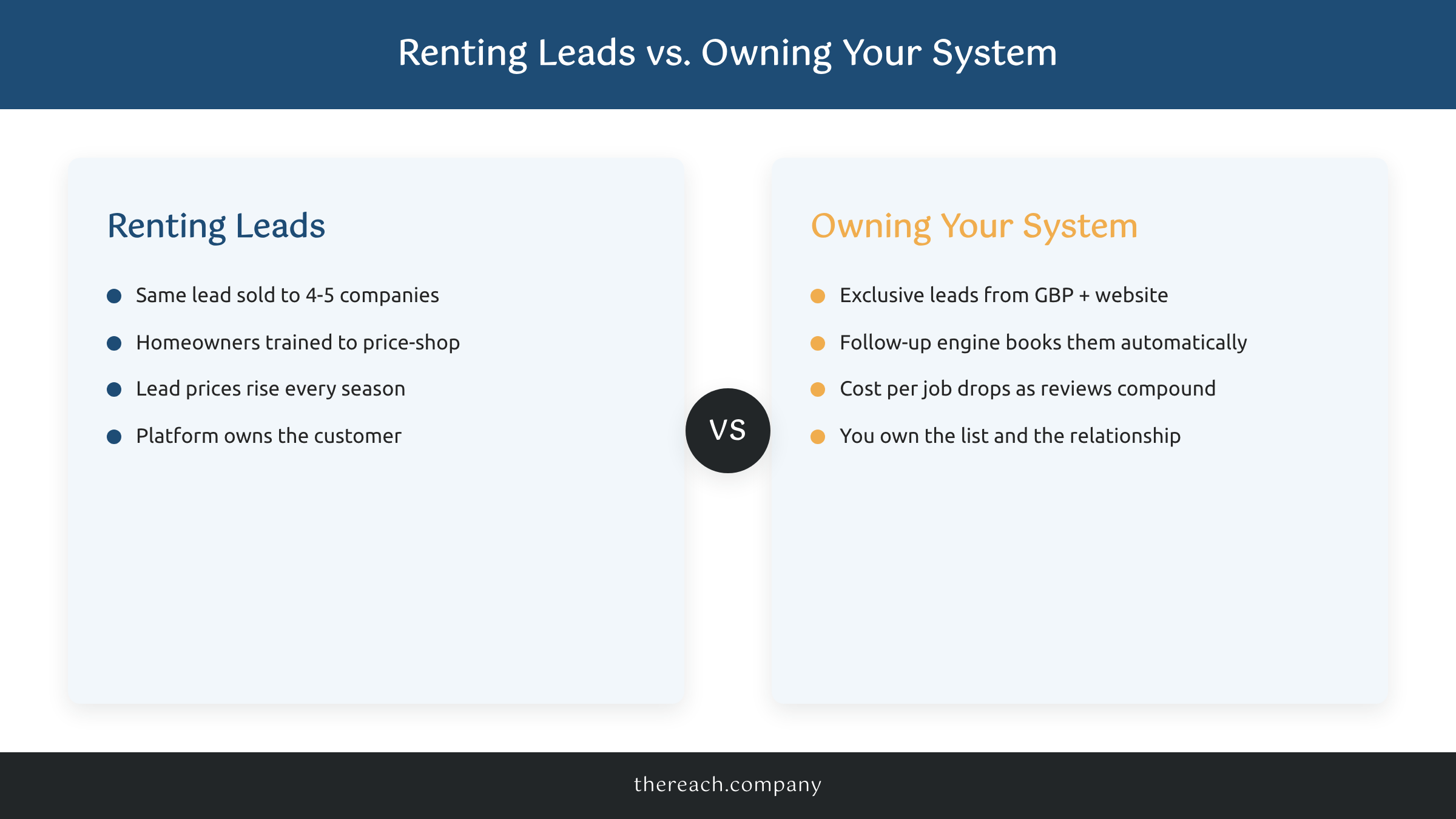
Renting leads feels faster because you can swipe a card today. Owning the system feels slower for about 90 days. Then it compounds. Your cost per booked job drops every quarter while the lead-buyers’ costs keep climbing.
What an Owned System Actually Produces
We build this exact machine for service businesses at The Reach Company, so here are real numbers instead of theory.
Chin Up Aesthetics is a medspa, not an HVAC company, but the machine is identical: Google Business Profile, converting website, automated follow-up. Their website produced 1,928 leads in one year, and they rank first in the map pack for more than eight core services. Nobody sold those leads to four competitors first. Every one was exclusive, every review landed on their own profile, and every review made the next month’s leads cheaper.
The Jewish Education Loan Fund has been with us for almost five years, and their conversions are up 54% over that relationship. Five years. That’s what owning assets looks like: not a spike, a compounding curve.
None of this is magic. It’s boring assets, wired together, maintained weekly. The schedule stays full because the machine doesn’t take February off.
Build the Machine Once: The Order That Works
If I were starting with an empty board and a phone that only rings in July, here’s the exact order:
Week 1: Claim and load your Google Business Profile. Right primary category (HVAC contractor), every service listed, accurate hours, real photos from real jobs. Then post to it weekly. It’s twenty minutes, not a project.
Weeks 2 and 3: Make the website book jobs. Tap-to-call at the top. “Book an estimate” above the fold. Service and city pages. If the site takes six seconds to load on a phone, fix that first. Speed is a conversion feature, not a nerd metric.
Week 4: Turn on the follow-up engine. This is the lead generation system we build for HVAC companies at The Reach Company, built on GoHighLevel: missed-call text-back, appointment reminders, review requests after every closed job, and a simple pipeline so no estimate dies in somebody’s inbox. It runs $299 a month, which is four shared leads. If you want to nerd out on the automation side, here’s how to automate your lead follow-up without hiring anyone.
Every job after that: ask for the review. Same day, by text, with a direct link. Reviews are the flywheel that makes everything above it work harder.
Then, and only then: add ads. Google Local Services Ads are the best paid fit for HVAC because you pay per lead instead of per click, and the Google Guaranteed badge does real work on trust. But ads amplify a system. Pointed at a slow website and an unanswered phone, they just burn cash faster.
One more move for the seasonality problem: sell a maintenance plan on every fall and spring visit. Members book before strangers do, and memberships are how you flatten the January dip instead of dreading it.
Keep Doing What You Do Best
You didn’t get into HVAC to become a marketer, and you don’t have to become one. But you do have to stop renting your future from lead platforms one $75 phone number at a time.
Build the profile. Fix the site. Wire up the follow-up. Ask for reviews. Then amplify with ads. That’s lead generation for HVAC companies in one paragraph, and every piece of it is an asset you own.
Want the fuller playbook with the sequencing, budget guidance, and FAQ? We wrote up a complete marketing strategy for contractors that applies the same order to any trade.
If you’d rather have somebody who genuinely cares build it with you, that’s literally what we do. Book a call at thereach.company and tell us what your board looks like in February. The finish line is a lot closer than it feels. Promise.

