
You built this business on word of mouth. One good job led to a referral, that referral led to two more, and for years the phone rang on its own. Then a slow month showed up. Then another. Here is the uncomfortable truth most contractors learn the hard way: word of mouth has a ceiling. It is real, it is valuable, and it will only carry you so far. A marketing strategy for contractors is what breaks through that ceiling, and it is not a logo, a slogan, or a Facebook page you post to twice a month. It is a sequence of moves that make you the obvious choice the moment a homeowner starts looking.
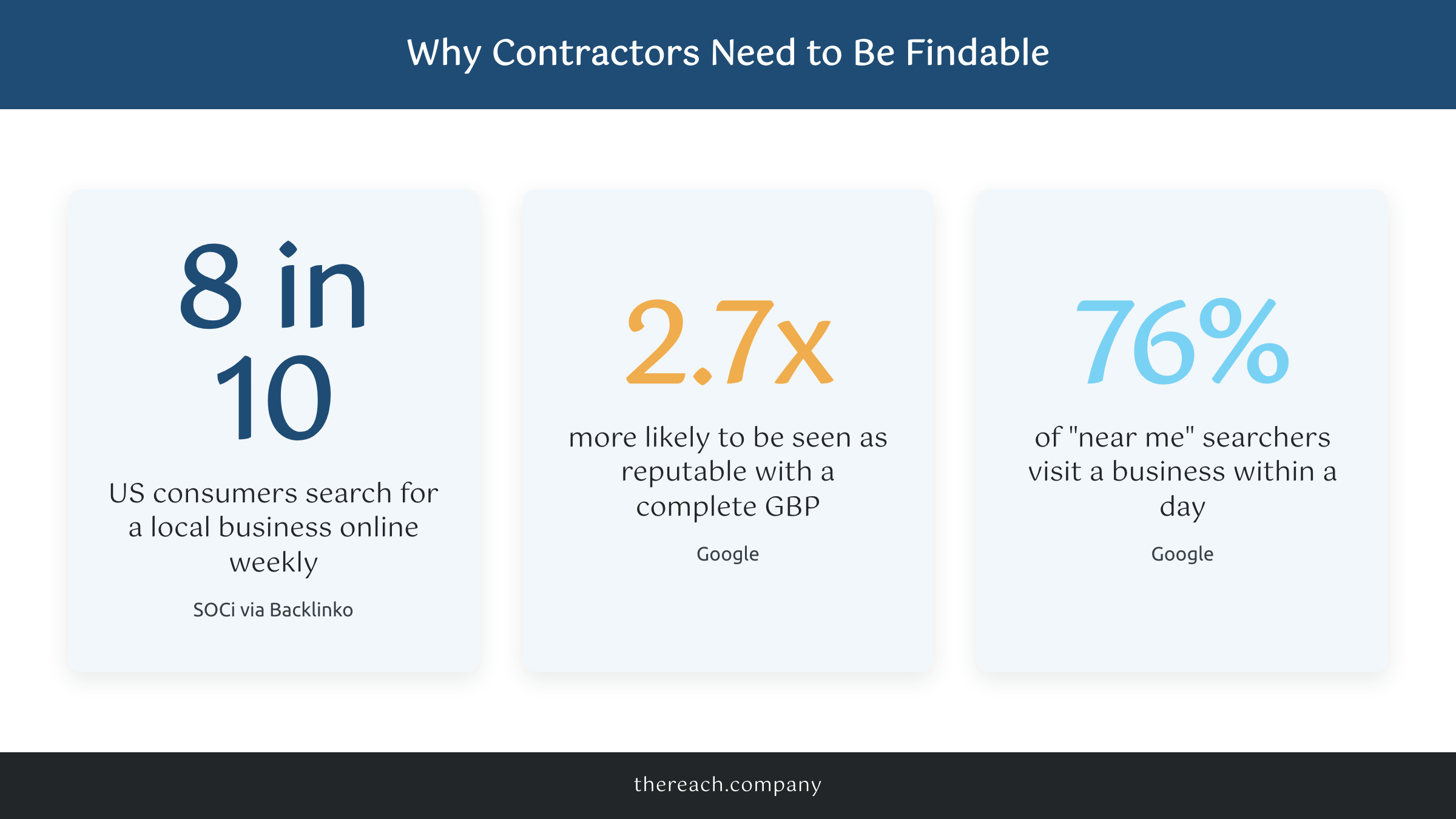
And they are looking. Eight in ten U.S. consumers search for a local business online at least once a week, according to Backlinko’s local search data. The plumber, the roofer, the electrician who shows up first, looks legit, and answers fast wins the job. The one who is invisible loses it, and never even knows the call happened.
Can I shoot straight with you? Most contractors don’t have a marketing problem. They have a sequence problem. They buy a website, boost a post, maybe run some ads, all in the wrong order, and none of it talks to the other pieces. This is the plan that actually brings in jobs, built in the order that works, and you can start it this week without hiring a full agency.
Word of Mouth Has a Ceiling
Referrals are the best leads you will ever get. They close faster, haggle less, and trust you before you say a word. Keep them coming forever. But referrals have a hard limit: they depend on other people remembering you at the exact moment their neighbor needs a contractor. You cannot schedule that. You cannot scale it. And you definitely cannot pay your crew with “I hope Jerry sends me another job.”
Here is the rub. When a homeowner has a leaking roof or a dead AC unit, they are not waiting for a referral. They pull out their phone and search. If a friend already gave them your name, they still look you up to confirm you are real. If nobody gave them a name, you are competing with whoever shows up first. Either way, the search happens, and either you are in it or you are not.
That is the whole reason a marketing strategy for contractors exists. Not to replace word of mouth, but to catch every job that word of mouth was never going to send you. The goal is simple: be findable, look trustworthy, and be easy to contact, in that order. The next sections are that system, built one layer at a time.
Start With Your Google Business Profile (Not Your Website)
The foundation of any marketing strategy for contractors is being findable, and being findable starts in one free place. Most contractors think step one is a shiny new website. It is not. Step one is your Google Business Profile, and it is free.
When someone searches “roofer near me” or “emergency plumber [your city],” Google shows a map with three businesses at the top. That box is the Local Pack, and it is prime real estate. For local trades it matters more than your website, because that is where the ready-to-buy homeowner looks first. A complete, active profile is how you get into it.
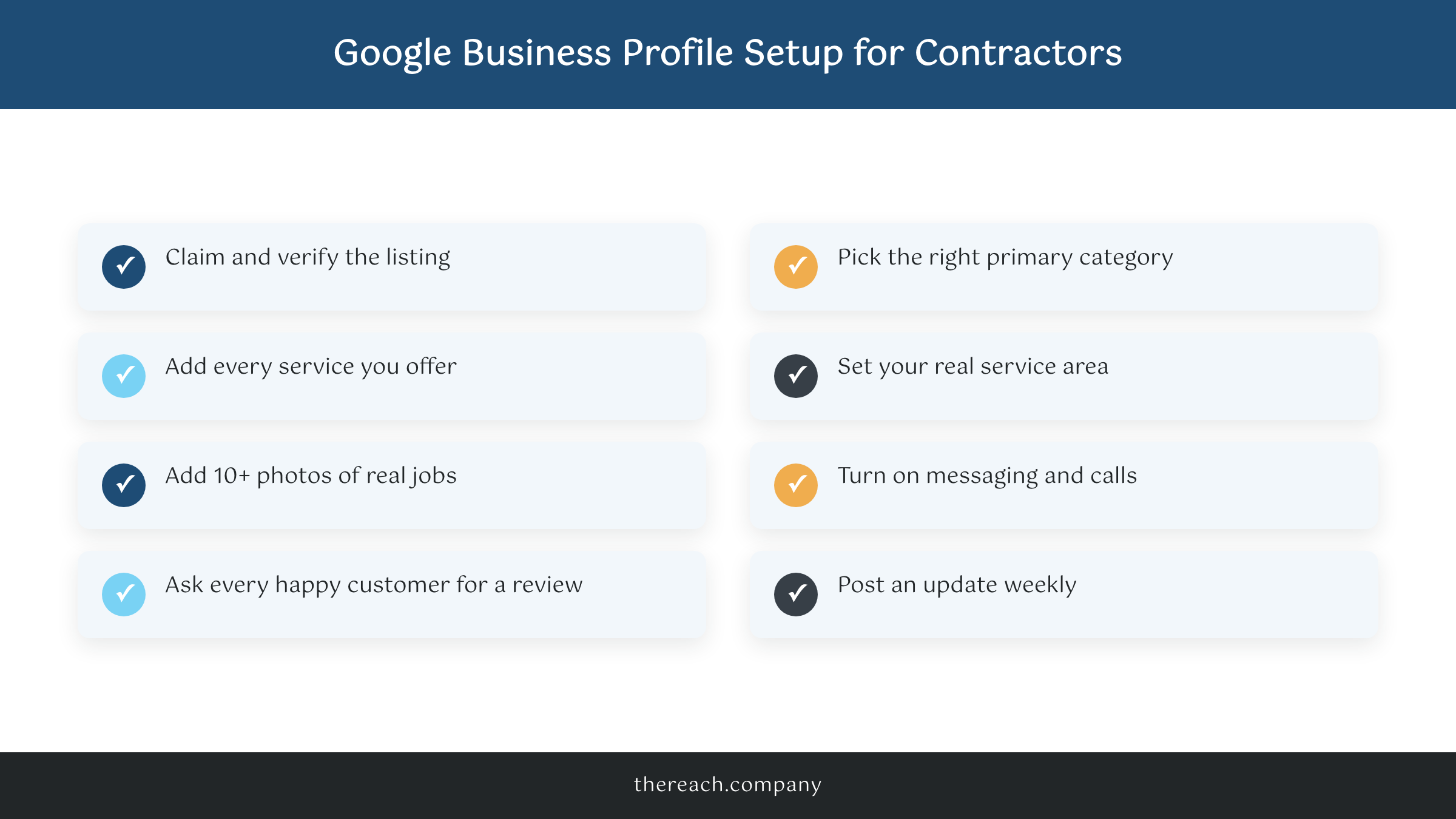
It also builds instant trust. Customers are 2.7x more likely to view a business as reputable when it has a complete Google Business Profile, per Google’s own research. Complete means claimed, verified, and filled all the way out: the right primary category, every service listed, your real service area, hours, photos of actual jobs, and a steady stream of reviews.
Reviews are the quiet workhorse here. A contractor with 82 reviews at 4.8 stars beats a contractor with 6 reviews every time, even if the six-review guy does better work. The homeowner cannot see your craftsmanship from a phone. They can see your rating. So ask every happy customer for a review, every time, and make it a habit for your crew to request one when they wrap a job.
If you do nothing else this month, get your business on Google Maps and fill the profile out completely. It costs zero dollars and it is the highest-return hour you will spend on marketing all year.
Your Website Is the Close, Not the Brochure
Once you are findable, the homeowner clicks. Now your website has one job: turn that click into a booked call. Not to look pretty. Not to list your company history. To close.
Most contractor websites fail at this because they were built like a digital brochure. Big hero photo, a paragraph about “quality workmanship since 1998,” and a contact form buried at the bottom. A homeowner with a flooded basement does not care about your founding year. They want to know you handle their problem, you serve their area, and they can reach you in the next thirty seconds.
A site that converts is blunt about three things. What you do, where you do it, and what to do next. Put your phone number in the top corner where a thumb can hit it. Put a “Get a Free Estimate” button above the fold and repeat it every screen or two. Load fast, because a slow page on a phone loses people before they read a word. And say, in plain language, the specific services and towns you cover, so both the homeowner and Google know exactly who you are for.
You do not need fifty pages. You need a handful that work: a clear home page, a page for each core service, a service-area page, and real reviews on the page itself. That is the website setup contractors actually need, and it is the difference between a site that sits there and a site that books jobs.
Ads Are the Amplifier, Not the Foundation
Here is where a lot of contractors light money on fire. They skip straight to ads. An agency calls, promises leads, and starts running Google Ads before the profile is complete or the website converts. It is like pouring water into a bucket full of holes. The clicks cost money, they land on a page that does not close, and three months later the owner decides “ads don’t work for my business.”
Ads work. They just cannot fix a broken foundation. That is the reframe most contractors never hear: ads amplify what is already working. If your Google Business Profile is dialed in and your site converts, ads pour more of the right people into a machine that turns them into jobs. If those two pieces are not ready, ads just make you lose money faster.
When you are ready, the highest-value ad channel for most trades is Google Local Services Ads. Those are the pay-per-lead ads with the green “Google Guaranteed” badge that sit at the very top of local searches. You only pay when someone actually calls or messages, and the badge itself builds trust. If you want the details, here is how Google Local Services Ads work for service businesses. Regular Google Search ads have their place too, especially for specific high-value services, but for a contractor starting out, Local Services Ads usually give the cleanest return.
The reason to run ads last is not that they are bad. It is that they are the amplifier, and you never turn the amplifier up on a broken signal. This is why your website, SEO, and ads have to work as one system instead of three disconnected line items. Build in order and every dollar works harder.
The Piece Nobody Talks About: Speed and Follow-Up
You can nail all of the above and still leak jobs, because of the least glamorous part of the whole system: speed and follow-up.
Think about how a homeowner actually behaves. Their AC dies in July. They are hot, annoyed, and they message three contractors in ten minutes. Whoever answers first usually wins, and it is often not the best contractor, just the fastest one. If your lead sits in an inbox for four hours because you were up on a roof, that job is gone. The homeowner already booked the guy who texted back in ninety seconds.
This is the part I have to be honest about, because it is the objection every contractor raises: “I’m too busy on the tools to answer my phone all day.” Exactly. That is the problem, and it is also why the fix has to be a system, not more willpower. You cannot out-hustle a missed call. You can automate around it.
At The Reach Company we set up GoHighLevel for this, and it changes the game. A missed-call text-back fires automatically the second you cannot pick up: “Hey, this is Dave with Dave’s Roofing, sorry I missed you, what’s going on and I’ll get right back to you.” The homeowner gets an instant human-sounding reply while you are still on the ladder. New leads from your website drop straight into a CRM with automated follow-up, so a lead that does not book today gets a friendly nudge tomorrow, and next week, instead of dying in a spreadsheet. The money is in the follow-up, and most contractors never do it because they are trying to do it by memory.
Speed to lead is not a nice-to-have. It is often the single biggest gap between contractors who are booked out and contractors who wonder where all the leads went.
What It Looks Like When the System Works
Let me show you what happens when the pieces actually connect, because the numbers are the whole point.
One local service business we work with, a medspa in Atlanta, came to us booked mostly on referrals and word of mouth, same as a lot of contractors. We built the full system in order: a complete Google Business Profile that ranked 1st in the Map Pack for 8+ of their core services, a website built to convert instead of decorate, and follow-up automation behind it. In one year, that website alone brought in 1,928 leads. Not clicks. Leads.
Different trade, same math. A medspa and a roofing company look nothing alike, but the homeowner behavior is identical: search, judge you in five seconds, contact the one who looks legit and answers fast. The system that made a medspa the obvious choice in its city is the same system that makes a contractor the obvious choice in theirs. Get found, look trustworthy, convert the click, answer fast. That is it.
The reason this matters is that none of those 1,928 leads came from one heroic tactic. There was no viral post, no secret ad hack. It was a sequence of ordinary pieces built in the right order and connected so they fed each other. Boring, on purpose. Boring is what scales.
Build the System in Order (What to Do Instead)
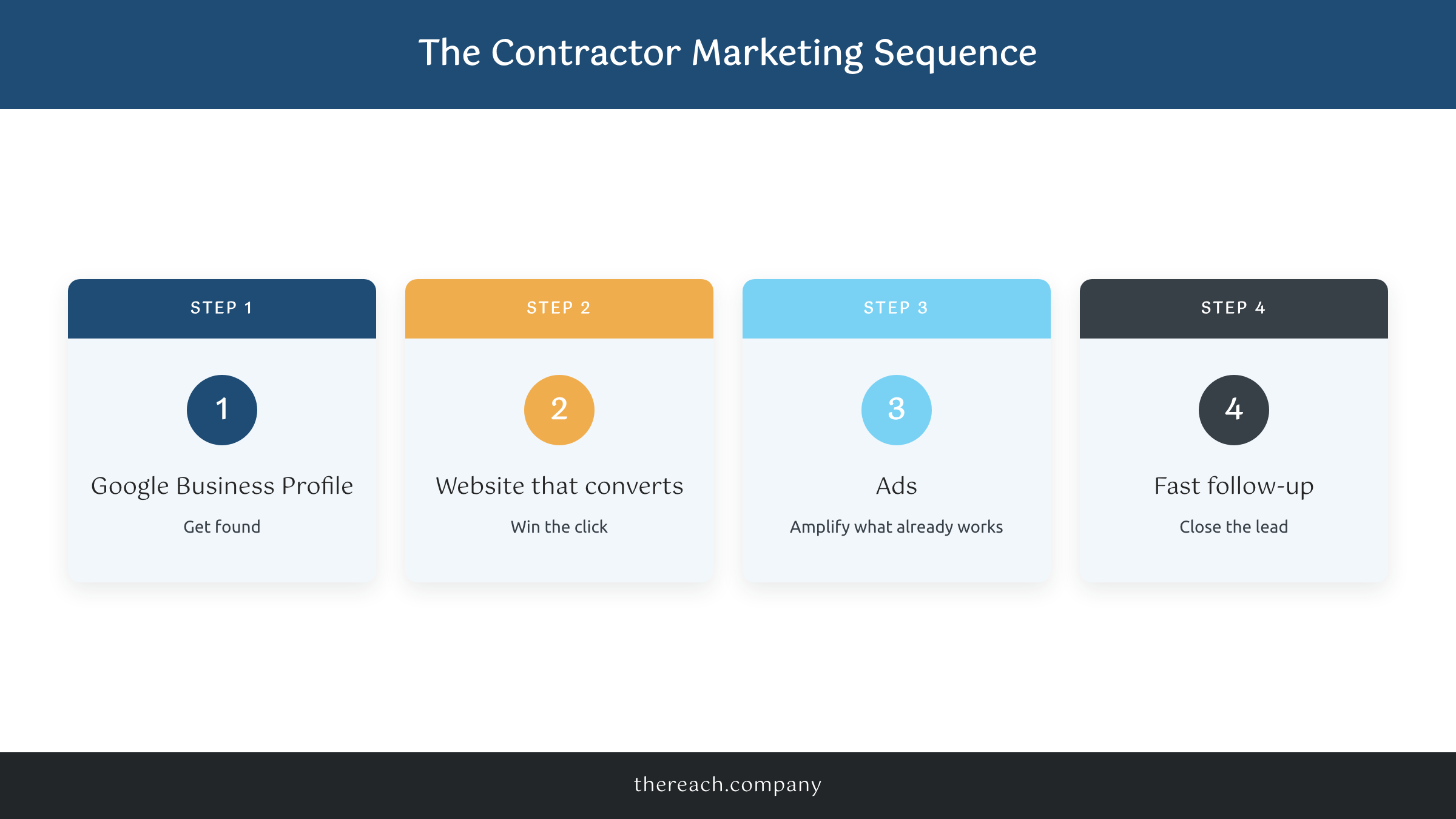
So here is the actual playbook. If you do these in order, you have a marketing strategy for contractors that compounds instead of a pile of tactics that fight each other.
First, own your Google Business Profile. Claim it, complete it, and start collecting reviews this week. This is your findability layer and it is free.
Second, fix your website so it closes. One obvious call to action, fast load, clear services and service area, phone number a thumb can reach. This is your conversion layer.
Third, add fast follow-up. A CRM, missed-call text-back, and an automated sequence so no lead goes cold. We use GoHighLevel for exactly this, usually starting around $299 a month for the whole setup. This is the layer that catches the money leaking out the back.
Fourth, and only now, turn on ads to amplify. Start with Google Local Services Ads, measure the cost per booked job, and scale what works. This is your amplification layer, and it only pays off because the first three are solid.
That order is not arbitrary. It is the exact logic behind the lead generation system we build for service businesses: website that converts, search that gets you found, ads that amplify, and follow-up that closes, all wired together as one machine instead of four separate bills. You can build it yourself, one layer at a time, or you can have someone build it with you. Either way, build it in this order.
Contractor Marketing Questions We Hear a Lot
How much should a contractor spend on marketing?
It depends on your margins and how fast you want to grow, but here is a realistic frame. The findability layer (Google Business Profile and reviews) costs mostly time. A website that converts and a follow-up system run a few hundred dollars a month. Ads are the variable: start with a budget you can watch closely, measure cost per booked job, and only scale once the number makes sense. Do not start with a giant ad budget and no system. That is how contractors waste thousands and conclude marketing does not work.
Do I even need a website if I have a Google Business Profile?
Yes. The profile gets you found, but the website is where you close and where you control the story. Plenty of homeowners find you on the map, then click to your site to decide if you are the one. A strong profile with no website is a handshake with no follow-through. You want both, and you want them pointing at each other.
How long before this actually brings in jobs?
The Google Business Profile can start producing calls within weeks, because you are showing up for people already searching. The website and follow-up system pay off immediately once live, since they close leads you are already getting. Broader organic search rankings take longer, usually a few months of steady work. Ads can produce leads almost right away, but only once the first layers are ready to convert them.
Should I do SEO or ads first?
Neither, technically. Do your Google Business Profile first, because it serves both. After that, if you need jobs this week, ads give you speed. If you are playing the long game and want leads that do not cost per click, organic search and reviews compound over time. Most contractors do both, in sequence, once the foundation is set.
The Bottom Line
Word of mouth got you here, and it is worth protecting. But it has a ceiling, and the jobs above that ceiling go to the contractor who is findable, trustworthy, and fast. That is not luck. That is a system, built in order: Google Business Profile, then a website that converts, then follow-up that closes, then ads that amplify.
You do not need a full agency and you do not need to do it all at once. Pick the first layer, get it right, then stack the next one. The finish line is a lot closer than it feels. Promise. And if you want a partner who will build the whole marketing strategy for contractors with you instead of selling you one piece of it, that is exactly what we do. You got this, and if you need a hand, we got you too.

