

Can I shoot straight with you? If you’ve been searching how to get more leads from Facebook ads and you’re already running campaigns, I’d bet the ads themselves aren’t your real problem. I’ve sat inside a lot of Facebook ad accounts for service businesses at The Reach Company, and most of the time the targeting is fine, the budget is fine, and the creative is decent enough. What’s broken is everything that happens after the click: a vague offer that doesn’t answer “why should I care right now,” a lead form asking for six fields when three would do, and a follow-up call that shows up 30 hours after someone raised their hand. Fix those three things and the same ad spend books more jobs. This isn’t a “spend more” article. It’s the conversion path audit I’d run on your account if you hired us tomorrow.
The Real Problem: Your Ads Aren’t Where the Leads Are Dying
Most Facebook ad accounts I look at don’t have a traffic problem. They have a conversion path problem, and the account manager (whether that’s an agency or the business owner themselves) keeps treating it like a traffic problem. The instinct when leads slow down is to raise the daily budget, refresh the creative, or widen the audience. Sometimes one of those actually helps. Most of the time it doesn’t, because the leak isn’t in the ad. It’s in the three steps between “someone clicks” and “someone becomes a booked job”: the offer, the form, and the follow-up.
Here’s the thing nobody tells you when you set up your first campaign: Meta’s own Ad Relevance Diagnostics measure your ad across quality, engagement, and conversion rate ranking compared to other ads chasing the same audience. Ads that rank well on all three cost less and get more results. But conversion rate ranking specifically measures what happens after the click, on your landing page or your form. You can have a perfect ad and still get penalized in the auction because your post-click experience is weak. Meta is literally telling you the funnel matters as much as the ad.
Fix #1: The Offer, Fix #2: The Form, Fix #3: The Follow-Up
The offer. “Contact us for a free consultation” is not an offer, it’s an invitation to think about it later. A real offer answers three things fast: what do I get, what does it cost me (time or money), and why should I act now instead of next week. For a home service business, “Get a same-day quote, no obligation” beats “Contact us” every time. For a med spa, “$99 intro Botox session, this week only” beats “Learn more about our services.” Specificity converts. Vague doesn’t.
The form. Every field you add past name, phone, and the one qualifying question (like zip code or service needed) costs you leads. I’ve watched businesses cut a 7-field Facebook lead form down to 3 fields and see cost per lead drop by a third, same ad, same budget, same audience. Facebook’s native lead forms pre-fill contact info from the user’s profile, which is exactly why they convert better than sending traffic to a slow-loading website form. If you’re not using native lead forms or a fast, mobile-first landing page (we build these on WordPress with WP Rocket for speed), you’re adding friction you don’t need.
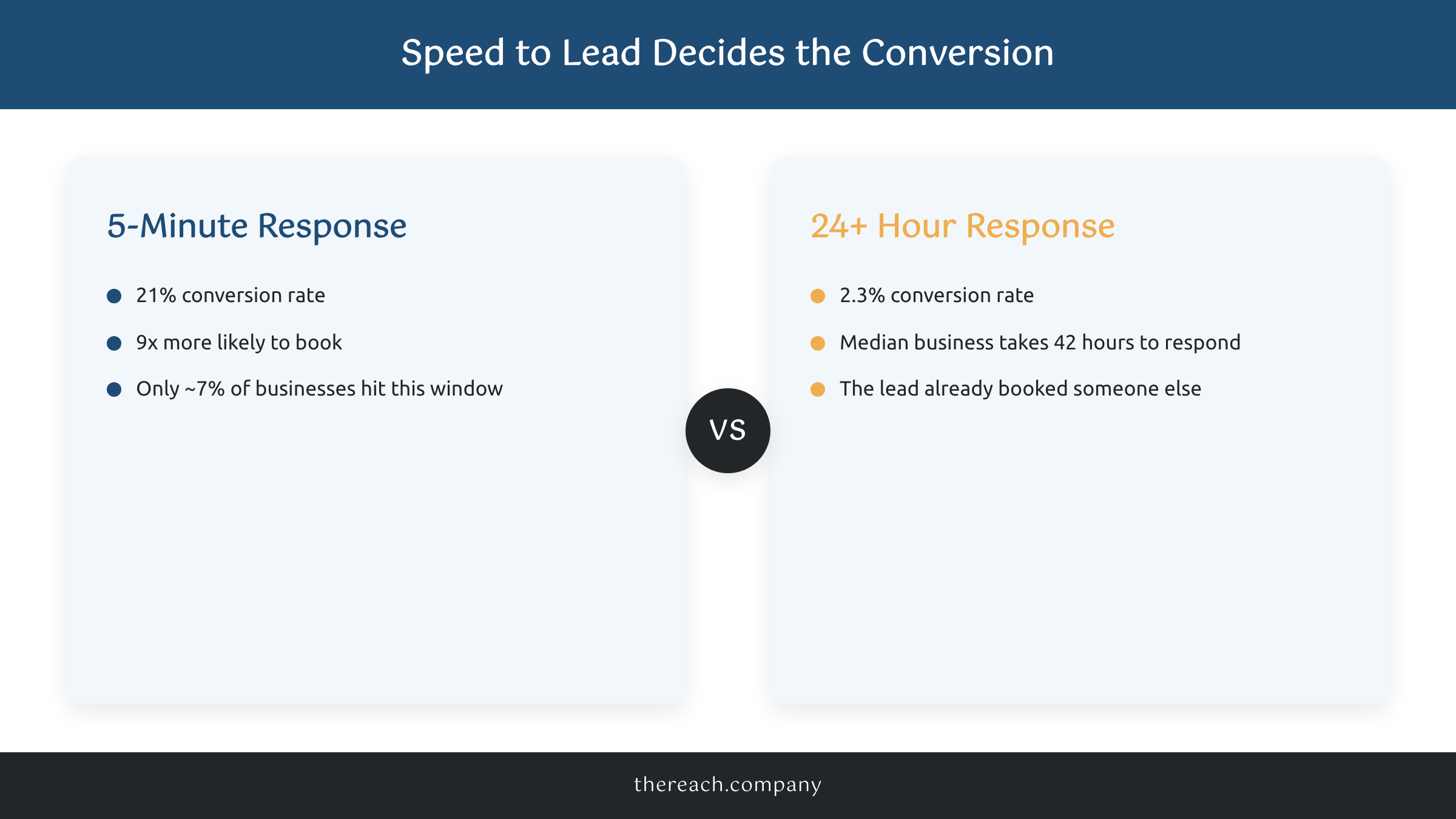
The follow-up. This is the one that actually costs the most money and gets talked about the least. Leads who get a response within 5 minutes convert at roughly 21%. Leads who wait until the next day convert at about 2.3%. That’s a 9x difference, and the median business takes around 42 hours to respond to a new lead. Only about 7% of businesses hit that 5-minute window at all. If your Facebook ad is generating leads and your close rate still feels low, don’t blame the ad. Check your response time first.
The Contrarian Truth: More Budget Makes a Broken Funnel Bleed Faster
Here’s the part that surprises people. If your offer is weak, your form is too long, and your follow-up is slow, increasing your ad budget doesn’t fix anything. It just makes you lose money faster and at a bigger scale. I’ve seen business owners double their Facebook ad spend to “get more leads,” and all that did was double the number of leads that got no response in time to book. The ads did their job. The system behind the ads didn’t. Before you touch your budget, fix the path the lead has to travel after they click. A $500/month campaign with a tight offer, a 3-field form, and a 5-minute response system will outperform a $2,000/month campaign feeding a slow, generic funnel every time.
Proof: What This Actually Looks Like
Chin Up Aesthetics, a medspa client of ours, generated over 1,300 leads from Facebook ads in a single year, and they were 1st in the Map Pack for eight-plus services on top of that. That didn’t happen because the ads were flashy. It happened because the offer was specific, the form was fast, and the leads landed in a system (we run these on GoHighLevel) that texts and calls within minutes of a form submission, not hours. The Unstuck Group, a different kind of client entirely, got a 29:1 return on one Facebook campaign and averaged under $2 per qualified lead, again because the funnel behind the ad was built to move fast, not because the ad spend was huge.
The pattern holds across industries: the ad gets someone to raise their hand. Everything after that determines whether they become a client or a name on a spreadsheet nobody called back.
What to Do Instead of Raising Your Ad Spend
If you actually want to get more leads from Facebook ads without throwing more money at the problem, work this list in order.
- Audit your offer first. Rewrite it so it answers what, cost, and why-now in one sentence. If you can’t do that in one sentence, it’s still too vague.
- Cut your form to 3 fields. Name, phone, and one qualifier. Everything else can be asked on the call.
- Build a follow-up system, not a follow-up habit. A human checking their phone “when they get a chance” is not a system. Automated text-back within 60 seconds, paired with a call from a real person within the hour, is. GoHighLevel handles this natively, which is why we set it up for every client we take on.
- Then, and only then, look at spend. Once your funnel converts well, more budget means more booked jobs. Before that, more budget just means more waste.
If you want the honest version of what a Facebook ads budget should actually look like once your funnel is fixed, we broke down real numbers here. And if you’re weighing whether ads are even worth it for your business right now versus fixing the funnel first, our pricing is public so you can see exactly what fixing this costs before you commit to anything.
You don’t need a bigger budget to get more leads from Facebook ads. You need the three fixes above running before you spend another dollar. Fix the path, then scale the spend. Plain and simple.
You’ve probably already got the budget it takes to make this work. Let’s make sure it’s not leaking out the bottom of a busted funnel. You got this.

