
When a pipe bursts at 7am, nobody opens a notebook and starts carefully comparing plumbers. They grab their phone, type “plumber near me,” and call one of the first three names they see. That’s the whole ballgame. SEO for plumbers isn’t about ranking for clever blog posts or stuffing your homepage with keywords. It’s about being one of those first three names when somebody has water spreading across their kitchen floor and zero patience.
Here’s the rub. Most plumbers either ignore this completely or hand it to an agency that treats a plumbing company like a SaaS startup. Neither one works. Let me walk you through what actually moves the needle, in plain English, no fluff.
SEO for Plumbers Isn’t Like Regular SEO
Most SEO advice online is written for ecommerce stores and bloggers chasing national keywords. That advice will quietly waste your money. A plumber lives and dies inside a 20-mile radius, and by intent that’s measured in minutes, not months.
Nobody dealing with a burst pipe is going to sit down and read your 2,000-word article on copper versus PEX first. They search, they scan three options, they call. So your entire strategy has to be built around showing up fast, locally, for people who are ready to hire right now. That single shift changes which keywords matter, which pages you build, and where you spend your limited time. Get the framing right and everything after it gets simpler.
The Map Pack Is the Whole Game
Open Google and search for a plumber in your city. See that box with three businesses, a little map, and the star ratings? That’s the local map pack, and for a plumber it’s worth more than every other result on the page combined.
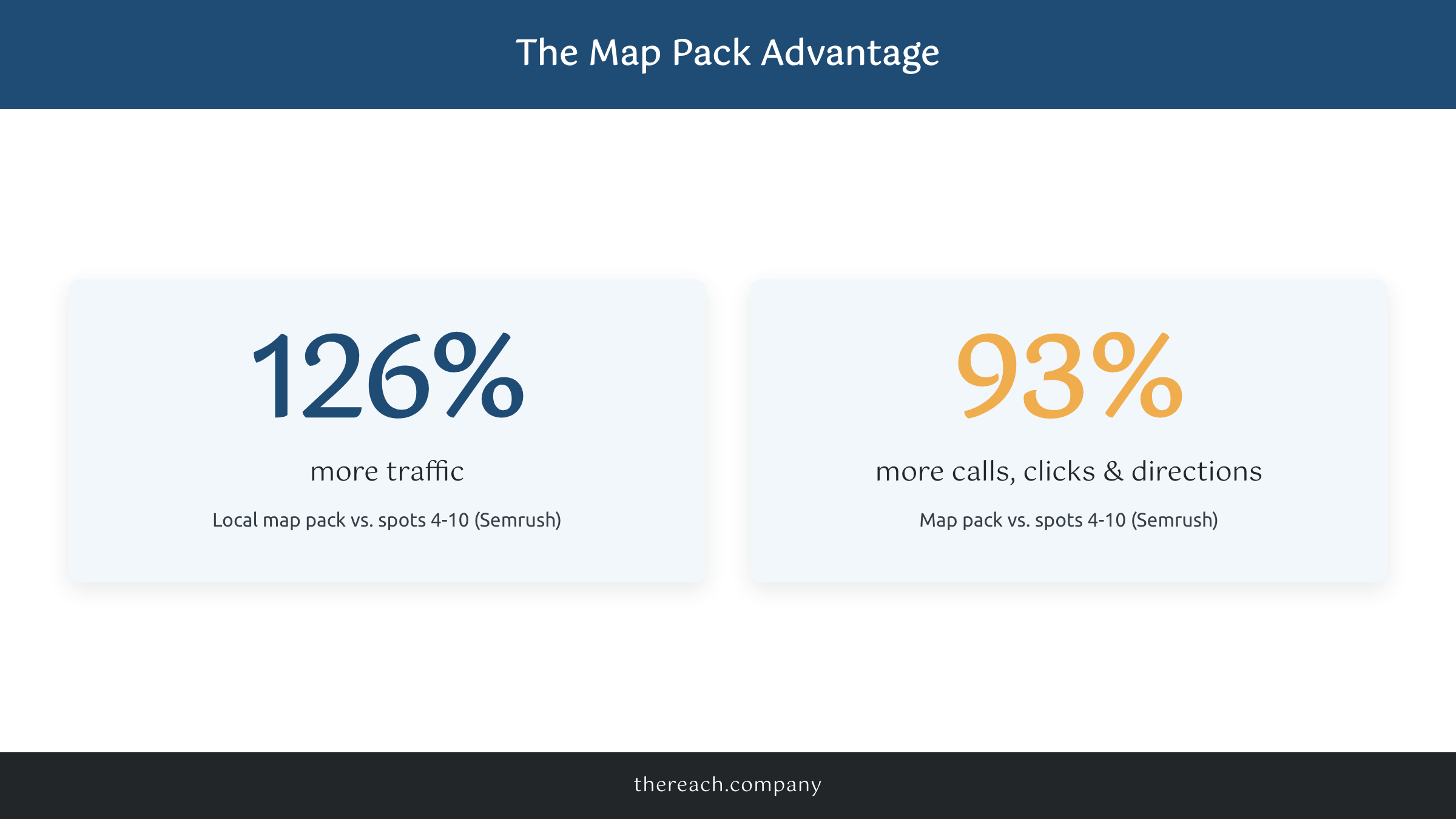
The numbers are not subtle. According to Semrush, businesses in the local map pack get 126% more traffic and 93% more calls, website clicks, and requests for directions than businesses ranked in spots four through ten. Let that sink in. The gap between landing in the top three and sitting at number six isn’t a small bump. It’s more than double the people picking up the phone.
Here’s the part most plumbers miss: the map pack runs on your Google Business Profile, not your website. Plenty of plumbers don’t even know they have one, or they claimed it years ago and never touched it again. That’s the first thing to fix. We’ve taken a local service business from barely showing up to first in the map pack for eight-plus core services, and almost all of that work happened on the profile, not a website rebuild.
Your Google Business Profile Does the Heavy Lifting
If you fix one thing this month, fix your Google Business Profile. Google decides who shows up in the map pack based largely on three things: relevance, distance, and prominence. You can influence all three.
Start with the basics most plumbers skip. Pick the right primary category (“Plumber,” not “Contractor”). List every service you actually offer as a separate item: water heater repair, drain cleaning, repiping, emergency plumbing. Add your real service areas by city. Upload actual photos of your trucks, your crew, and finished jobs, not a stock photo of a shiny wrench.
Then there’s reviews. Reviews are the prominence signal that separates the plumber getting calls from the one nobody can find. Ask every happy customer for one. Make it a habit at the end of every single job: send a text with a direct link while you’re still in the driveway. A tool like GoHighLevel can fire that review request automatically the second you close out a ticket, which is exactly how we set it up for service clients so it never depends on anybody remembering.
The Keywords That Actually Turn Into Jobs
Not every search is worth the same. “How does a toilet work” brings traffic. “Emergency plumber Marietta” brings a customer with a credit card already in hand. SEO for plumbers means chasing the second kind and happily ignoring the first.
The pattern that converts is almost always service plus city. Think “water heater replacement Marietta,” “drain cleaning Atlanta,” “burst pipe repair near me.” These don’t have huge search volume, and that’s the point. They’re lower competition and they’re typed by people who need a plumber today, not someday. Ten of these little searches that each bring two or three calls a month will beat one fantasy keyword you’ll never rank for. The volume looks small on a keyword tool and feels huge on your calendar.
Build a real page for each of your money services and each city you serve. Not one thin “Services” page that lists everything in a bulleted blur. A real page for water heater repair. A real page for your top three or four cities. This is the exact spot most plumbers and most generic agencies get wrong, which means it’s where you can quietly pull ahead. If you want the full breakdown of how local search works under the hood, we wrote a plain-English guide to local SEO that covers it without the jargon.
Your Website Still Has to Back It Up
Google won’t reward you with map-pack placement if your website looks like it was built in 2009 and takes nine seconds to load. The profile gets you seen. The site closes the deal. And Google quietly watches whether people actually stick around once they click.
Three things matter most on a plumbing site. Speed: half your visitors are on a phone with one bar of signal, standing over a flood. If your site crawls, they bounce and call the next guy, so run it through Google’s PageSpeed Insights and fix what it flags. Click-to-call: your phone number should be a big, tappable button at the top of every page, not buried inside a contact form. When somebody’s ankle-deep in water, a contact form is an insult. Proof: reviews on the page, real photos, your service-area list, and a clear “we answer 24/7” if that’s true.
This is where SEO stops being a standalone trick and starts being part of a system. Your Google Business Profile feeds the map pack, your website converts the click, and the two have to point at each other. That’s the thinking behind our Local SEO service and the way we treat marketing as one connected machine instead of a pile of disconnected tactics.
What to Do This Week
You don’t need to boil the ocean. Here’s the short list, in order:
- Claim and fully fill out your Google Business Profile. Right category, all services, real photos, accurate hours.
- Ask your last 10 happy customers for a Google review. Send the link by text.
- Build or rewrite one service page targeting “[your top service] [your city].”
- Add a tap-to-call button to the top of your site and check your load speed.
- Make sure your name, address, and phone number match everywhere online, exactly the same.
Do those five and you’ll be ahead of most plumbers in your zip code, because most of them haven’t done a single one. None of it is instant. Profile changes can show up in the map pack within a few weeks, while new service pages usually take a couple of months to settle. It really depends on how competitive your city is, but the work compounds. Every review and every page keeps paying you back long after you’ve done it.
Can I shoot straight with you? SEO for plumbers isn’t complicated, but it is consistent work, and consistency is hard when you’re already running 12 jobs a week. If you’d rather hand that hat to someone who does this every day and actually cares whether your phone rings, that’s what we’re here for. You keep fixing pipes. We’ll help you get found. You got this.

