
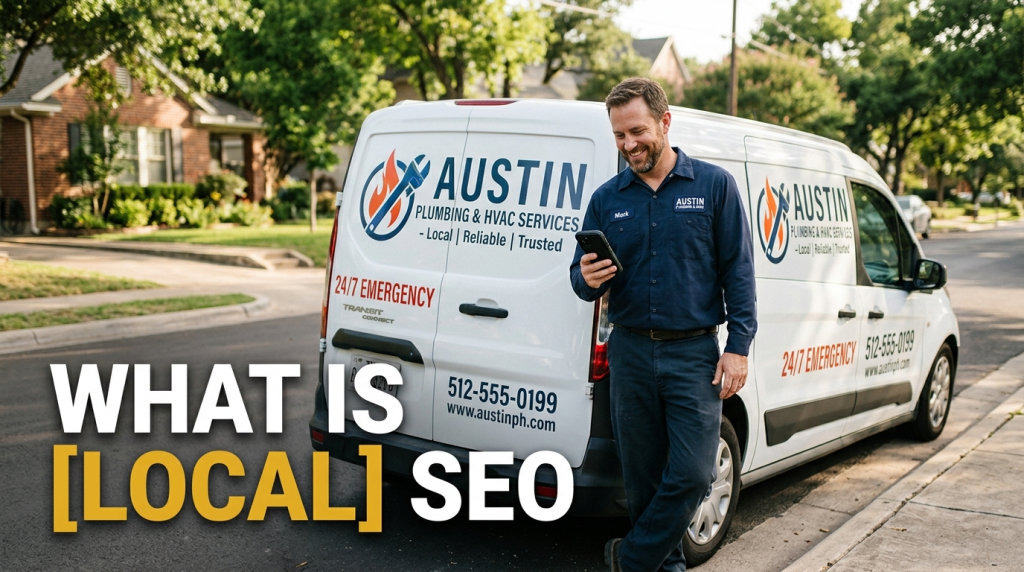
Picture two plumbers on the same street. Same trucks, same skill, same fair prices. A pipe bursts three blocks away, and the homeowner does what everybody does now: pulls out a phone and types “emergency plumber near me.” One of those plumbers shows up in the top three results with 140 reviews and a “call” button. The other one is on page two, where nobody ever looks. Guess who books the $900 job.
That gap is local SEO. So let me answer the question straight: what is local SEO? It is the work that gets your business found by the people near you who are ready to buy right now. Not visitors from three states away. Not vanity traffic. The person down the road with a problem you solve and a credit card in their pocket.
Here is the rub. Almost every article that tries to explain what is local SEO is written for marketers, stuffed with terms like “SERP features” and “entity salience,” and it never tells a busy owner what to actually do on Monday morning. This guide is the opposite. Plain English, real numbers, and the handful of things that genuinely move the needle for a service business. By the end you will know exactly what local SEO is, how local search actually works, what matters, and what you can safely ignore.
What Local SEO Actually Is (in Plain English)
Regular SEO is a competition for the whole internet. If you sell a course or ship products nationwide, you are fighting everyone, everywhere, for a search term. That is a long, expensive war.
Local SEO is a much smaller, much fairer fight. It is the practice of getting your business to show up when someone in your area searches for what you do. “HVAC repair Marietta.” “Best medspa near me.” “Roof leak Sandy Springs.” Google looks at where the searcher is standing and tries to serve up businesses that are close, relevant, and trusted. Local SEO is how you become one of those businesses.
The difference matters because of intent. Somebody searching “how does air conditioning work” is curious. Somebody searching “AC not blowing cold air near me” at 2pm in July is sweating, frustrated, and ready to pay the first credible company that picks up. Local SEO puts you in front of that second person. That is why, for a service business, local search is usually the highest-return marketing you can do. You are not interrupting anyone. They already raised their hand. You just have to be there when they look.
Here is the part that should make you feel better: you are not competing with Amazon or some venture-funded national brand for these searches. You are competing with the other three or four shops in your town. That is a fight you can win.
How Local Search Actually Works
When someone runs a local search, Google shows two different things on the same screen, and understanding the split is half the battle.
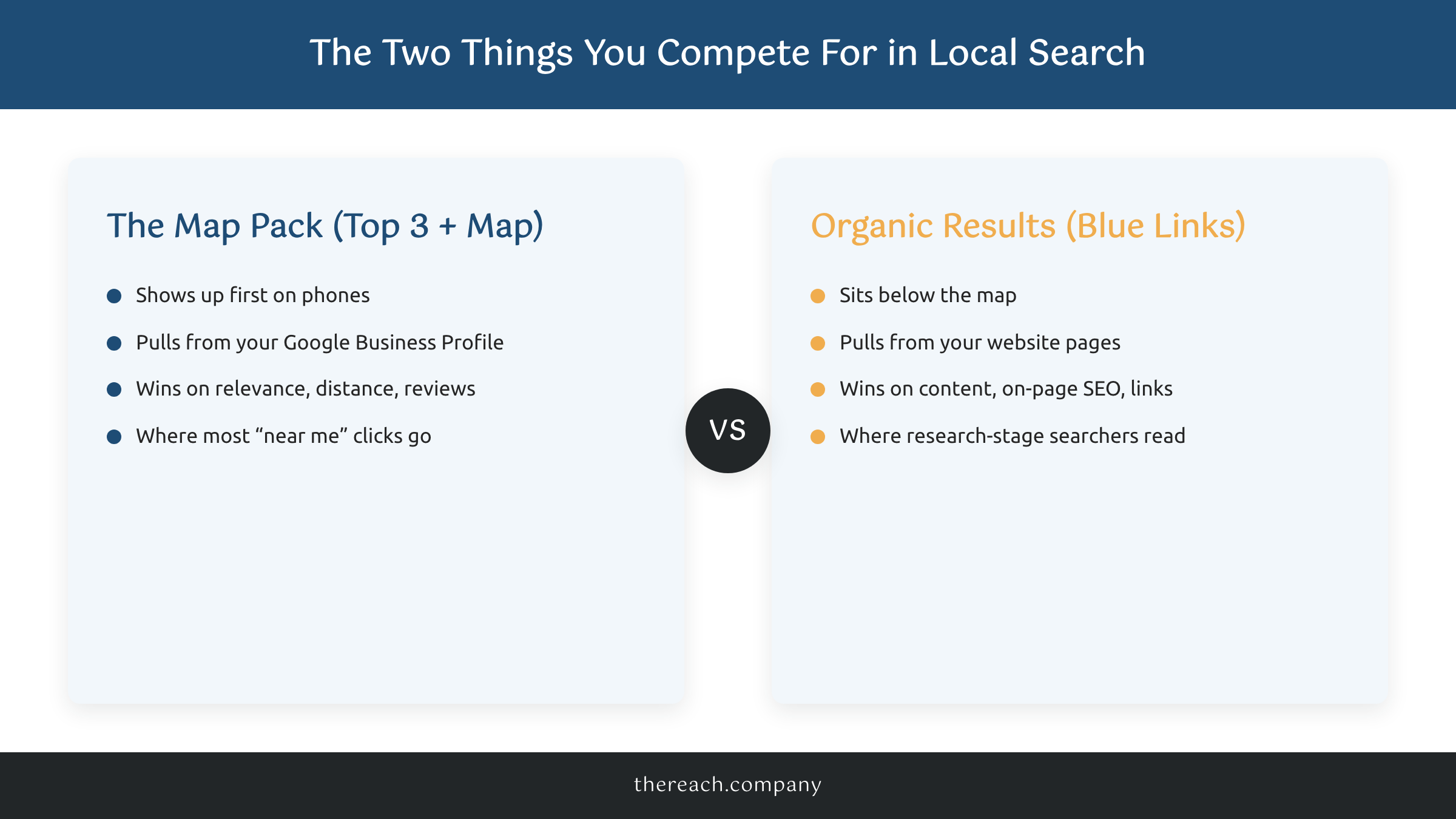
First is the map pack. That is the little map with the top three businesses pinned under it, usually with stars, hours, and a call button. On a phone, the map pack eats most of the screen before anyone scrolls. The businesses in those three spots get the lion’s share of the clicks and calls. The map pack is powered mostly by your Google Business Profile, the free listing you claim and manage for your business.
Second is the organic results, the regular blue links below the map. Those are powered by your website: your pages, your content, the on-page basics, and the links pointing to you. Someone in research mode (“what does drain cleaning cost”) often scrolls down and reads those.
So when you do local SEO, you are really working two surfaces at once: your Google Business Profile (to win the map pack) and your website (to win the organic links). The best local results come from both working together, which is exactly the kind of integrated approach that makes the whole system pay off instead of one piece carrying the load.
Google decides who ranks using three plain-English factors. Relevance: does your business actually match what they searched? A profile that says “plumber” and lists your real services beats a vague one. Distance: how close are you to the searcher, or to the area they named? Prominence: how well-known and trusted are you, measured through reviews, mentions across the web, and your overall reputation. You cannot move your shop closer to every customer, but you can absolutely win on relevance and prominence, and that is where the work lives.
If you want the current lay of the land, we broke down what actually changed in local SEO this year in a separate piece. The fundamentals below have not changed, but the tactics around them shift every year.
What Actually Moves the Needle
This is where most “what is local SEO” guides drown you in a 47-item checklist. Forget that. Here is the short list that actually decides whether you show up.
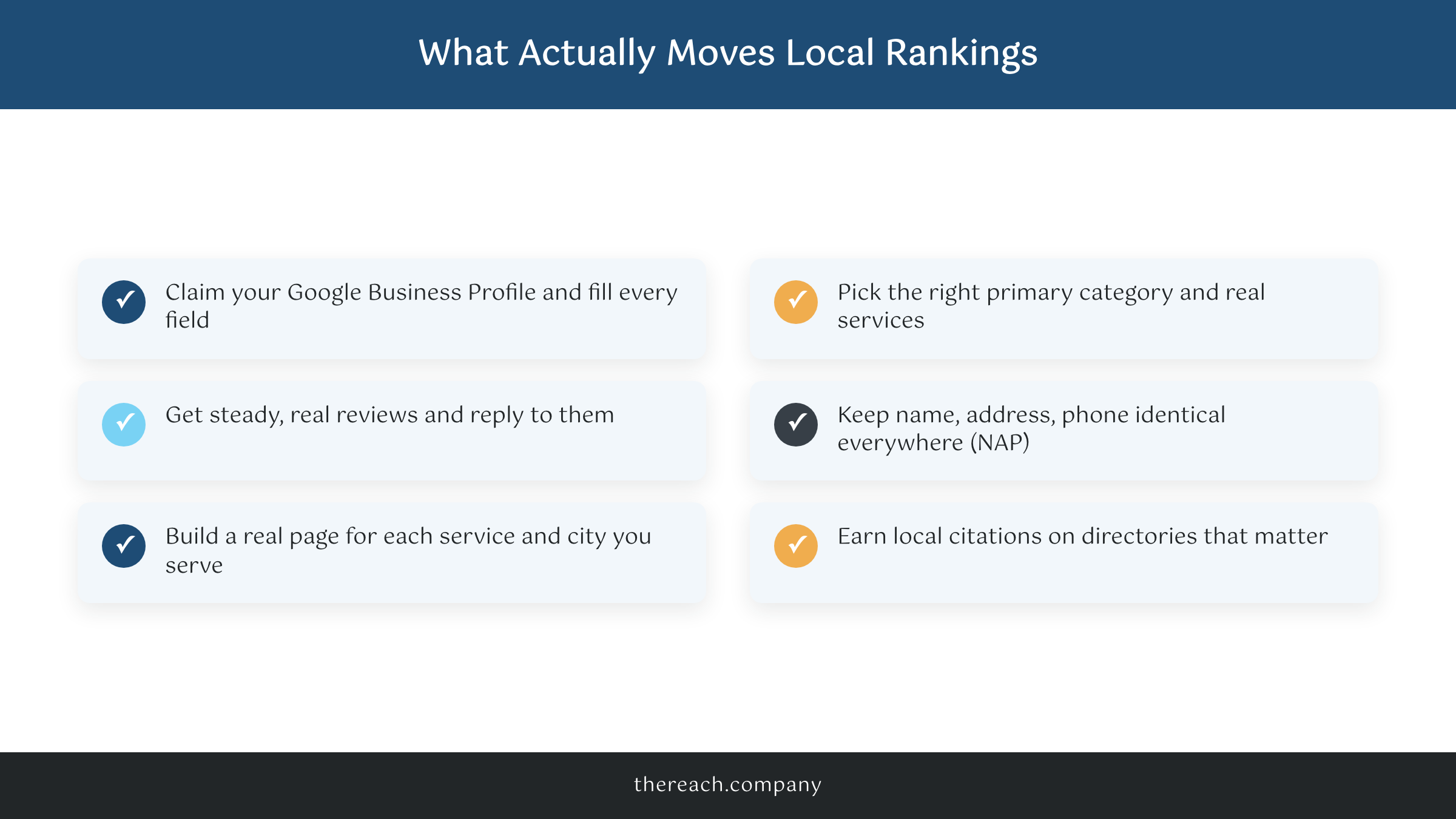
Your Google Business Profile. This is the single highest-leverage thing you own, and it is free. Claim it, then fill in every field: the right primary category, your real services, hours, service area, photos, and a description that sounds like a human. An incomplete profile is like a storefront with the lights off. Google will not feature a business it cannot understand, and customers will not call one they cannot read. Most owners set this up once, half-finished, and never touch it again. Going back and completing it is often the fastest local SEO win there is.
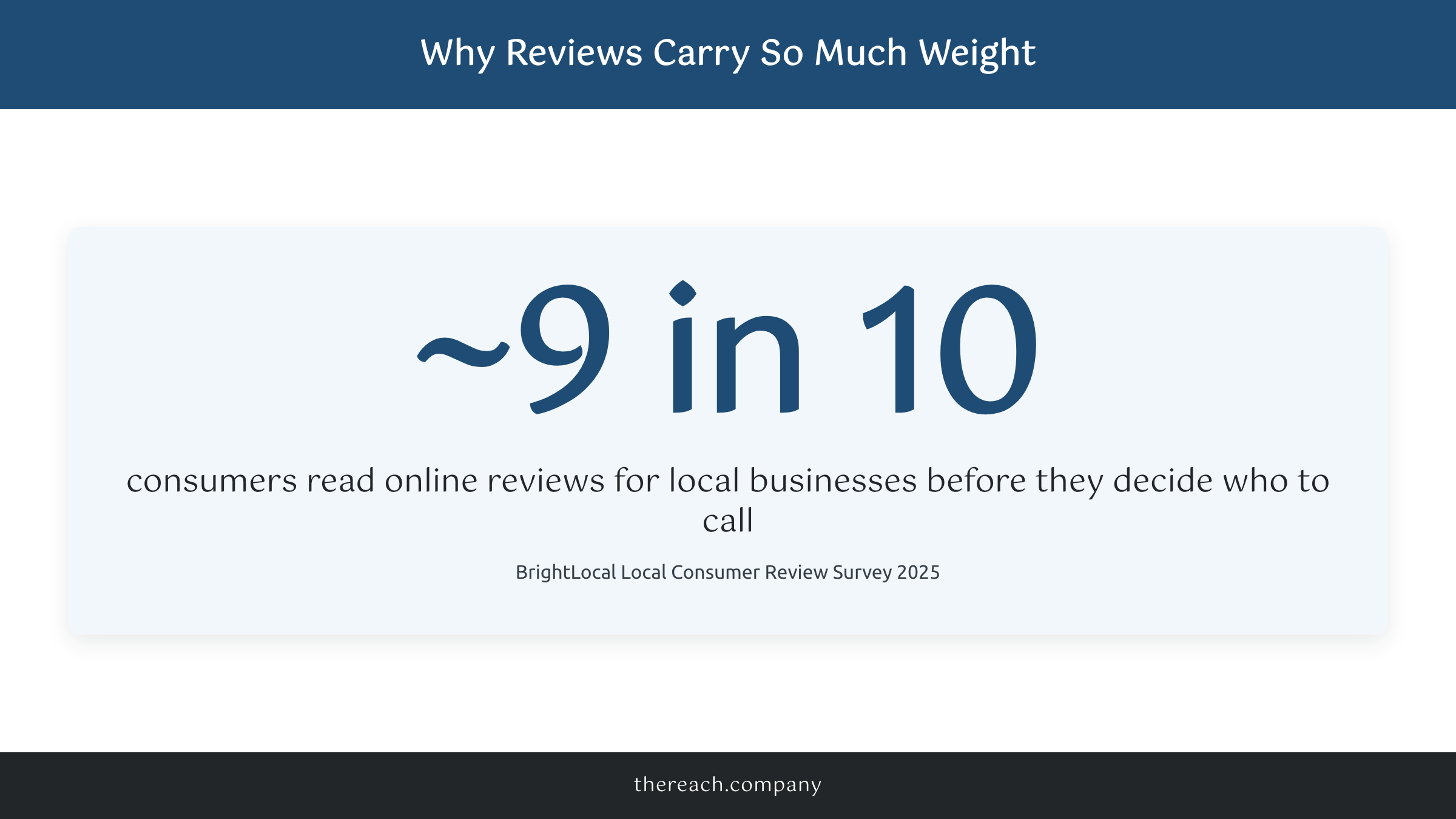
Reviews. Reviews do two jobs at once: they tell Google you are prominent and trusted, and they tell humans you are safe to call. And humans are paying attention. According to BrightLocal’s Local Consumer Review Survey, roughly nine in ten consumers read online reviews for local businesses before they decide who to call. Let that sink in. The work you did getting found is wasted if your reviews are thin or stale next to the shop beside you.
You do not need a thousand reviews. You need a steady drip of real ones and the basic courtesy of replying to them. Ask every happy customer, make it a one-tap link, and respond to the good and the bad alike. A business with 90 reviews and recent activity will usually beat one with 300 reviews that all stopped two years ago.
The practical move is to make asking automatic instead of awkward. After every finished job, send a one-tap review link by text while you are still in the driveway and the customer is still glad you showed up. A tool like GoHighLevel can fire that text the second you mark a job complete, so it does not ride on memory or good intentions at the end of a long day. Then reply to the reviews that land. A fifteen-second “Thanks, Maria, glad we got that water heater sorted before the weekend” tells the next reader you are present and you actually care, and it quietly signals to Google that the profile is alive. None of this is hard. It just has to happen week after week, instead of being the thing you keep meaning to set up someday.
NAP consistency. NAP stands for Name, Address, Phone. Google wants to trust that you are a real, stable business, and one way it checks is by seeing your exact same name, address, and phone number everywhere it finds you: your website, your Google Business Profile, Yelp, Facebook, directories. If your address says “Suite 200” in one place and “Ste. 200” in another, with a different phone number on an old listing, you are sending mixed signals. Cleaning that up is boring, unglamorous, and genuinely effective.
A real website with localized pages. Your Google Business Profile wins the map pack, but your website earns the organic links and backs up everything the profile claims. The big move here is simple: build a real page for each core service and, if you serve multiple towns, a real page for each city. Not thin doorway pages, actual useful pages that answer what that customer wants to know. A “Drain Cleaning in Smyrna” page that talks specifically about drain cleaning in Smyrna will out-rank a generic “Services” page every time.
Citations. A citation is just your business listed on another site, like a directory or an industry association. They reinforce that NAP and add to your prominence. You do not need hundreds. A handful on the directories that matter for your trade, with consistent information, covers it.
That is the list. Google Business Profile, reviews, NAP consistency, localized pages, and a few solid citations. Do those well and you are ahead of most of your competitors, because most of them are doing none of it consistently.
The Part Nobody Tells You
Can I shoot straight with you? Most people think local SEO is about “ranking.” It is not. Ranking is the scoreboard, not the game. The actual game is being the obvious, trusted choice the moment someone needs what you sell.
Here is why that reframe matters. You could obsess over moving from position four to position three on a keyword nobody important is searching, and feel productive doing it, and book zero extra jobs. Or you could make sure that when a real customer in your town searches the thing they actually type, they find a complete profile, a stack of recent five-star reviews, a clear call button, and a website that confirms you do exactly what they need. The second business wins even if a competitor technically “ranks higher” on some term in a tool.
Local SEO is a trust machine, not a ranking trick. Every piece feeds the same outcome: a stranger with a problem decides, in about eight seconds, that you are the safe choice. The map pack gets you seen. The reviews make you credible. The website closes the loop. When people ask me what local SEO is really for, that is the honest answer: it is how you become the default option in your area instead of one of several names a stressed-out customer is nervously comparing.
That is also why local SEO compounds. Every review, every completed profile field, every localized page is a brick. Stack enough of them and you stop competing on price, because you are the obvious choice and the obvious choice does not have to be the cheapest.
What This Looks Like When It Works
This is not theory. One of our clients, a medspa, came to us getting buried by bigger, louder competitors. We did the unglamorous work: completed and optimized the Google Business Profile, got the review engine running, cleaned up the listings, and built real pages for each service. Within the year that medspa ranked first in the map pack for more than eight of its core services and pulled 1,928 leads from the website. First place, on the searches that actually turn into booked appointments, in a competitive metro.
Nothing about that was a magic trick. No secret algorithm hack. It was the same short list above, done consistently, for a business that was great at its actual job and just needed to be found. That is the whole point of local SEO. You keep doing what you do best. The marketing makes you the obvious choice for the people already looking.
The reason it worked is the same reason it works anywhere: the fundamentals are not a secret, they are just tedious, and most competitors quit before they compound. Show up, do the boring brick-laying for a few months, and you pass the businesses that gave up.
What You Can Safely Ignore
Now the relief. A lot of what gets sold as “local SEO” is noise, and ignoring it will save you money and stress.
Ignore keyword-stuffed footers that list 40 city names in tiny gray text. Google has seen that trick for a decade and it can hurt you now. Ignore anyone selling you fake reviews or “review gating” schemes, because that is a fast way to get your profile suspended and torch the trust you are trying to build. Ignore cheap backlink packages from overseas sellers promising “500 links for $99.” Those links are worthless at best and toxic at worst. And ignore the endless parade of algorithm-rumor panic. The fundamentals above have held for years. The shop that quietly completes its profile and earns real reviews beats the one chasing every rumor.
Here is the honest line on doing it yourself: a determined owner absolutely can handle the Google Business Profile, the reviews, and the NAP cleanup. That is the 80/20 right there, and you should not pay anyone to do what you can knock out in a weekend. The deeper website work, the localized pages, the technical pieces, and the ongoing consistency are where it gets to be a real job. That is the point where a lot of owners decide they would rather have it local SEO done for you so they can get back to the work that actually pays. There is no shame in either choice. Just know which parts are quick wins and which parts are a grind.
Local SEO FAQ
How long does local SEO take to work?
Local moves faster than national SEO, but it is not instant. Profile and review work can shift things in weeks. Website and ranking gains usually take a few months to compound. If someone promises page-one results in seven days, run. We laid out the real SEO timeline in its own post.
Is local SEO worth it for a small business?
For a service business that serves a defined area, it is usually the best marketing money you can spend, because you are reaching people who already want what you sell. The honest catch: it requires consistency, not a one-time push.
Can I do local SEO myself?
Yes, the core of it. Claim and complete your Google Business Profile, get a steady stream of real reviews, and make your name, address, and phone identical everywhere. That alone puts you ahead of most competitors. The website and technical layers are where many owners bring in help.
Do I even need a website if I have a Google Business Profile?
You need both. The profile wins the map pack, but the website earns the organic links, answers deeper questions, and proves you are legit. A profile with no real website behind it caps how far you can climb.
So, What Is Local SEO? The Short Version.
Local SEO is the work of becoming the obvious choice for the people near you who are ready to buy. It runs on two surfaces, your Google Business Profile and your website, and it is decided by relevance, distance, and prominence. The short list that actually matters is a complete profile, real reviews, consistent NAP, localized pages, and a few solid citations. The rest is noise.
Plain and simple: you do not have to master all of it this week. Claim your profile, ask three happy customers for a review, and fix your address everywhere it is wrong. That is a real start, and it is more than most of your competitors will ever do.
The finish line is a lot closer than it feels. Promise. You got this. And if you would rather hand off the grind and get back to running your business, we got you too.
Ready for the specific playbook? Here is exactly how to get your business on Google Maps and climb into the Map Pack.
If you keep tripping on the map pack specifically, here is a plain walk-through of why your Google Business Profile isn’t showing up and how to fix it.

