

Can I shoot straight with you? Every AI vendor pitching your business right now calls their product “agentic,” and half of them couldn’t give you a straight answer if you asked what is agentic AI. Somebody heard the term at a conference, slapped it on a landing page, and now it’s stamped on every SaaS pricing tier from your CRM to your email tool.
Here’s the plain version. Agentic AI is software that takes the next step without you clicking a button. Not “AI that drafts an email you still have to send.” AI that reads the lead’s reply, decides what it means, books the call, and texts you a heads-up, on its own, in whatever order the situation actually calls for.
That’s the whole concept. It’s not science fiction and it’s not a scam. It’s a specific, useful upgrade to the AI tools you already use, and by the end of this you’ll know exactly where it fits in a business with no IT department.
The Real Problem
Most business owners I talk to have already used ChatGPT to draft a Facebook post or asked Claude to summarize a contract. That’s real AI, and it’s genuinely useful. But it’s also reactive. You type a prompt, it responds, and the conversation ends the second you close the tab. Nothing happens unless you’re the one driving.
So what is agentic AI, actually, versus the chatbot you already use? A chatbot answers a question. Agentic AI pursues a goal. It checks a calendar, cross-references a CRM record, decides a next action is warranted, and takes it, all without you sitting there prompting each step.
Confuse the two and you’ll make one of two expensive mistakes. Either you overpay for a “smart assistant” that’s really just a chatbot with a new logo slapped on the pricing page, or you underestimate what a genuinely agentic tool can take off your plate and keep doing everything by hand.
What Actually Makes AI “Agentic”
Per Zapier, the company behind one of the most widely used agent platforms for small businesses, agentic AI is “an AI system that can accomplish a goal autonomously: taking actions, making decisions, and course-correcting along the way without the need for human intervention.” The distinction Zapier draws that matters most for a business owner: a one-off automation runs the same fixed sequence every time. Agentic AI adjusts based on what worked and what didn’t.
Break that into four steps and it stops sounding abstract:
- Perceive — the system pulls in information: a new form submission, a missed call, an inbox reply.
- Reason — it decides what that information means and what should happen next.
- Act — it does the thing. Sends the text, updates the record, books the slot, escalates to a human.
- Learn — it adjusts its next decision based on the outcome of the last one.
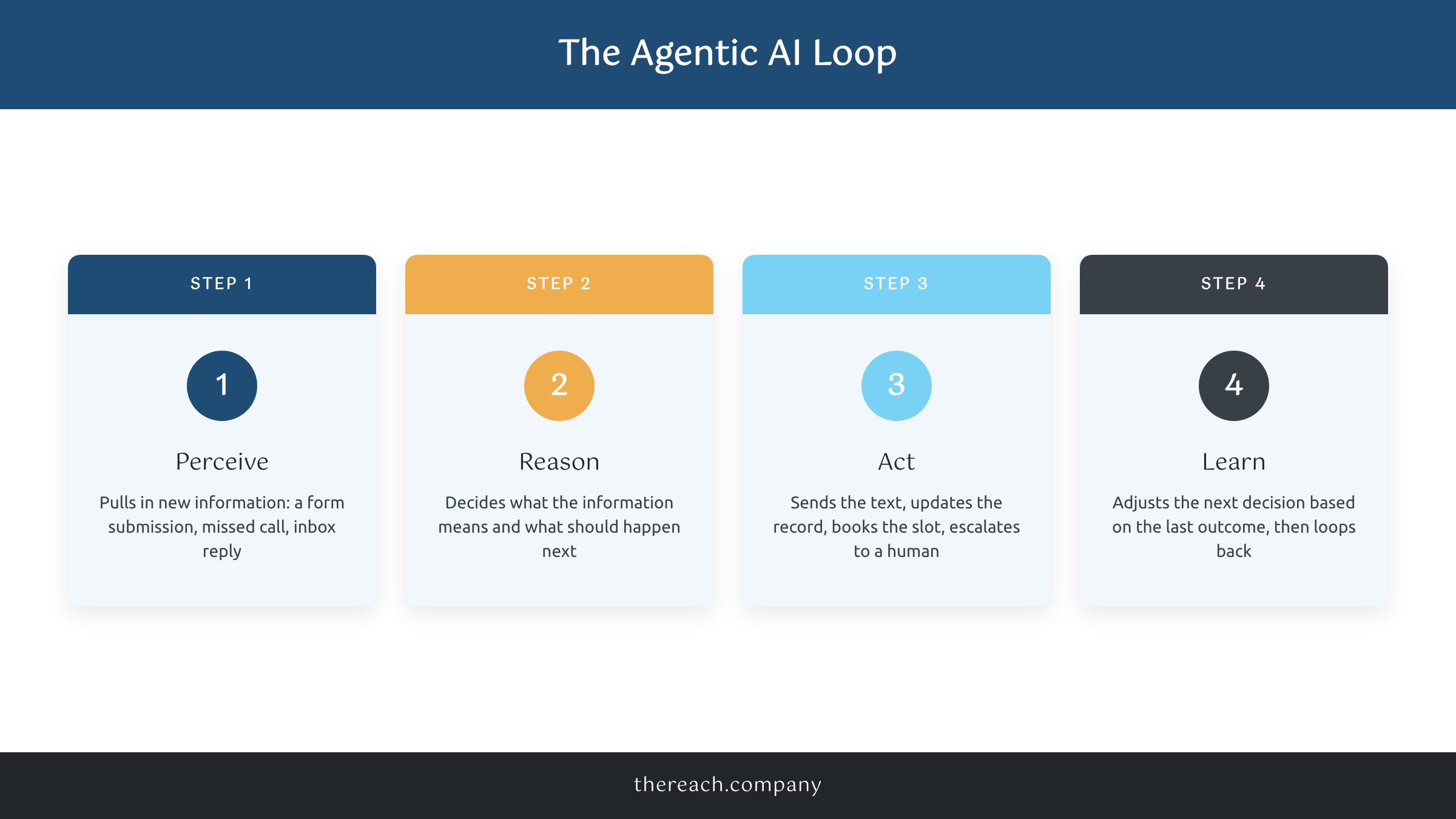
That loop is the entire difference between “automation” and “agentic.” A basic workflow that fires an email when a form is submitted is automation. Useful, but it does the same thing every time, in the same order, forever. An agent watching that same form decides whether the lead needs a call today or a nurture sequence next week, and it can change its mind next month if the pattern in your leads changes. If you want the deeper walkthrough of what these systems actually look like inside a small business, we cover AI agents for business here.
For a service business, that’s the entire value proposition. You’re not paying for novelty. You’re paying to stop losing leads between the form submission and the phone call, which is exactly where most small businesses bleed revenue.
The Contrarian Truth
Here’s the part most AI content won’t say out loud: you don’t need agentic AI to fix 90% of what’s broken in your follow-up right now. Most small businesses aren’t losing leads because they lack an autonomous AI agent. They’re losing leads because nobody follows up within five minutes, nobody logs the call, and the CRM is a graveyard of contacts nobody re-engages.
Buying an agentic AI platform before you have basic automation in place is like buying a self-driving car before you’ve learned to drive. It doesn’t close the underlying gap. It just makes the gap more expensive.
The honest answer to what is agentic AI worth to your business is: less than the sales page claims, at first. The businesses winning with agentic AI right now aren’t the ones who bought the fanciest agent on the market. They’re the ones who already had a working, if manual, follow-up system, and then let AI take over the parts that were repetitive and rules-based. The work of marketing and follow-up really is changing under your feet. Pretending otherwise doesn’t help you. Learning to use the tools well does.
Proof
We set up GoHighLevel, the CRM and automation platform The Reach Company runs for every client, for a metro-area spa client last year. The starting point wasn’t agentic AI. It was basic automation: new lead comes in, gets a text within 60 seconds, and gets a follow-up call scheduled automatically if they don’t respond within 24 hours.
That alone drove a 58% increase in booked appointments. Most of the “lost” leads weren’t actually lost. They were just never followed up with fast enough for a human to realistically manage across dozens of daily inquiries.
The agentic layer came second. Instead of one fixed 24-hour rule for every lead, the system started reading reply sentiment, sorting “not right now” from “call me next week” from total silence, and adjusting the follow-up cadence per lead instead of applying one rule to everyone. That’s the “reason and adjust” piece Zapier’s definition points to, not a chatbot bolted onto a contact form for show.
The lesson isn’t “buy an agent.” It’s “get the sequence right first, then let the sequence get smarter.”
What To Do Instead
If you’re a service business without an IT department, here’s the actual order of operations, not the order the sales pages want you to follow:
- Fix your follow-up speed first. If a lead waits more than five minutes for a first response, you’re already losing money, and no AI is required to solve that. Just a real system.
- Get one platform doing the coordination. GoHighLevel, HubSpot, or a comparable CRM that can see the lead, the calendar, and the conversation in one place. Agentic AI can’t act on data it can’t see.
- Automate the rules-based decisions first. “If no response in 24 hours, send X” is automation, not agentic AI, and it’s usually 80% of the value for 20% of the cost.
- Layer in agentic behavior where judgment actually matters. Lead scoring, reply-sentiment routing, and dynamic follow-up cadence are where agentic AI earns its keep, once the foundation exists to feed it good data.
Skip straight to step 4 and you’ll pay for intelligence you don’t have the plumbing to use yet.
Understanding what is agentic AI matters less than fixing your follow-up system first. Get that right, and the agentic layer becomes an upgrade instead of an expensive experiment.
Agentic AI isn’t hype and it isn’t a myth. It’s a real, useful category, and it’s going to keep showing up in more of the tools you already pay for. The mistake is treating it as a starting point instead of an upgrade. Get your lead follow-up working like clockwork first. That’s what our Lead Generation System is built to do, GoHighLevel automations that catch every lead the moment they raise their hand, so when you’re ready for the agentic layer, you’ve actually got something worth making smarter. You got this. And if the follow-up system isn’t there yet, we can build it with you.

