
You signed the agreement three weeks ago. The first invoice cleared. And tonight you’re staring at your inbox wondering what, exactly, is happening over there.
Can I shoot straight with you? Most owners have no idea what to expect from a marketing agency in the first 90 days. Nobody hands you a baseline. So when week three feels quiet, you can’t tell whether your agency is stalling or doing exactly what good work looks like at this stage. From the outside, both look identical.
This post is that baseline. What should be done by week 2, what should be shipped by month 1, what results are realistic by month 3, and the checkpoint questions that separate a real partner from an expensive subscription.
Why You Can’t Tell Stalling From Real Work
Picture hiring an office manager. Thirty days in, you ask what they’ve been working on and you get a shrug and a spreadsheet you can’t read. You’d have a hard conversation that same week. Agencies routinely survive that exact scenario for six months. Not because owners are pushovers, but because marketing work is invisible from the outside.
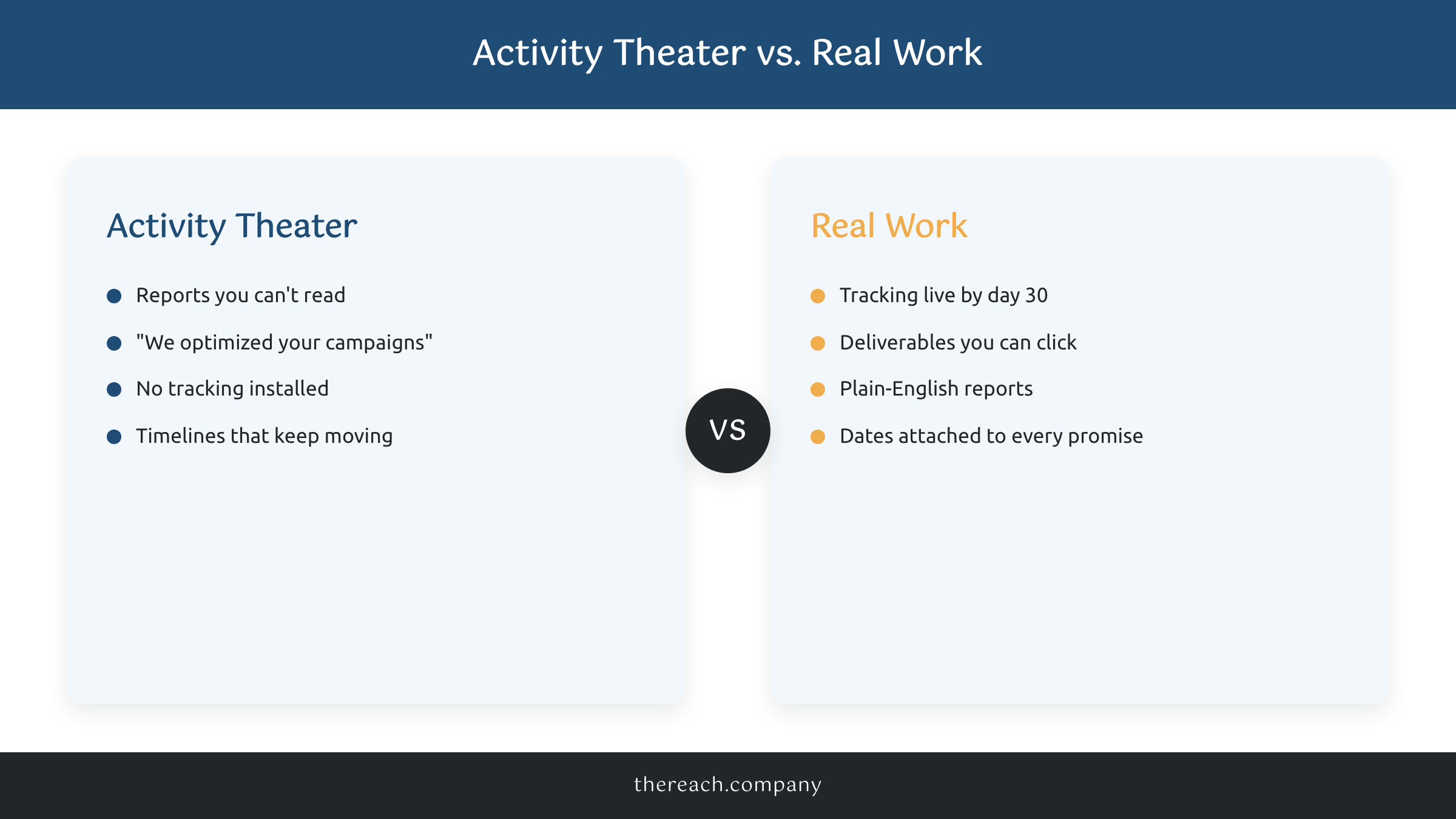
The problem isn’t that you lack the smarts to evaluate the work. It’s that many agencies report activity instead of outcomes. “We optimized your campaigns.” “We worked on your SEO.” Those sentences describe motion, not progress. When the reporting is vague, stalling and real work read exactly the same.
Before you signed, you did your homework. You probably asked some version of the 9 questions to ask before hiring a marketing agency. Here’s what happens after: most owners stop asking questions the day the contract starts, because they assume the agency will volunteer the plan. Good ones do. The rest count on your silence.
The Honest 90-Day Timeline
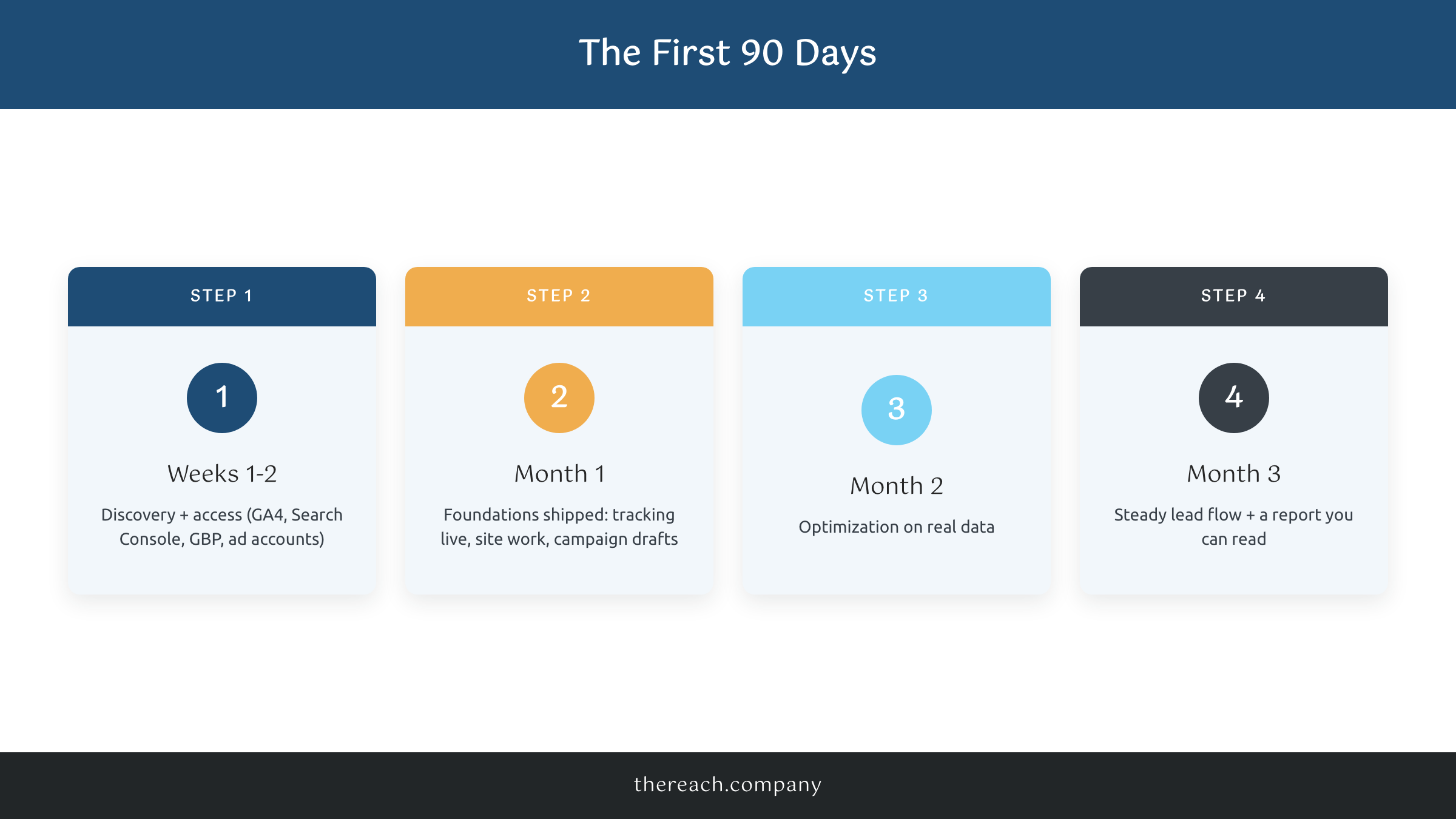
This is what to expect from a marketing agency that’s actually doing the job. Timelines shift a week or two depending on how fast access gets granted, but the shape holds.
Weeks 1 and 2: discovery and access. A good agency asks a lot of questions and requests a lot of logins. Google Analytics, Search Console, your Google Business Profile, ad accounts, website hosting, your CRM. They should be learning who your best customer is, which jobs make you the most money, and where your leads come from today. If ads are launching in week one before anyone asked those questions, that isn’t speed. That’s a template.
Month 1: foundations shipped. By day 30 you should see real deliverables. Tracking installed and tested, so every call and form fill gets counted. Website fixes underway, or a new build in motion. Campaign drafts you’ve approved. A strategy explained in plain English instead of a 40-slide deck of jargon. At The Reach Company this is our Discovery and Onboarding work, and we don’t skip it for anyone.
Months 2 and 3: the work starts compounding. Ads get optimization passes based on real conversion data instead of guesses. SEO content starts publishing. The first steady lead flow shows up. And your report should answer three things in under a minute: how many leads came in, what each one cost, and what happens next.
What you should NOT expect by day 90: page-one rankings for competitive keywords, or SEO that has already paid for itself. SEO is a compounding investment measured in months, not weeks. Anyone who promised otherwise sold you a timeline they can’t deliver.
A Quiet Start Is a Good Sign. A Loud One Usually Isn’t.
Here’s the rub. The agencies that look most impressive in week one are often the ones performing. Ads live on day 3, social graphics flying, a “We’re launched!” email in your inbox. Activity feels like value. But if nobody asked about your margins, your service area, or your best customer first, that speed came from a template with your logo dropped in.
The quiet agency asking annoying questions in week one is doing the work that makes month three pay.
Don’t take my word for it. Google publishes its own guide for hiring search help, and it’s blunt: no one can guarantee a #1 ranking on Google, and if someone guarantees you first place in search results, find someone else. Google’s guide also recommends granting read-only access to Search Console during an audit, not write access. Your accounts are yours. A trustworthy agency never makes ownership complicated, and you should own your ad accounts, your website, and your data on day one and every day after.
So if the pitch that won you over included “page one in 90 days,” expect the first 90 days to be spent learning why that promise was the red flag.
What a Real First 90 Days Produced for Our Clients
Our process runs Discovery, then Onboarding, then Full Build, then Launch, then Make It Better. The first 90 days covers roughly the first four phases. Here’s what that groundwork turned into.
Chin Up Aesthetics, a medspa client, pulled 1,928 leads from their website in one year and 1,300+ more from Facebook ads, and ranks first in the Map Pack for 8+ core services. None of those numbers existed on day 30. Day 30 looked like tracking installs, rebuilt pages, and campaign drafts. The leads showed up because the foundation was real.
The Unstuck Group averages a 14:1 return on their Google campaigns. That ratio came from months of optimization passes on real conversion data, and that data only existed because tracking went in during week two.
By day 90 you should have a running system and your first consistent leads. The headline numbers come later, and they only come if the boring early work actually happened.
Your Checkpoints: Day 14, Day 30, Day 90
Put three dates on your calendar the day you sign. Then ask:
Day 14: Can they describe your best customer back to you? Is there a written tracking plan? Do you still own every account they’ve touched? You should. Forever.
Day 30: What shipped? Ask them to show you, not tell you. Live tracking, pages, approved campaign drafts. You should also know exactly where every dollar goes. We publish everything on our pricing page: websites from $299/mo, lead generation at $299/mo, ad management at $500/mo per campaign. Any agency should be able to account for your money with that level of clarity.
Day 90: How many leads came in, what did each one cost, and what’s the plan for next quarter? If you want to pressure-test the answers, here’s how to tell if your marketing is actually working beyond vanity metrics.
Vague answers at one checkpoint is a conversation. Vague answers at all three is your answer.
The Baseline Is the Whole Game
Knowing what to expect from a marketing agency turns you from a hopeful bystander into an informed owner. And informed owners get better work. Not because agencies fear them, but because clarity keeps everyone honest.
If you’re 90 days in with nothing to show for it, or you’re about to sign and want a partner who hands you this timeline before you ever ask for it, schedule a call with us at The Reach Company. We’ll walk you through exactly what your first 90 days would look like before you spend a dollar. You got this.

