
Can I shoot straight with you? Most marketing plans never get used.
Somebody downloads a 40-page template, spends a Saturday filling in boxes about "brand pillars" and "target persona psychographics," saves it to a folder, and never opens it again. Six months later the business is in the exact same spot, except now there's a document to feel guilty about. If that sounds familiar, this is for you. Learning how to create a marketing plan for small business growth has almost nothing to do with the length of the document. It has everything to do with whether the plan actually tells you what to do on Monday morning.
Here's the rub. You don't need a binder. You need one page that answers five questions: what result you want, where your leads come from now, which three channels you're going to run, what you can spend, and how you'll know it's working. That's it. Everything else is filler that big agencies add to justify the invoice. In this post I'll walk you through building that one-page plan, step by step, in plain language, with real numbers and the actual tools we use at The Reach Company. The finish line is a lot closer than it feels. Promise.
Why Most Marketing Plans Die in a Drawer
Let's name the real problem before we fix it. Marketing plans fail for three reasons: they're too long, they're too vague, and nobody ever looks at them again.
Too long, because the template told you to write twelve sections when your business needs three. Too vague, because "increase brand awareness" and "engage our audience" aren't things you can actually do on a Tuesday. And never revisited, because a plan you can't read in two minutes is a plan you'll avoid.
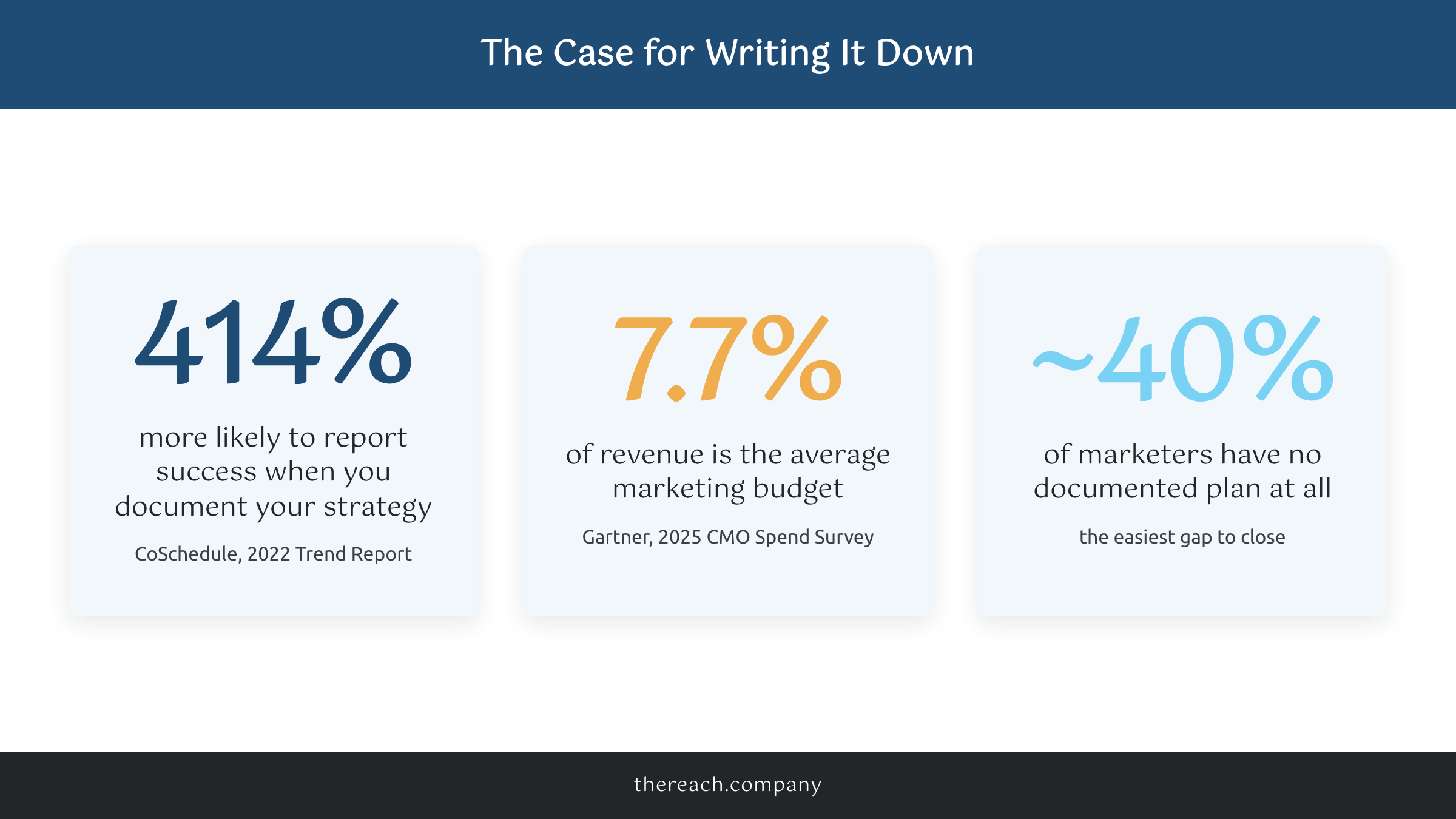
Here's the part that should sting a little. CoSchedule found that marketers who document their strategy are 414% more likely to report success, and almost 40% of marketers have no documented strategy at all. Read that again. Writing the plan down is one of the highest-leverage things you can do, and four in ten people skip it entirely. The ones who do write something usually overcook it into a document so heavy it becomes useless.
So the goal isn't a longer plan. It's a plan you'll actually use. Think of it less like a binder and more like a filter. A good one-page plan makes decisions for you. When a sales rep pitches you a billboard, you look at your page and ask, "Does this move my one number?" If not, easy answer. Heck naw. That filter is worth more than any 40-page strategy doc you'll ever download.
What a Marketing Plan Actually Needs (and What to Ignore)
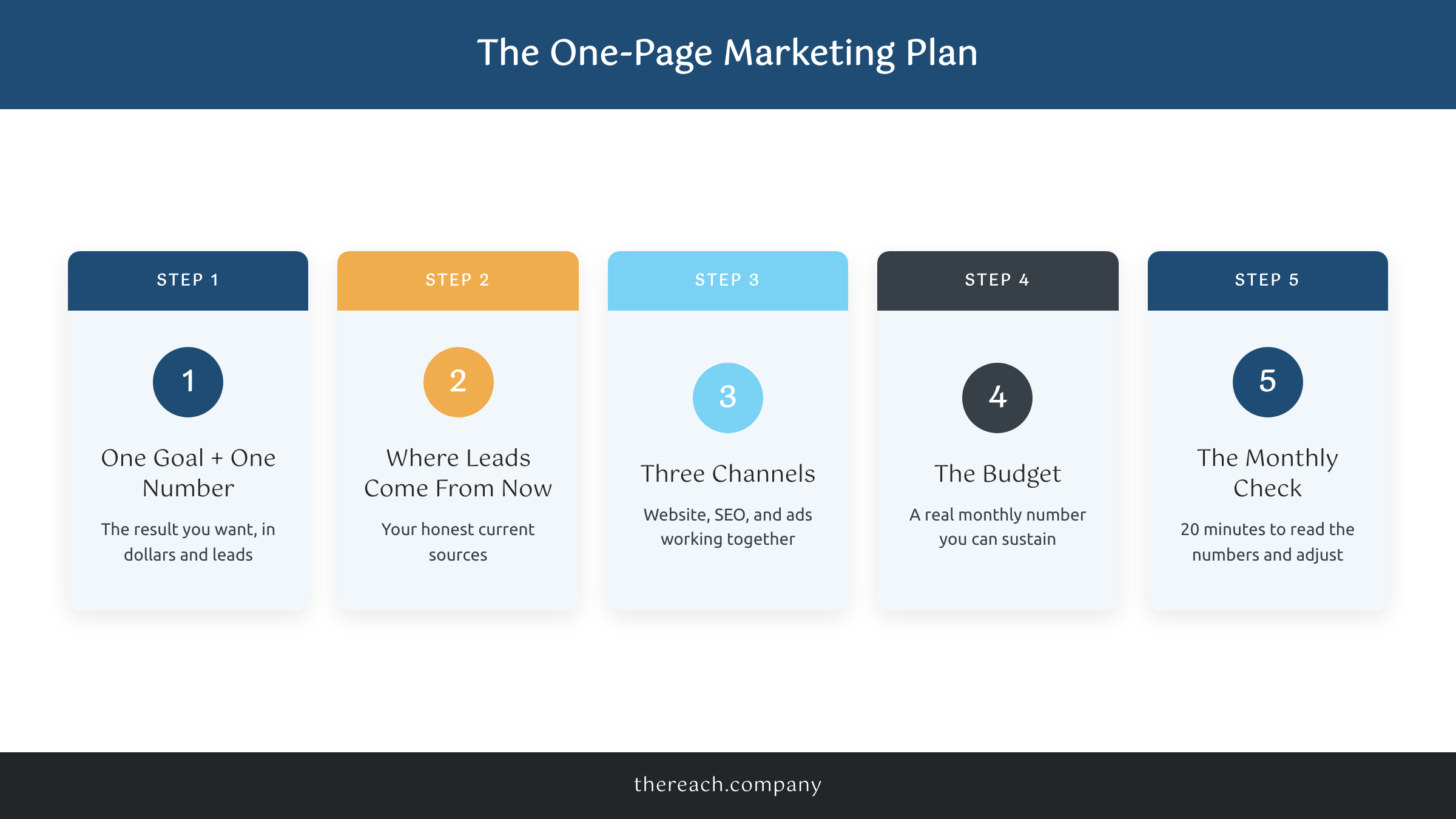
A marketing plan for a small business needs exactly five parts. Anything beyond these is decoration.
- One goal and one number. The result you want, written in dollars and leads.
- Where your leads come from now. An honest audit of your current sources.
- Three channels. The specific places you'll spend time and money, working together. Maybe start with one?
- A real budget. A monthly number you can sustain without flinching.
- A monthly check. Twenty minutes to read the numbers and adjust.
What can you ignore? The persona worksheet with the made-up customer named "Marketing Mary." The competitor SWOT analysis you'll never update. The mission statement. The eight-channel "omnichannel" matrix. None of that gets you a single lead. If a section of a template doesn't change what you do this month, cut it. Plain and simple.
The rest of this post is just those five parts, one at a time. Grab a single sheet of paper or open one note. We're going to fill it in together.
Step 1: Get Honest About Where Your Leads Come From Now
Before you add anything new, you have to know what's already working. Most owners can't actually answer "where did my last 10 customers come from?" off the top of their head. That's the first thing to fix.
Pull your last 20 to 30 customers and write down how each one found you. Referral. Google search. Google Business Profile. Facebook. A repeat client. A networking event. You don't need software for this. A notepad and ten minutes of honesty will do. If you do have call tracking like CallRail or a CRM, even better. Use it.
Here's what usually happens. An owner swears they need TikTok, then does this exercise and realizes 70% of their business came from referrals and Google. That changes everything. Now you're not guessing. You're building on a foundation that already exists. We had a contractor who was about to dump money into Instagram ads. The audit showed that almost every paying job came from Google and word of mouth. So we doubled down on local SEO and a follow-up system instead, and the phone rang more, not less.
While you're at it, fix the going-forward problem too. The reason you couldn't answer this off the top of your head is that nobody was capturing it. So start. Add one question to your intake: "How did you hear about us?" Put a source field on your contact form. If you run GoHighLevel or any CRM, tag every new lead with where it came from. It takes ten seconds per lead and in 90 days you'll have real data instead of a hunch. You can't improve what you refuse to measure.
Write your top two or three real sources at the top of your page. That's the ground you're standing on. Everything else builds from there.
Step 2: Pick One Goal and One Number
This is where most plans go soft. "Grow the business" is a wish, not a goal. You need one goal tied to revenue and one number you can count.
Start with the revenue you want, then work backward. Say you want an extra $120,000 in revenue this year. Your average job is worth $2,000. That's 60 new jobs, or 5 a month. If you close one in four leads, you need 20 qualified leads a month. There it is. Your one number is 20 leads a month. Not "more engagement." Not "10,000 followers." Twenty leads.
That reverse math is the most useful 15 minutes you'll spend on this whole plan, because now every channel has a job. You're not running ads to "build the brand." You're running them to help hit 20 leads a month. The money is in the list, and now you know how long the list needs to be.
One more thing about the number, because it's where people fool themselves. Pick a number you can actually count every month, not one you have to guess at. "Leads" is countable. "Awareness" is not. A lead is someone who raised their hand: a form fill, a phone call, a booked appointment. If your number is a real action a human took, you'll know on the last day of the month whether you hit it. If it's a vibe, you'll argue with yourself forever. Make it countable.
Write your one goal and one number on the page, right under your current lead sources. Two lines. Done.
Step 3: Choose Three Channels, Not Thirteen
Here's the trap. You feel behind, so you try to be everywhere at once. Facebook, Instagram, TikTok, LinkedIn, YouTube, a podcast, a newsletter, flyers, and a booth at every local event. You end up doing all of it badly and none of it consistently. That's not a plan. That's panic with a calendar.
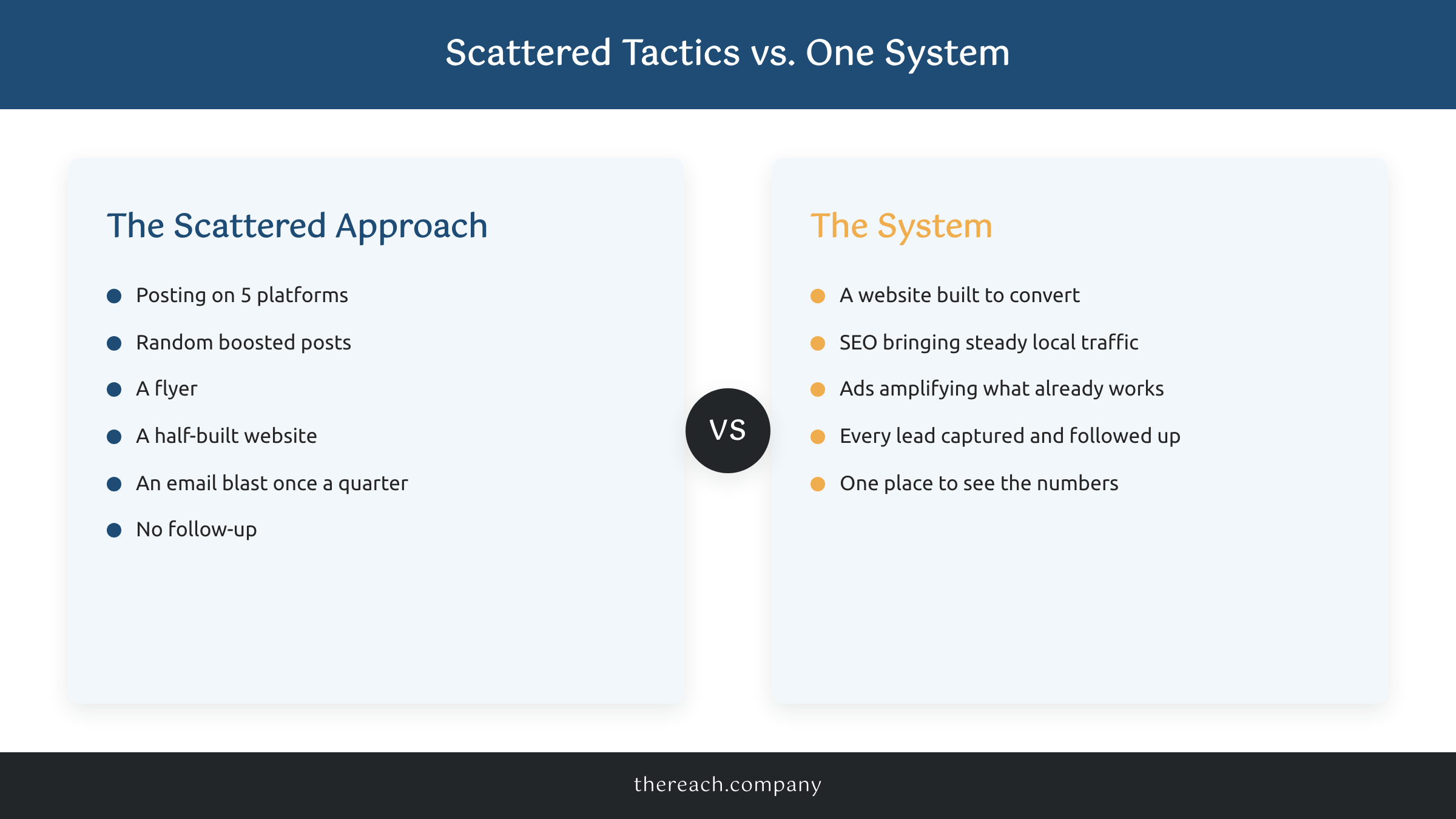
Pick three channels that work together as a system. For most service businesses, the three that actually move the number are a website built to convert, local SEO that brings steady traffic, and ads that amplify what's already working. That's not random. A website that converts catches the leads, SEO brings people to it for free over time, and ads pour fuel on the fire when you want more, faster. At The Reach Company we wire those three into one lead generation system so a lead never falls through the cracks, because the website, the follow-up, and the tracking all talk to each other through GoHighLevel.
Why three and not thirteen? Because consistency beats variety every single time. Three channels you run well for a year will bury thirteen channels you touch once a month. If social is one of your three, fine, but pick the one platform your customers actually use and commit to it. The rest can wait.
Write your three channels on the page. If you can't say how a channel helps hit your one number, it doesn't make the list.
Step 4: Set a Real Budget (Numbers, Not Percentages)
Most budget advice is useless because it's a percentage. "Spend 7 to 10% of revenue." Okay, on what? The Gartner 2025 CMO Spend Survey put the average marketing budget at 7.7% of revenue, and that's a fine sanity check, but it's an average across billion-dollar companies. It doesn't tell a $700,000 service business what to actually do.
So flip it. Start with a floor, not a ceiling. What's the smallest amount you can put toward your three channels every month and keep there for a year? Consistency matters more than size. $1,000 a month spent for twelve months straight beats $5,000 spent once and then yanked the second cash gets tight.
Real numbers, since I hate vague advice. A lead generation platform runs around $299 a month. Local SEO done right is a few thousand a month if you hire it out, or your own sweat if you do it yourself. A starter ad budget that's actually worth running is usually $500 to $1,000 a month per platform plus management. If you want the full breakdown, I wrote a whole piece on how much a small business should actually spend on marketing with real numbers instead of percentages.
And split it in the same order you're building. If your budget is $1,500 a month, you don't divide it evenly across three channels on day one. You fund the website and follow-up first, because that's the drain under the faucet. Then you put the next dollars into SEO so free traffic starts compounding. Ads come last, once the first two are catching everything. A budget spread thin across three half-built channels does less than the same money aimed at one finished one. Sequence the spend, don't sprinkle it.
Write your monthly budget on the page as one honest number. The number you'll still be spending in month twelve, not the number that sounds impressive in month one.
The Part Everyone Skips: Your Plan Is a Sequence
Here's the AHA moment, and it's the thing that separates a plan that works from a list that doesn't. Your plan is a sequence, not a menu. Order matters more than the items.
Think of it like building a house. You don't hang the art before you pour the foundation. Yet that's exactly what most marketing plans do. They run ads to a website that doesn't convert, which is like turning on a faucet over a sink with no drain. The water just spills everywhere. So sequence it. First, fix the website so it actually captures and follows up on leads. Second, turn on SEO so free traffic starts compounding. Third, add ads to amplify once the first two are catching everything that comes in.
This is why "do everything at once" fails and why a documented plan wins. When it's written down in order, you stop reacting to whatever shiny tactic showed up in your inbox this week. You just do the next thing on the page. That's the whole reason the CoSchedule number is so high. A documented sequence removes the daily guesswork that quietly kills momentum.
On your page, number your three channels in the order you'll build them. Not all at once. First, second, third.
Step 5: Put It on One Page and Check It Monthly
You've now got five things written down: your real lead sources, your one goal and number, your three channels in order, your monthly budget, and the sequence. That's your plan. It fits on one page. If yours is longer, you added filler. Cut it back.
The last part is the one almost nobody does, and it's where the plan earns its keep. Once a month, block 20 minutes and read the numbers. Not every day. Once a month. Marketing is slow on a daily scale and obvious on a monthly one.
Here's what to actually look at. Open Google Search Console and check whether impressions and clicks are trending up over the last three months. Look at your call tracking or CRM, like CallRail or GoHighLevel, and count how many real leads came in versus your one number. Check what each channel cost you against what it brought back. You're not looking for a perfect month. You're looking for a trend line that points up over three to four months. If a channel has had six months and still isn't pulling its weight, that's your signal to fix it or cut it.
Let me show you what a healthy trend actually looks like, because the first month or two will tempt you to quit. A real example: a local client launched SEO and saw almost nothing move in month one. Month two, a handful of new impressions. Month three, clicks started climbing and the first organic leads came in. By month six the channel was carrying real weight. If they'd judged it on month one, they'd have killed the thing right before it worked. That's why you read the trend, not the day. Up and to the right over three to four months is a win, even when any single week looks flat.
That monthly check is what turns a plan from a document into a system. It's the difference between hoping and knowing.
What to Do Instead of Downloading Another Template
So here's the honest takeaway. You do not need another 40-page template. You need one page with five answers and the discipline to check it once a month. That's how to create a marketing plan for small business growth that actually changes your revenue instead of your guilt.
Can I be honest? I fall short on the monthly-review habit too sometimes. It's the boring part. But it's also the part that compounds, so I keep dragging myself back to it, and it always pays off. Build the page first. Then protect the 20 minutes a month. You got this.
And if you'd rather not wire the website, SEO, ads, and follow-up together yourself, that's what we do all day. We take the marketing hat off your head and turn the plan into a running system, with real numbers you can actually read. You keep doing what you do best. We'll help you scale it. If you want a hand turning your one-page plan into a machine that runs, book a call and let's talk it through.
Once your plan is on paper, the next question is how to allocate a marketing budget so every dollar in it has a job.

