

A junior hire costs about $5,000 a month. Before benefits. Before taxes. Before the three months of training where they’re still asking you what the company even does.
I’m not anti-junior. I’ve hired plenty of them. Some of the best people I’ve ever worked with started as juniors. But if you’re a solo consultant or running a small shop and you’re trying to figure out whether you can afford to hire one, can I shoot straight with you for a second?
You probably don’t need a junior. You need a stack.
I’ve been using AI in my own business daily for about three years now, and the last twelve months have changed what one person can realistically do in a week. Not in the breathless "AI will replace everyone" way the LinkedIn crowd keeps screaming about. In the quiet, useful, "huh, I just did in 20 minutes what used to take me an afternoon" way.
So here’s the stack I’d build today if I were starting a consulting practice from zero. Four tools. About $80 a month. Each one earns its keep on a single workflow your junior would otherwise own.
Let me get this outta the way first
This stack does not replace judgment. It does not replace relationships. It does not replace the part of consulting where someone trusts you enough to tell you what they actually need (which is rarely what they asked for).
What it does replace is the part of the work that’s mechanical: drafting, summarizing, formatting, following up. The stuff your junior hire would spend 70% of their week doing while you wished they were doing strategy. AI is great at the mechanical 70%. You keep the 30% that’s worth your hourly rate.
Plain and simple.
The math: $5,000 junior vs $80 stack
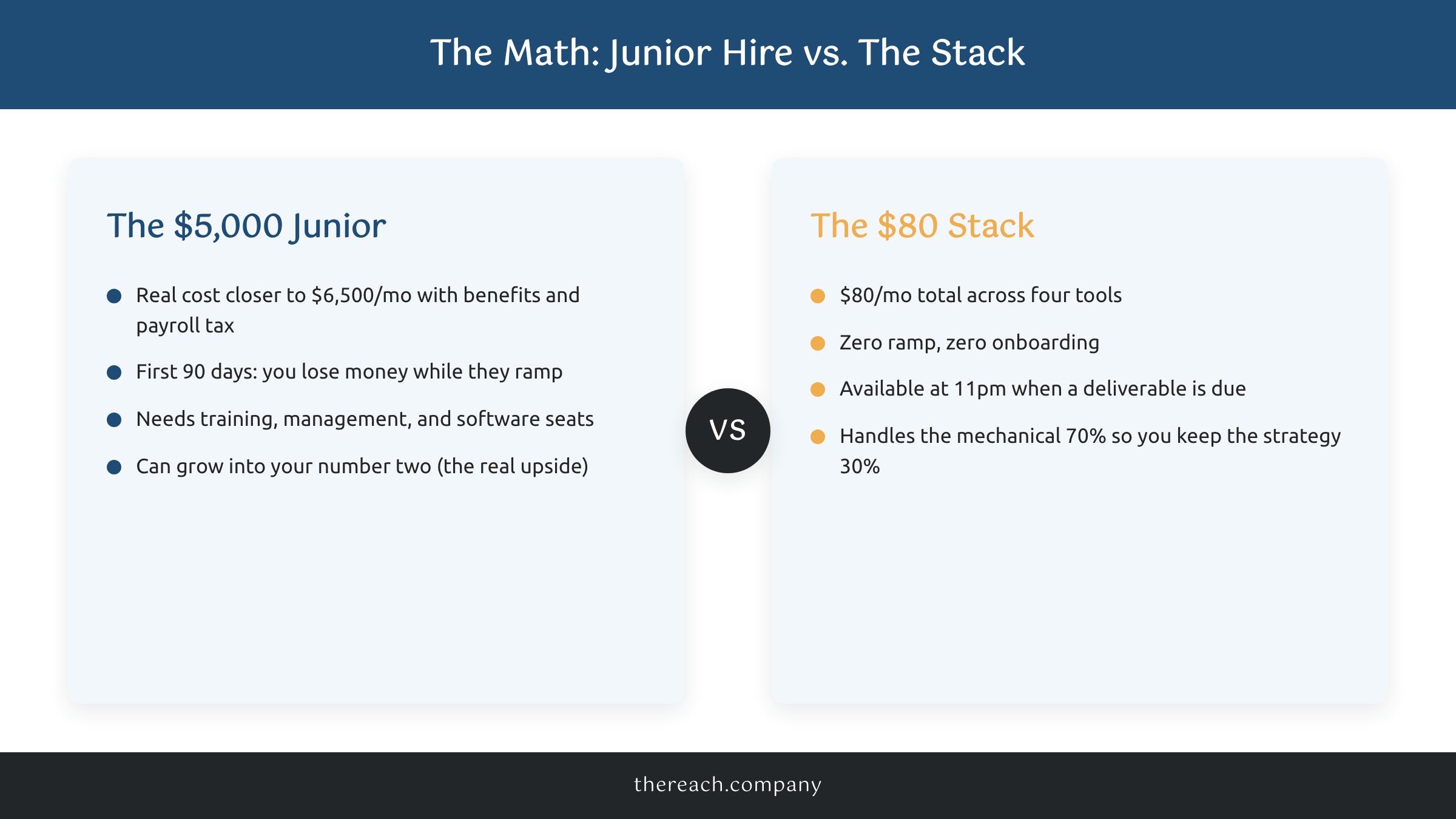
Let’s not pretend the comparison is one-to-one. A junior takes meetings, has a heartbeat, can grow into your number two. The stack doesn’t. But for the work-output piece of the equation, here’s what you’re actually comparing:
- Junior hire: $5,000/mo base. Add $1,000+ for benefits, payroll tax, software seats, onboarding time. Real cost closer to $6,500/mo. First 90 days, you’re losing money on them while they ramp.
- The stack: $80/mo. Zero ramp. Zero onboarding. Available at 11pm when you remembered you still owe a client a deliverable.
That’s $77,000/year in difference. Let that sink in. Let it really sink in. That’s a full salary you keep, or a part-time senior you can hire who actually moves your business forward.
Here’s the stack.
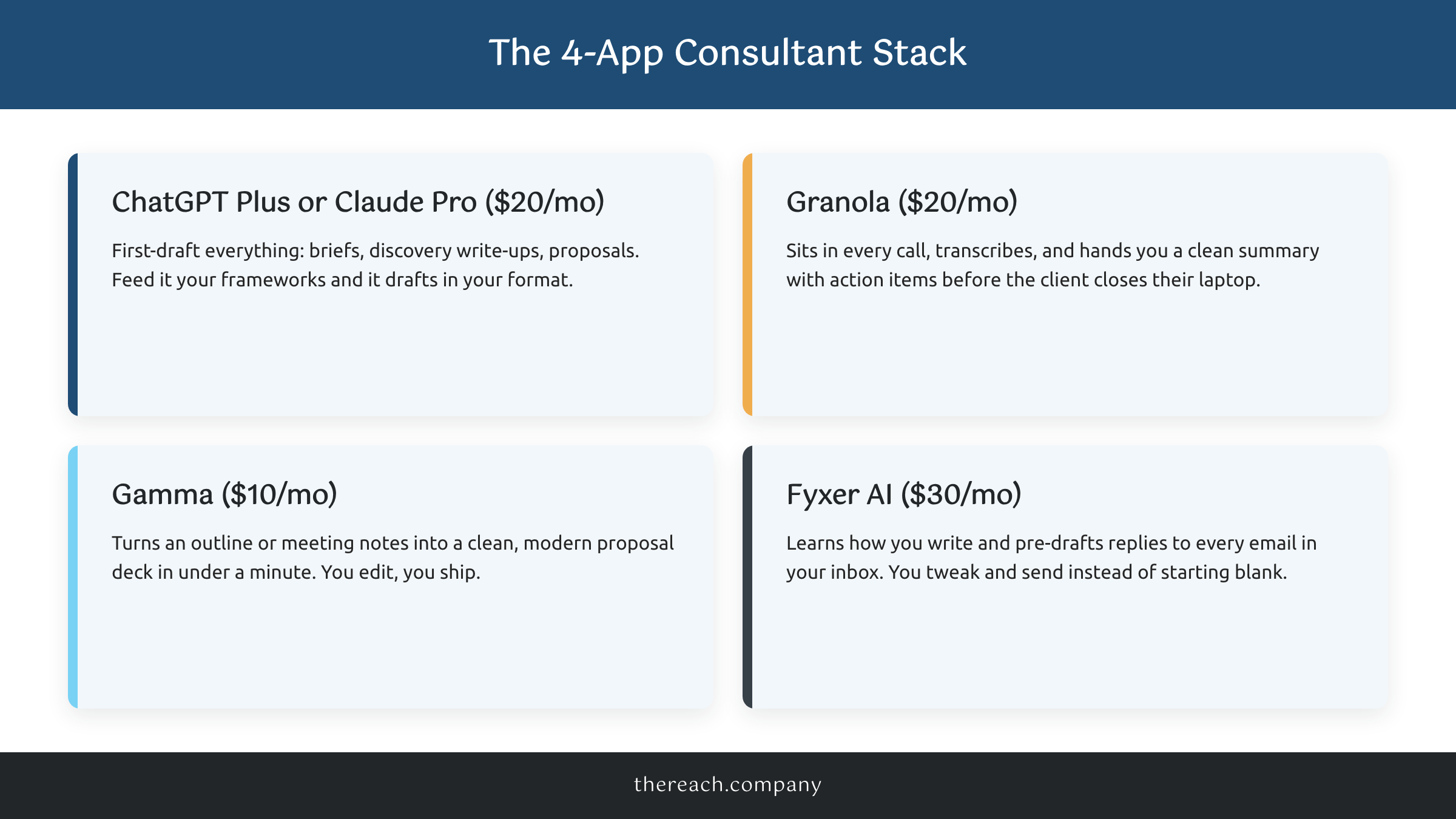
1. ChatGPT Plus (or Claude Pro): $20/mo, your deliverable drafter
Yeah, I know. This is the obvious one. But hear me out, because most consultants are still using ChatGPT the way they used Google in 2008: typing a question, copying the first answer, calling it done. That’s not where the leverage is.
Where the leverage is: feed it your actual frameworks. The slide structure you always use for kickoffs. The format of the audit report you’ve delivered 40 times. The list of questions you always ask in discovery. Once the model knows what your work looks like, "draft a first pass at the discovery findings for [client] using my standard format" takes 30 seconds instead of two hours.
This is what a junior would do badly for the first six months. This is what AI does on day one if you feed it your patterns.
When it earns its keep: first-draft anything. Client briefs. Discovery write-ups. Workshop agendas. Email follow-ups. Meeting recaps you didn’t get to write. Section drafts of proposals.
What it can’t do: Make the recommendation. Decide what matters. Read the room. That’s still you.
2. Granola: $20/mo, your meeting prep and notes
If you do more than five calls a week and you’re still writing notes by hand or trying to remember what was said while you scramble between meetings, this one alone is worth the whole stack.
Granola sits quietly during your meeting (Zoom, Meet, in-person, doesn’t matter), transcribes everything, and gives you a clean structured summary the second the call ends. Action items pulled out. Key decisions captured. A follow-up email you can edit and send in 90 seconds.
I used to send follow-up emails the next day, half the time. Now they go out before the client has closed their laptop. That alone has changed how prospects perceive me. It looks like I have an assistant. I don’t. I have a $20 subscription.
When it earns its keep: every discovery call, every kickoff, every check-in. Anything where "what did we agree to?" matters a week later.
What it can’t do: Know which person in the meeting is actually the decision-maker. Read the silence after someone says "sounds good" and means "I’m checking out." You still gotta show up present.
3. Gamma: $10/mo, your proposal and deck builder
If you’ve ever spent three hours fighting with PowerPoint trying to make a proposal not look like a 2007 PowerPoint, Gamma is going to feel like cheating.
You feed it an outline (or just paste in the discovery notes from Granola. See how this stack starts to compound?) and it builds a clean, modern, on-brand deck in under a minute. You edit. You ship.
The consulting proposal is one of the most expensive deliverables in your week because it’s high-effort and unpaid until you win. Cutting it from three hours to thirty minutes means you can quote more work without burning weekends. That’s not productivity. That’s a different business model.
When it earns its keep: client proposals, kickoff decks, workshop materials, the "here’s what we found" readout at the end of an engagement.
What it can’t do: Tell you what story to tell. The deck is only as good as your point of view. Gamma builds the slides. You still bring the argument.
4. Fyxer AI: $30/mo, your inbox and client comms
This is the one most consultants don’t know about yet, and it’s the one that gets you closest to having an actual assistant.
Fyxer plugs into your email, learns how you write (over a couple weeks of you editing its drafts), and starts pre-drafting replies to every email that hits your inbox. You open Gmail in the morning and there are 14 drafts already sitting under the messages, in your voice, ready to be tweaked and sent.
For a consultant who lives in their inbox, this is a different life. The drafts aren’t always right (maybe a third need real editing), but starting with a draft instead of a blank reply window is the difference between "I’ll get to that later" and "sent."
When it earns its keep: client follow-ups, intro replies, scheduling logistics, the "here’s where we are" updates you owe three clients by Friday.
What it can’t do: Write the hard email. The one where you’re pushing back on scope, or having the awkward money conversation, or repairing a strained relationship. That’s still your job.
When you should still hire the junior
I told you I’d be honest. So here’s where this stack stops working: when you need a human in the room with a client, when you need someone who can grow into ownership of an account, when you need scale that goes beyond "Andrew with better tools." If you’re trying to build a 10-person consultancy, the stack is the floor, but you’re still going to hire people.
The stack is for the solo consultant who’s hitting a ceiling because their hours don’t stretch. It’s the bridge between "I’m at capacity" and "I can take on the next client without breaking myself." Use it to buy yourself the runway to make a real hire later: a senior one, who’s worth what you’re paying.
The honest catch
None of this works if you don’t actually use it. I’ve watched consultants pay for ChatGPT Plus for six months and use it to generate cover letters. AI tools have a learning curve. Not a hard one, but a real one. The first two weeks of using Granola are weird. The first time Fyxer drafts an email in "your voice" it sounds like a stranger. You push through that or you don’t get the leverage.
The other catch: the stack changes every six months. Tools I would’ve recommended a year ago aren’t on this list. Whatever I write here is probably out of date by Q4. The point isn’t "these four specific tools forever." The point is "build the stack, keep the stack updated, treat it like infrastructure."
That’s it. Four tools. $80/mo. Roughly $77K/year in cost difference vs. that junior hire, and a noticeable lift in how much one person can actually ship.
If lead follow-up and first drafts are the two jobs eating your evenings, we broke down AI for solopreneurs who want their evenings back and the three jobs to hand off first.
If you want to talk through whether this kind of stack would actually fit your consulting practice, or you’ve already tried to DIY a stack and it’s a tangled mess, grab a free strategy call. I’ll tell you what I’d actually do in your shoes. No pitch. No deck. Just a conversation.
The finish line is a lot closer than it feels. Promise.

