

Every article about marketing budgets ends the same way: spend 7 to 10% of your revenue and call it a day. Fine. Say you did that math and landed on $2,500 a month. Now you’re staring at the only question that actually matters: where does it go?
That question is how to allocate a marketing budget, and it’s a completely different skill than deciding how big the budget should be. Get the split wrong and you can spend the “right” percentage for a full year with nothing to show for it but a stack of invoices. I’ve watched it happen: an owner pushing $2,000 a month into Google Ads while his website converted almost nobody. The pot was fine. The split was broken.
So this post is the split. Four buckets, the order to fund them, and real dollar breakdowns at $1,000, $2,500, and $5,000 a month.
A Percentage Is Not a Plan
Gartner’s 2025 CMO Spend Survey found that marketing budgets have flatlined at 7.7% of company revenue, and half of the CMOs surveyed are working with 6% or less. Those are billion-dollar companies with entire teams whose whole job is arguing about the size of the pot.
Here’s the rub: the size of the pot doesn’t book a single job. Two businesses can spend the exact same percentage and get wildly different results, because one gave every dollar a job and the other handed the whole thing to whichever ad rep called first. Money without a job assignment always drifts toward whoever is selling the loudest.
A percentage is a ceiling. It is not a plan. Learning how to allocate a marketing budget starts after the percentage math ends. If you’re still working out the size of the pot, we already covered how much a small business should spend on marketing. This post picks up where that one stops: the money is approved, it’s sitting in the account, and every dollar needs a job before it leaves.
Give Every Dollar a Job: The Four Buckets
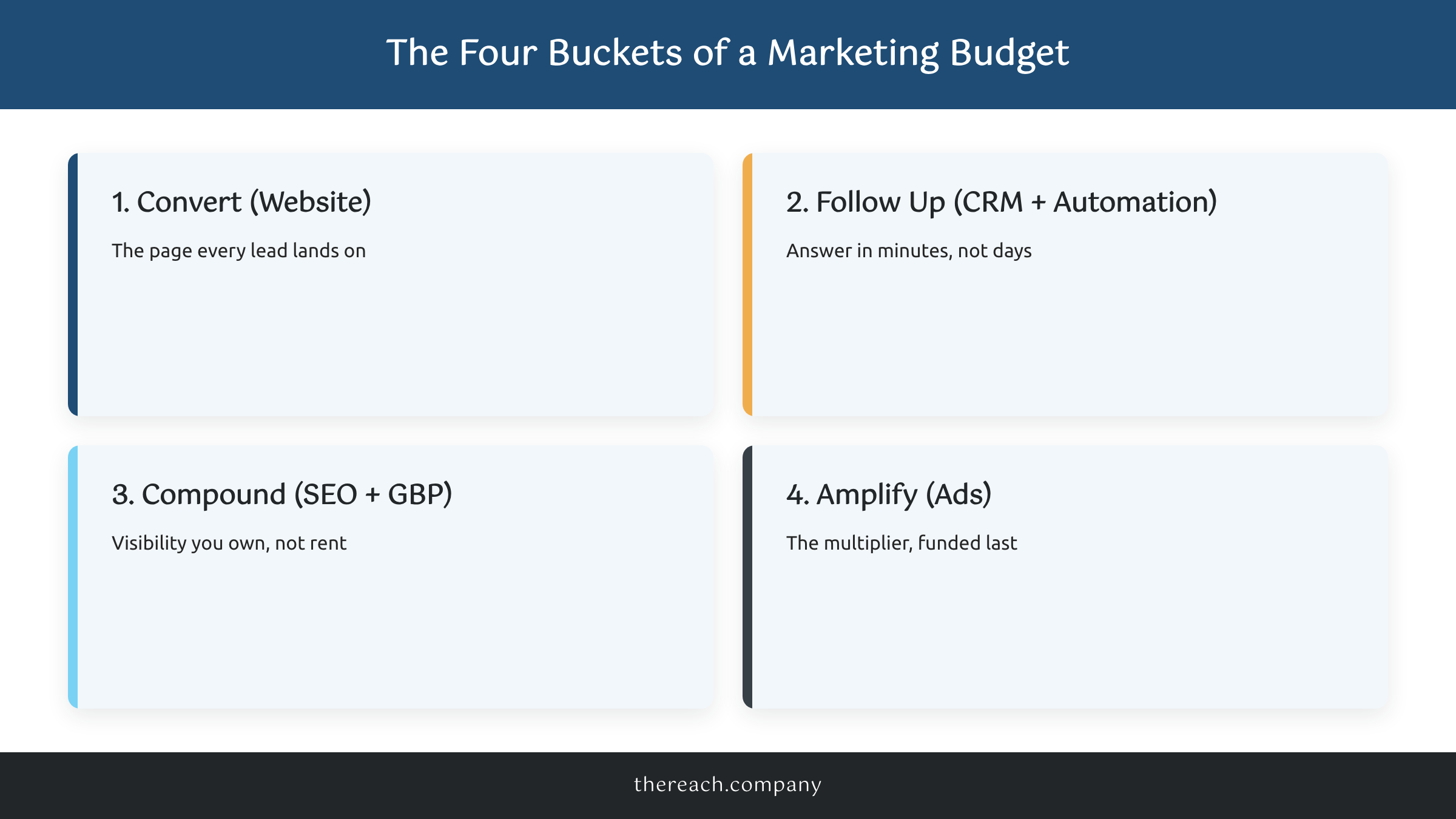
Every dollar in your marketing budget belongs to one of four buckets. The order matters more than the amounts.
Bucket 1: Conversion. Your website. Every lead eventually lands here, whether they came from Google, an ad, a review, or a referral text. If the site loads slow, buries your phone number, or reads like a brochure, every other bucket leaks. A page that converts 8% of visitors instead of 2% quadruples the value of every dollar you spend in buckets 2 through 4. That’s why it gets funded first, even when it’s boring.
Bucket 2: Follow-up. The unsexy bucket everybody skips. A CRM with automated follow-up, missed-call text-back, appointment reminders, and review requests. We build this on GoHighLevel for $299 a month, and for most service businesses it pays for itself with one saved job. You already paid to generate those leads. This bucket stops them from dying in your voicemail box.
Bucket 3: Compounding visibility. SEO and your Google Business Profile. This bucket is slow, and it’s the only one that compounds. The rankings and reviews you earn this year keep sending calls next year without another dollar of spend. Ads stop the second you stop paying. This bucket doesn’t.
Bucket 4: Amplification. Ads. Google, Meta, Local Services Ads. Ads are a multiplier on a machine that already works. Point them at a converting site with follow-up behind it and they print. Point them at a broken machine and they just make the leak more expensive. They come last on purpose.
Most Owners Split It Backwards
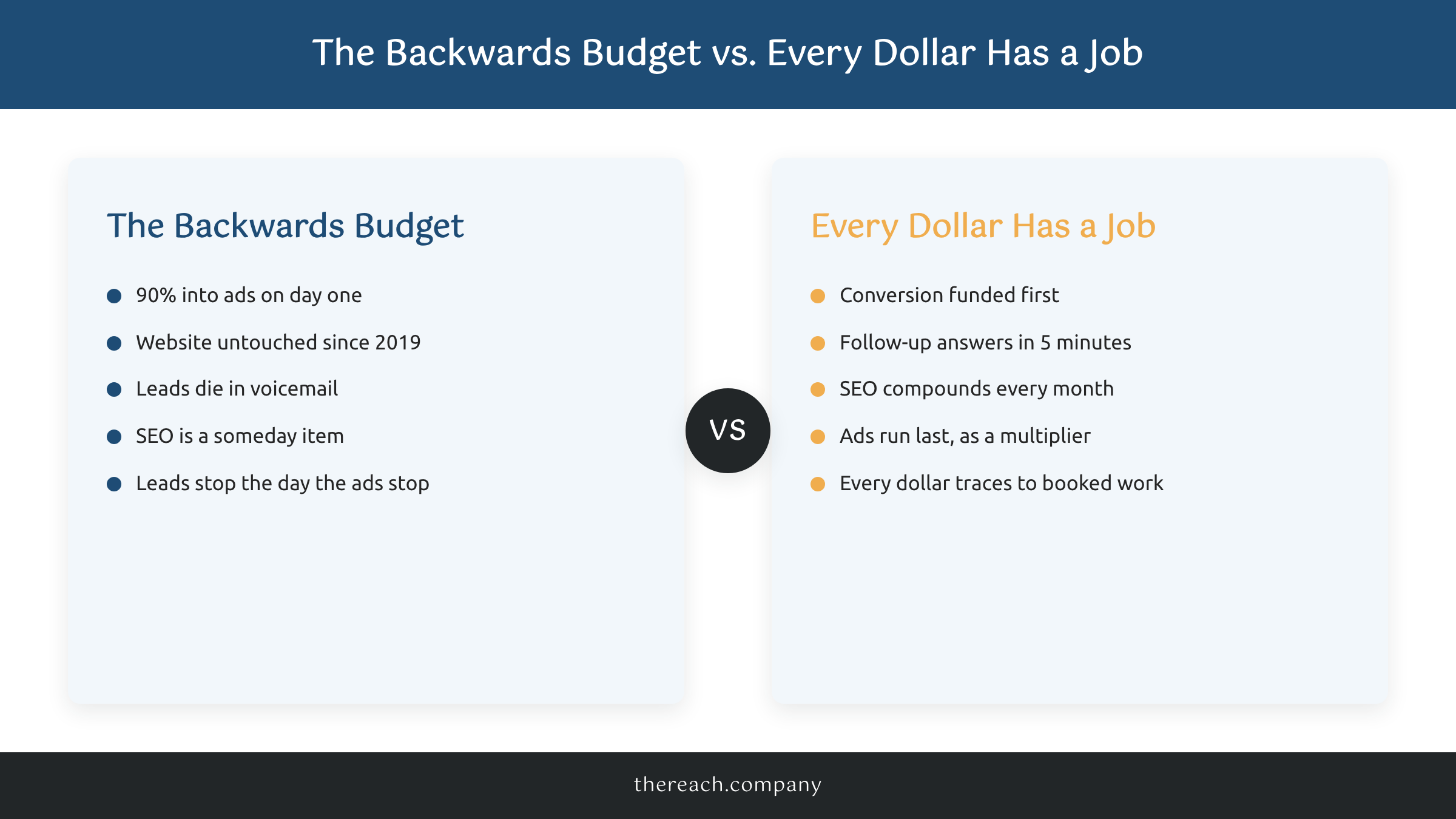
The typical marketing budget breakdown I see when we audit a small business looks like this: 80 to 90% into ads, zero into follow-up, and a website nobody has touched since 2019. That’s the four buckets in reverse.
Part of it is copying the big guys. In that same Gartner survey, paid media ate 30.6% of big-company marketing budgets, the largest single line item. But those companies have converting landing pages, follow-up teams, and analysts squeezing every click before a dollar of media goes out. When you copy the media spend without the machine behind it, you get the bill without the results.
Here’s the picture I use with clients: ads are a gas pedal. If the car has no tires (a site that doesn’t convert) and no driver (no follow-up), flooring it just burns fuel louder. One owner I talked with had spent $24,000 in a year on ads pointed at a homepage with no call button above the fold and no follow-up on the leads that did trickle in. The ads weren’t the problem. The order was.
You can usually spot a backwards budget from three symptoms: leads stop cold the moment ads pause, nobody responds to an inquiry in under an hour, and the owner can’t say what a booked job actually costs. If two of those three sound familiar, the fix isn’t more budget. It’s a new split.
The Split at $1,000, $2,500, and $5,000 a Month
Real numbers, because that’s the whole point of this post. These are the splits we’d build for a service business at three common budget levels, using our actual pricing.
At $1,000 a month: $299 goes to a managed website built to convert (Bucket 1), $299 to the follow-up engine on GoHighLevel (Bucket 2), and the remaining $400 into compounding visibility: Google Business Profile work, review generation, and one solid piece of local content a month (Bucket 3). Ads get zero dollars. Not because ads are bad, but because at this level every dollar has a more productive job elsewhere.
At $2,500 a month: Same first two buckets. Then roughly $1,400 into local SEO and content, and if the website is already converting, the last $500 opens one ad campaign: management plus a starter spend, usually Google or Local Services Ads, where the intent is highest and the wasted clicks are lowest.
At $5,000 a month: The full machine. Website and follow-up funded, $2,480 into local SEO, and the balance running one to two ad campaigns with real spend behind them. At this level the buckets feed each other: ads generate data, SEO captures the searches ads proved out, and follow-up converts all of it.
Every one of those numbers is public on our pricing page. No mystery retainers, no “contact us for a quote.” If an agency won’t show you where the dollars go, that tells you everything about how they’ll split them.
Proof: What the Right Split Looks Like
Chin Up Aesthetics, a medspa client, runs the full four-bucket machine. Their website produced 1,928 leads in one year, and they rank first in the Map Pack for more than 8 core services. Notice the order underneath those numbers: the site converts, the follow-up runs automatically, the SEO compounds, and then ads pour fuel on a working engine, 1,300+ leads from Facebook alone.
The Unstuck Group averages a 14:1 return on Google ad spend. Not because the ads are magic. Because every click lands on a page built to convert, with follow-up behind it. Bucket 4 performs because buckets 1 through 3 were funded first.
And the Jewish Education Loan Fund, a client of nearly five years, grew conversions 54% with barely any paid spend at all. Buckets 1 through 3 doing quiet, compounding work, year after year.
Different businesses, different amounts, same order. That’s the whole argument for treating your website, SEO, and ads as one system instead of three separate line items fighting over the same pot.
What to Do With Your Budget This Week
Grab a sheet of paper and write down what you actually spent on marketing last month, sorted into the four buckets. Most owners discover 90% of their money sits in one bucket, and it’s almost always the last one.
Then fund in order. Conversion first, follow-up second, compounding third, amplification last. If that means pausing ads for 60 days to fix the website they’re pointing at, pause them. It feels backwards. It’s also the fastest path to a budget that books actual work instead of buying traffic that bounces.
That’s how to allocate a marketing budget: give every dollar a job, fund the jobs in order, and let ads amplify a machine instead of covering for one that doesn’t exist.
And if you’d rather have someone who does this every day look at your split, book a call with us. We’ll walk your numbers bucket by bucket and tell you plainly where the leaks are. The finish line is a lot closer than it feels. Promise.

