
Can I shoot straight with you? When most service business owners decide they need more leads, the first move is to open their wallet. Boost a post. Turn the Google Ads budget up. Sign a contract with someone who promises a flood of calls. A month later the calls are about the same, the bank account is lighter, and the conclusion is always the same: "I guess I need to spend more."
So they type some version of "how to get more leads for service business" into Google, hoping for a magic channel they missed. Here's the rub. The number of leads you get almost never comes down to how much traffic you can buy. It comes down to whether you have a system that catches the people already trying to find you, turns them into booked jobs, and follows up with the ones who don't say yes on the first try.
That's the whole game. Leads aren't a traffic problem. They're a system problem. And the good news is a system is something you can build on purpose, mostly without lighting money on fire and without posting on social media every single day. This is how to get more leads for your service business by building three reliable sources that hold each other up.
Why "More Leads" Usually Isn't a Traffic Problem
Ads feel like the answer because they're fast. You put in $50, you get clicks today. There's nothing wrong with that, and we run ads for clients every week. The problem is what happens when ads are your only source.
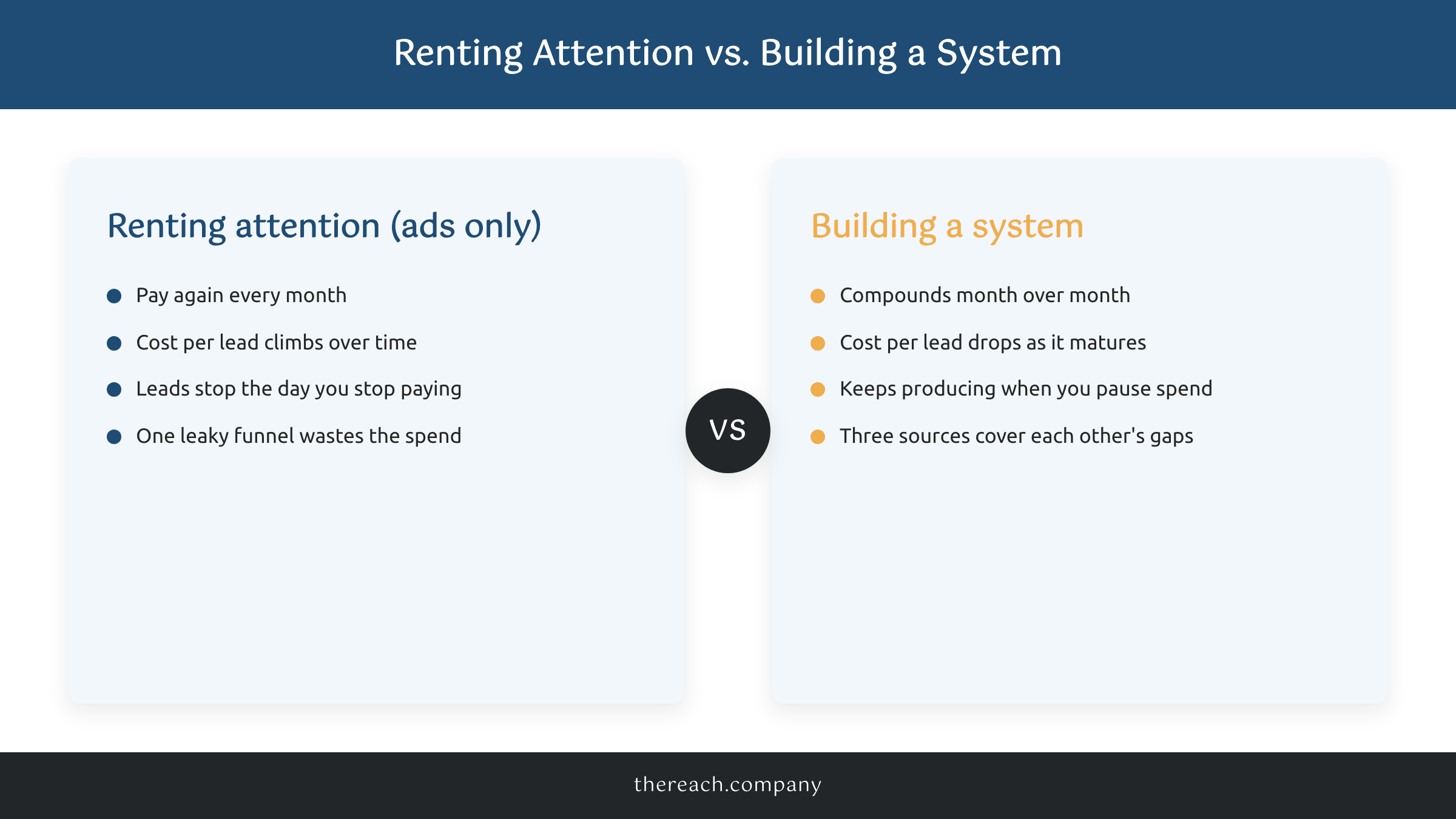
When you buy attention, you rent it. The day you stop paying, the leads stop. And the price keeps climbing, because every other business in your city is bidding on the same clicks. So you spend more each year to stand still. That's not a strategy, that's a treadmill.
Meanwhile, here's what's usually true under the hood. People are already searching for what you do. Some of them already landed on your website. A few of them already called once and never heard back. The leads are there. They're leaking out of a bucket with holes in it, and pouring more water into a leaky bucket is the most expensive way to stay thirsty.
This is the same reason why your website, SEO, and ads have to work together instead of being three separate line items you bought from three separate people. A lead source on its own is fragile. Three lead sources feeding each other is a machine. So before you spend another dollar on ads, let's build the machine.
Lead Source #1: Show Up When People Are Already Looking
The first source is the cheapest intent you'll ever find: people typing "plumber near me" or "emergency HVAC repair Marietta" into their phone at the exact moment they have a problem and a credit card.
You don't have to convince these people they need you. They already know. You just have to be there. And the front door to "being there" for a local service business is your Google Business Profile, the listing with your map pin, hours, photos, and reviews.
Most owners claim it, fill in half of it, and never touch it again. That's leaving money on the table. Here's what actually moves it:
- Fill in every field. Categories, services, service areas, hours, a real description. Google ranks profiles it understands.
- Get reviews on a schedule, not by accident. Ask every happy customer the day the job wraps. Volume and recency both matter.
- Add real photos. Trucks, crews, before-and-afters. Profiles with photos get more clicks and calls.
- Post to it. A quick update or offer every week or two signals the profile is active.
Underneath the profile sits your local SEO, which is just the work of helping Google trust that you're a real, relevant business in your area. If that phrase makes your eyes glaze over, read our plain-English breakdown of what local SEO actually is. It's less mysterious than the acronym makes it sound. The point is simple: when someone searches with intent, you want to be one of the three businesses in the map pack, not on page two where nobody looks.
And here's the quiet advantage. This source costs you almost nothing to feed. A claimed profile, a steady habit of asking for reviews, and a few fresh photos a month is not a budget line, it's a routine. The businesses winning the map pack in your city usually aren't spending more than you. They're just consistent. When you get complacent here, your competitors eat your lunch. Plain and simple.
Lead Source #2: A Website That Turns Clicks Into Booked Jobs
Here's where most of the leaking happens. You can have great search visibility and a steady trickle of clicks, and still get almost no leads, because the website those clicks land on is a brochure.
A brochure says, "Here we are, here's our logo, here's a list of services, call us if you feel like it." A lead machine says, "Here's the exact problem you have, here's how we fix it, and here's the one button to start." The difference is night and day, and it's the cheapest lift on this whole list because the traffic is already arriving. We wrote a whole piece on the difference between a website that's a brochure versus a lead machine, but here's the short version of what a converting site needs:
- One clear offer above the fold. Not "welcome to our website." Something like "Same-day AC repair in Cobb County, booked online in 60 seconds."
- One obvious next step. A single, repeated call to action. When you give people five choices, they pick none.
- Fast load on a phone. Most of your visitors are on mobile. If the page takes more than a few seconds, a big chunk leave before it even finishes loading.
- A way to raise their hand without calling. A short form, a web chat widget, a "text us" button. Plenty of people will type a question at 9pm who would never pick up the phone.
Think about your own last ten visitors. If even three more of them had turned into a booked call because the path was obvious, that's three jobs you already paid to attract and would have otherwise lost. You didn't need more traffic. You needed the bucket to hold water.
Here's a quick gut check you can run today. Open your own website on your phone, the way most of your customers will. Time how long it takes to load. Then ask one question: in the first five seconds, is it obvious what you do, where you do it, and how to start? If you have to scroll or squint to answer that, a stranger with a problem and three other tabs open already left. Fixing those five seconds is usually worth more than any new traffic source, and it's a one-time fix, not a monthly bill.
Lead Source #3: Follow-Up and Referrals
This is the source almost everyone ignores, and it's the one with the highest payoff. Plain and simple.
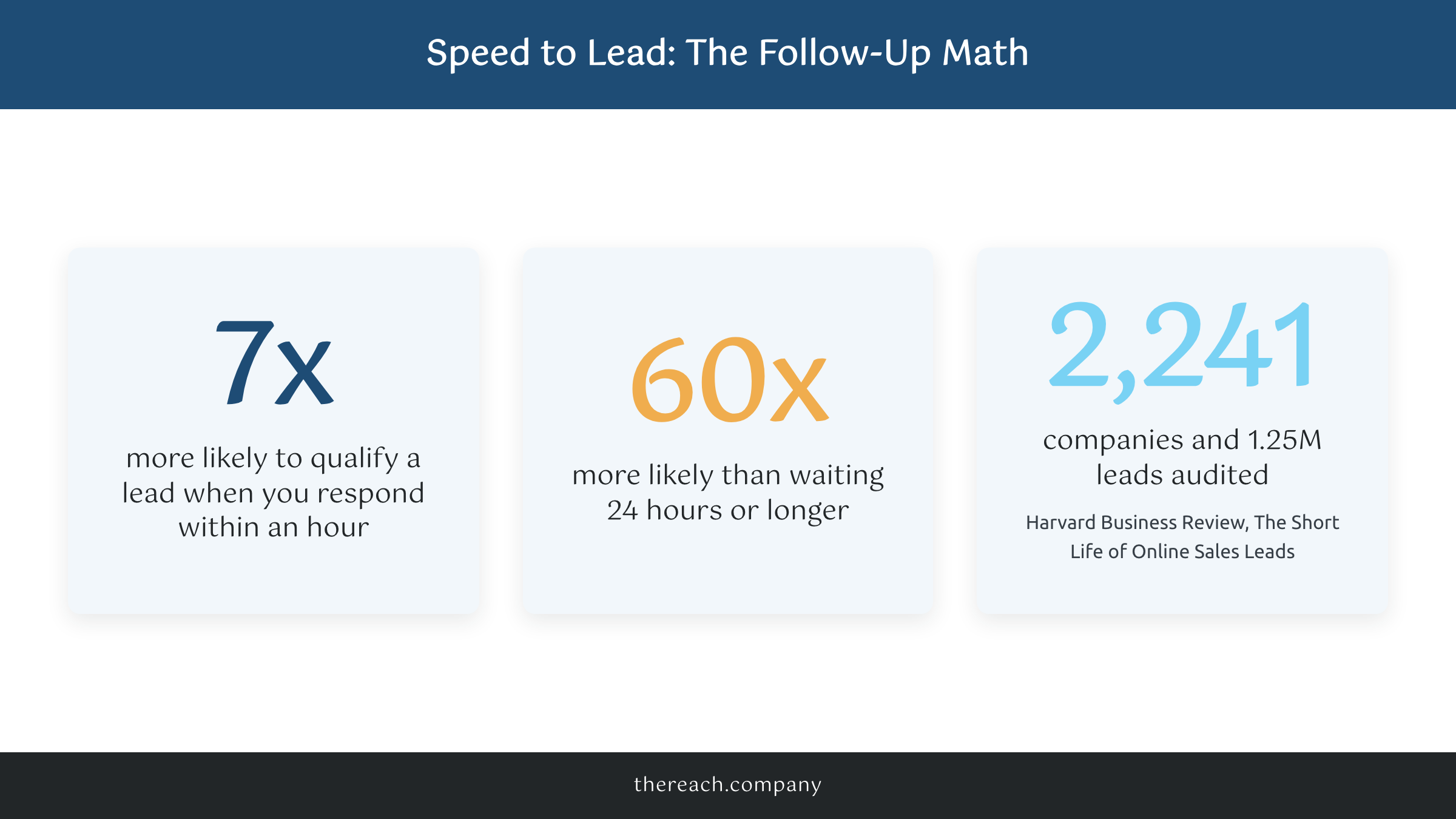
Start with speed. Harvard Business Review audited 2,241 companies and more than 1.25 million leads and found that businesses contacting a new lead within an hour were nearly 7 times more likely to qualify that lead than those who waited even an hour longer, and more than 60 times more likely than businesses that waited a day or more. Let that really sink in. The lead you already paid for is mostly won or lost in the first hour, and most service businesses take most of a day to respond, if they respond at all.
You can't sit by the phone all day. You're on a roof or under a sink. So the fix isn't discipline, it's automation. At The Reach Company we set up GoHighLevel so the second a form comes in or a call gets missed, the lead gets an instant text: "Hey, this is Mike at ABC Plumbing, saw you reached out, what's going on?" That one auto-text catches people while they still care. Then a short follow-up sequence over the next few days nudges the ones who got busy, so a lead doesn't die just because nobody got back to it. If you want the deeper version of this, we broke down how to automate your lead follow-up without hiring anyone or learning code.
Then there's the cheapest lead source on earth: the customers you already made happy. Referrals close faster and at a higher value than any cold lead, and most owners "do referrals" by hoping. Build it instead. After every completed job, the system sends a thank-you, asks for a review, and a week later asks who else they know that could use the same help. The money is in the list, and the list is full of people who already trust you.
The Real Math: Three Average Sources Beat One Heroic One
Here's the part that changes how you think about all of this. You don't need a miracle. You need three decent sources that compound.
Say you're getting 20 leads a month right now and closing 5 of them. Most owners try to fix that by doubling ad spend to chase 40 leads, hoping to close 10. Expensive, and it ignores every leak.
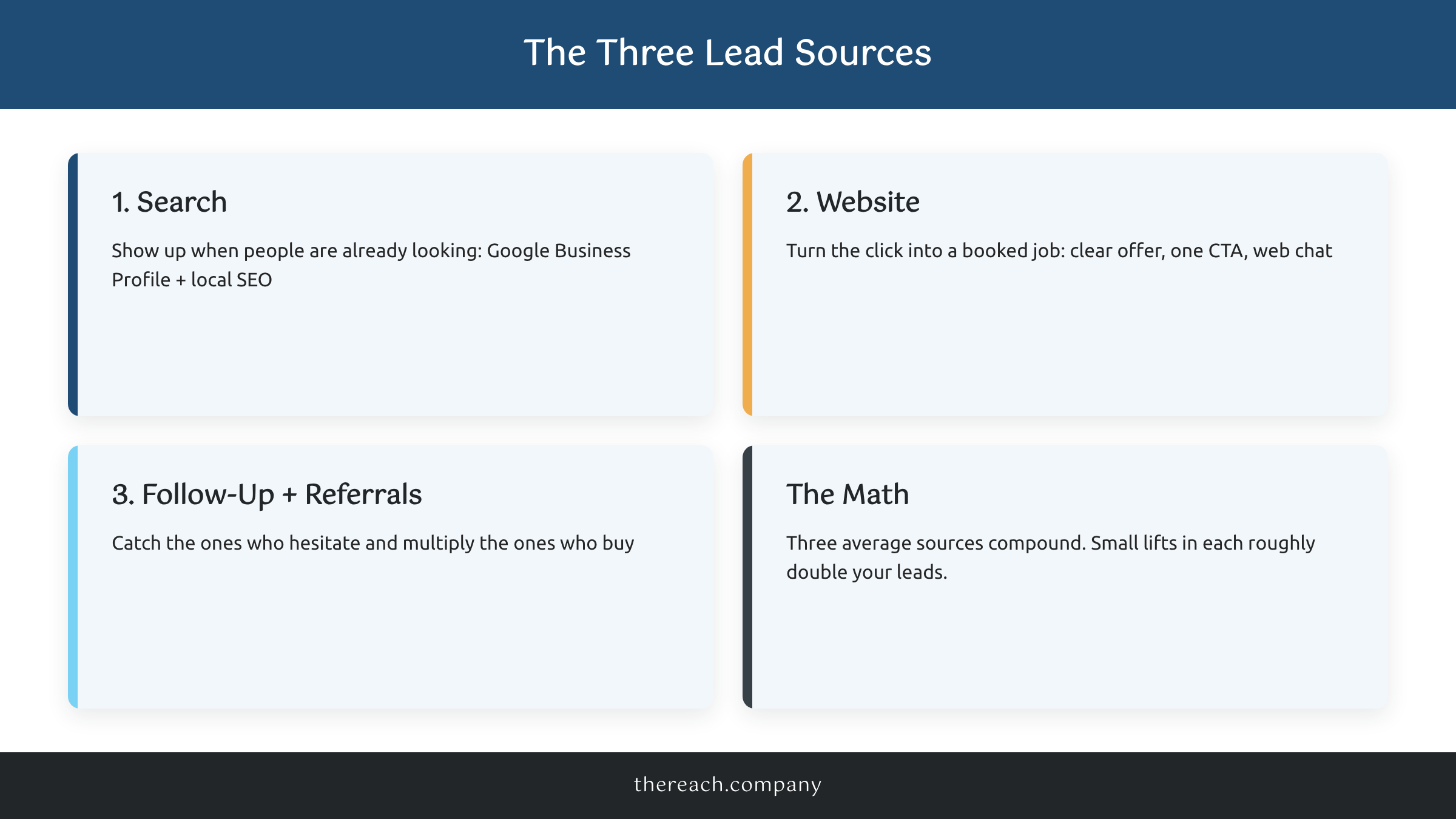
Now run it the system way. Tighten the Google Business Profile and you pull in 25% more of the people already searching. Fix the website so a few more visitors actually book, lifting conversion by 30%. Add the instant-text follow-up and recover another 20% of the leads that used to go cold. None of those are heroic numbers. Each one is a reasonable Tuesday. But stack them and your booked jobs roughly double, and you did it without spending a dime more on traffic. That's the difference between buying leads and building a system. One is a cost that resets every month. The other is an asset that gets stronger.
This is the heart of how to get more leads for service business owners who don't have a giant budget to throw around. You're not hunting for one magic channel that 10x's overnight. You're finding three ordinary improvements, locking them in, and letting them stack. Small lifts compound. A leaky bucket never does, no matter how much water you pour.
What This Looks Like in Real Life
This isn't theory. Chin Up Aesthetics, a medspa we work with, pulled 1,928 leads from their website in a single year, ranked first in the Google Map Pack for more than 8 of their core services, and brought in another 1,300-plus leads from Facebook ads on top of that. Notice the shape of it. The ads weren't carrying the business. The website was converting, the local search was feeding it, and paid traffic amplified a machine that already worked. That's why the numbers got big.
Or take the Jewish Education Loan Fund, a client we've worked with for nearly five years. Over that relationship we lifted their conversions by 54%, not with one explosive campaign, but by steadily fixing how the pieces fed each other. It really depends on the business, but the pattern holds: the wins compound when the sources work together instead of competing for the same budget.
The reason this works is boring and powerful. Every source covers a different gap. Search brings in the people actively shopping today. The website earns the ones who are comparing two or three options. Follow-up rescues the busy ones who meant to call back and forgot. A business leaning on ads alone has none of those backups, so every dollar has to do all the work. A business with three sources has slack in the system, which is exactly what makes the leads steady instead of feast-or-famine.
What to Do First (and Where Ads Actually Fit)
If you're staring at all three sources thinking "I can't do everything at once," good, don't. Here's the order that wastes the least money.
First, fix capture and follow-up. The instant-text, the obvious call to action, the form that works. This is cheap and it stops the bleeding immediately, because you're keeping leads you're already getting.
Second, strengthen search. Optimize the Google Business Profile, get the review engine running, build real service pages. This grows the top of the funnel with the cheapest, highest-intent traffic there is.
Third, and only now, add ads. Here's the honest truth about paid: ads are an amplifier, not an engine. Pour spend into a system that already converts and follows up, and every dollar works harder. Pour it into a leaky bucket and you're just paying to fill the holes faster. Ads aren't the villain. Running them first is.
If building all of this sounds like one more hat you don't have time to wear, that's exactly the gap we fill. It's the whole reason we built the lead generation system we build for clients: website, search, and follow-up wired together into one machine instead of three disconnected tools. You keep doing what you do best. We handle the system that keeps your schedule full. Either way, the move is the same: stop renting leads and start building sources that earn them.
FAQ
How long before this actually produces more leads?
Capture and follow-up fixes can pay off in days, because you're keeping leads you already get. Search compounds slower, usually a few months to really move. It really depends on your market and how much groundwork is already there, but the follow-up piece is almost always the fastest win.
How much does it cost to set up?
Way less than most owners assume, and far less than the ad spend they're wasting. A tool like GoHighLevel that handles web chat, CRM, follow-up texts, and review requests runs a few hundred dollars a month, and it replaces a stack of separate subscriptions. The expensive option is the one you're probably on now: paying for leads that leak out the bottom.
Do I still need to run ads?
Eventually, yes, if you want to grow faster than search alone allows. But ads work best on top of a system that already converts and follows up. Build the machine first, then amplify it.
The Bottom Line
You almost certainly don't have a traffic problem. You have a system problem, and that's good news, because a system is something you can build. Show up where people are already looking. Make your website turn those clicks into booked jobs. Follow up fast and ask for referrals every time. Three reliable sources, holding each other up, producing leads whether or not you're spending on ads that week.
The finish line is a lot closer than it feels. Start by finding your biggest leak, plug it this week, and build from there. You got this. And if you'd rather hand the whole system to someone who does this every day, we've got you too.
And if the dialing grind is the part you dread, here is how to get leads without cold calling.
Running a commercial cleaning company specifically? The buyer and the sales cycle are different enough that we wrote a separate playbook: how to get commercial cleaning leads that turn into contracts, not one-off jobs.

