

Can I shoot straight with you? Every “how to grow a service business” article you’ve read this year told you to do more. Post more. Run more ads. Try TikTok. Start a newsletter. Show up on five platforms at once. So you tried, and now you’re exhausted while your leads are still inconsistent.
Here’s the uncomfortable truth: growth doesn’t come from adding channels. It comes from wiring fewer things together into a system that keeps working while you do the job you’re actually good at, whether that’s running job sites, seeing patients, or managing client accounts. This isn’t a hustle problem. It’s a plumbing problem.
The Real Problem
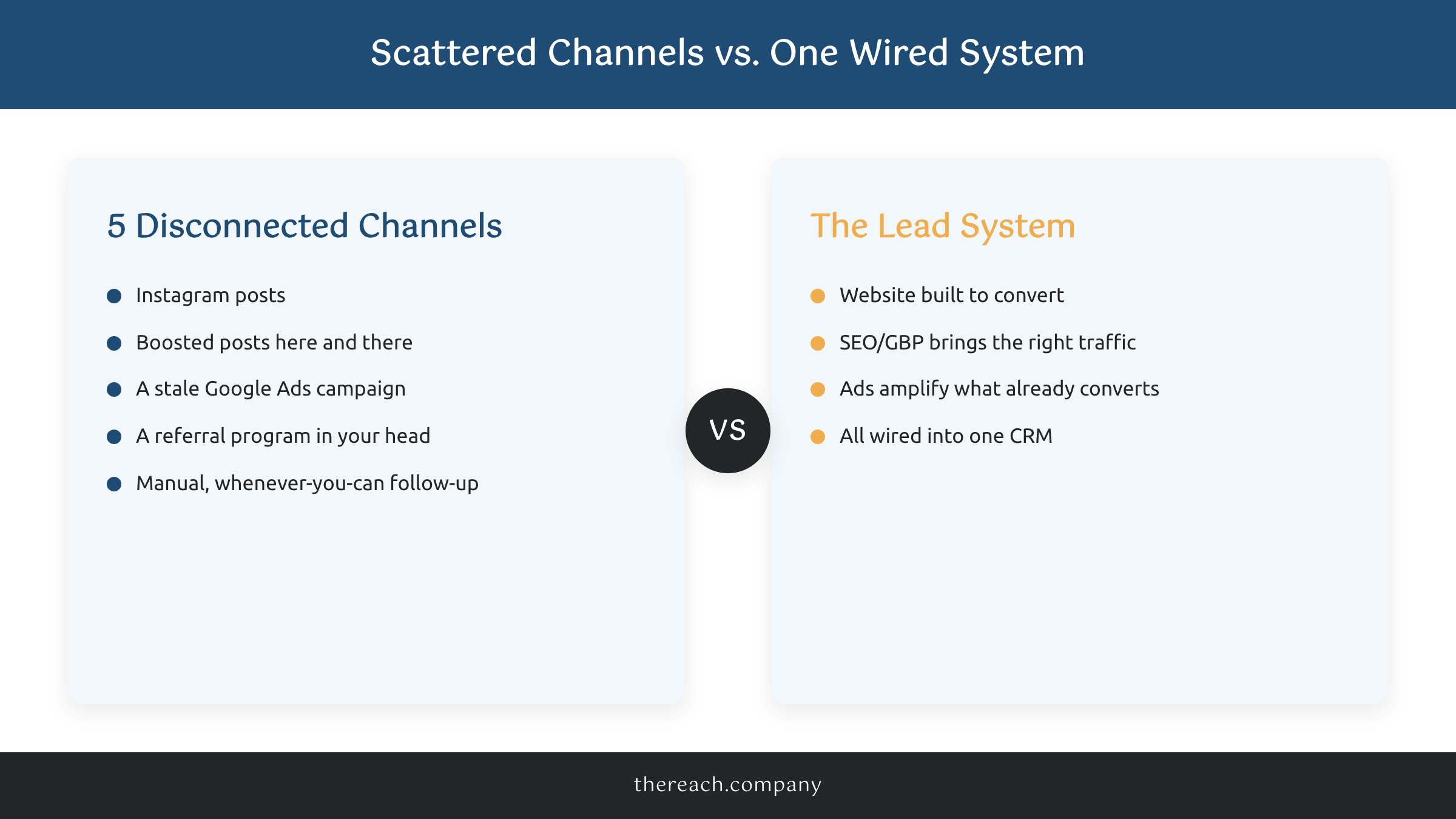
If you’re searching for how to grow a service business right now, you’ve probably already tried the “do more” advice and burned out on it. Most service business owners are running a marketing junk drawer, not a system. A little Instagram here, a boosted post there, a Google Ads campaign nobody’s watched the numbers on since March, a referral program that lives entirely in your head. Nothing’s connected. Nothing compounds. Every lead you get feels like luck instead of a process.
HubSpot’s 2026 State of Marketing report found that 25.7% of marketers say their workload increased significantly over the past year, and another 47.4% say it increased moderately. That’s not a “you’re bad at marketing” problem. That’s what happens when the advice is “add more” and nobody tells you what to take off your plate first.
The number one challenge marketers report in that same study is measuring ROI, cited by 33% of respondents. If you can’t tell which channel is actually bringing you customers, you can’t cut the ones that aren’t. So you keep everything running out of fear, and your marketing budget bleeds out across five half-working tactics instead of funding two that actually work.
Why More Channels Doesn’t Mean More Growth
Here’s the math nobody walks you through. Every channel you run needs three things to work: a way to bring people in, a way to convert them once they’re looking, and a way to follow up when they don’t buy today. Most business owners have the first part for four or five channels and the second and third parts for none of them.
That’s the trap. You don’t have a traffic problem. You have a follow-up problem wearing a traffic costume. I’ve watched contractors spend $1,500 a month on Google Ads sending clicks to a homepage with no clear next step and no automated follow-up, and then conclude “ads don’t work for my business.” Ads worked fine. The system behind them didn’t exist.
Do the math on your own week. If you’re spending four hours posting on Instagram, two hours boosting posts, an hour a week “checking on” the Google Ads account, and another hour manually texting back leads that came in over the weekend, that’s eight hours a week, a full workday, spent half-running five different things instead of fully running two or three. None of those five gets the attention it needs to actually compound. You’re not lazy and you’re not bad at marketing. You’re spread across too many half-built systems to make any single one work.
At The Reach Company, we build what we call the Lead System: a website built to convert, SEO or Google Business Profile work that brings the right traffic, and ad spend that amplifies what’s already converting, all wired into one CRM so nothing falls through. It’s not flashy. It’s three legs of a stool instead of eight legs pointed in eight directions.
The System That Actually Compounds
Here’s the contrarian part: adding a channel should almost always be your last move, not your first. The first move is making the channels you already have actually talk to each other. A lead who fills out your contact form should automatically get a text within five minutes, not a callback whenever you get to your voicemail that night. A Google review should trigger a thank-you sequence that nudges toward a referral. Your ad spend should only go toward the service or offer you already know converts, based on real numbers, not a guess.
It really depends on your business which piece to fix first. A medspa with strong Instagram but a slow, confusing website should fix the website before spending another dollar on ads. A roofer with a good website but zero follow-up on estimate requests needs the CRM piece before touching SEO. There’s no universal order. There’s just the honest question: which leak is costing you the most leads right now?
Here’s a plain example of what “wiring it together” looks like in practice, no jargon, just the sequence. A homeowner searches “roof repair near me,” lands on a Google Business Profile you’ve actually kept current, clicks through to a website with a clear “get a free estimate” button above the fold, fills out a three-field form, and gets a text back inside five minutes confirming the appointment window, automatically, through GoHighLevel, with zero manual effort on your end. That’s not five channels. That’s one path, three tools, wired together so a stranger becomes a booked estimate before you’ve even seen your phone buzz.
Proof: What a Wired-Together System Actually Does
The Jewish Education Loan Fund has been a Reach Co client for five years. We didn’t add channels for JELF every year. We built one system, website, content, and email working together, and kept refining it. The result: a 54% increase in conversions and 38% traffic growth year over year, with a 52% conversion rate on their first online event once the follow-up sequence was dialed in. That’s not from doing more. That’s from making what they already had work harder, together.
That’s what growing a service business actually looks like from the inside: fewer channels, more follow-through. The Unstuck Group is the sharper example of amplification done right. Once their website and lead capture were converting, we layered in ads on top of what was already working: a 29:1 return on one campaign, a 14:1 average ROAS on Google, and under $2 per qualified lead on Facebook. Ads amplified a system that already worked. They didn’t replace the missing parts of one that didn’t.
What to Do Instead
Stop asking “what channel should I add next.” Ask these three questions instead, in order:
- Does my website actually convert the traffic it already gets? If your site is a digital brochure with a contact form nobody fills out, fix that before spending a dollar on new traffic.
- Am I following up with every lead within minutes, not hours? A CRM like GoHighLevel can text, email, and nurture automatically. If a hot lead sits for six hours before anyone responds, you’re losing them to whichever competitor answers first.
- Is my ad spend going toward what I already know converts, or am I guessing? Amplify proven winners. Don’t use ad budget to find out if something works. Use it once you already know it does.
This is the actual work behind how to grow a service business without adding a sixth platform to your plate. Fewer moving parts, wired together, beats more moving parts running in parallel every time.
If you want a second set of eyes on which leak is costing you the most right now, that’s exactly what our Lead Generation System is built to fix, website, follow-up, and ad amplification working as one system instead of three separate headaches. You don’t have to figure out the wiring alone.
Can I be honest? I fall short here all the time too. It’s tempting to chase a shiny new platform because a client asks about it, or because a competitor is on it. The discipline isn’t refusing new channels forever. It’s refusing to add one until the two or three you already have are actually wired together and pulling their weight. Once your website converts, your follow-up is automatic, and your ad spend is aimed at a proven winner, adding a fourth channel is a smart bet instead of another half-finished experiment.
You got this. And if you’d rather have someone who does this every day take a look first, we got you too.

