
Can I shoot straight with you? If a stranger read your website homepage right now and then read your biggest competitor’s homepage, could they tell you apart? For most small businesses I talk to, the honest answer is no. Same stock photo of a handshake. Same line about “quality service you can trust.” Same vague promise that could belong to literally any business in your category. That’s not a website problem. That’s a unique selling proposition problem, and it’s costing you the sale before your salesperson ever picks up the phone.
A unique selling proposition, or USP, is not a slogan and it’s not a mission statement. It’s the one true differentiator about your business that you can prove with a number. If you can’t say it in one sentence, your prospects can’t either, and when they can’t tell you apart from the next name on their list, they default to picking whoever’s cheapest. This post is about finding yours: what a real USP looks like, why “we care more” doesn’t count, and the specific framework we walk clients through to build one that survives contact with a spreadsheet.
The Real Problem
Here’s the rub: most small business owners think they already have a USP, because they’ve got a sentence on their homepage that sounds like one. “We treat you like family.” “Quality and integrity in everything we do.” “Your trusted partner for all your [service] needs.” None of that is a USP. It’s filler that every competitor in your zip code could paste onto their own site with a global find-and-replace on the business name.
A real USP answers one specific question a prospect is asking, whether they say it out loud or not: why you, and not the guy down the street who’s $200 cheaper? If your answer is some version of “we care more” or “we do better work,” you don’t have an answer. You have a feeling, and feelings don’t win against a lower quote.
Here’s proof of how much this actually costs you. HubSpot’s own research into sales conversations puts confidence and differentiation right at the center of whether a prospect buys at all. Their sales team’s rule is blunt: “If you don’t believe in your product, it’s likely the prospect won’t believe in it either” (source: HubSpot, Unique Selling Proposition). A vague USP doesn’t just fail to convert. It actively signals to prospects that you don’t know what makes you different, so why should they take the time to figure it out for you?
What a USP Actually Is (Not a Slogan)
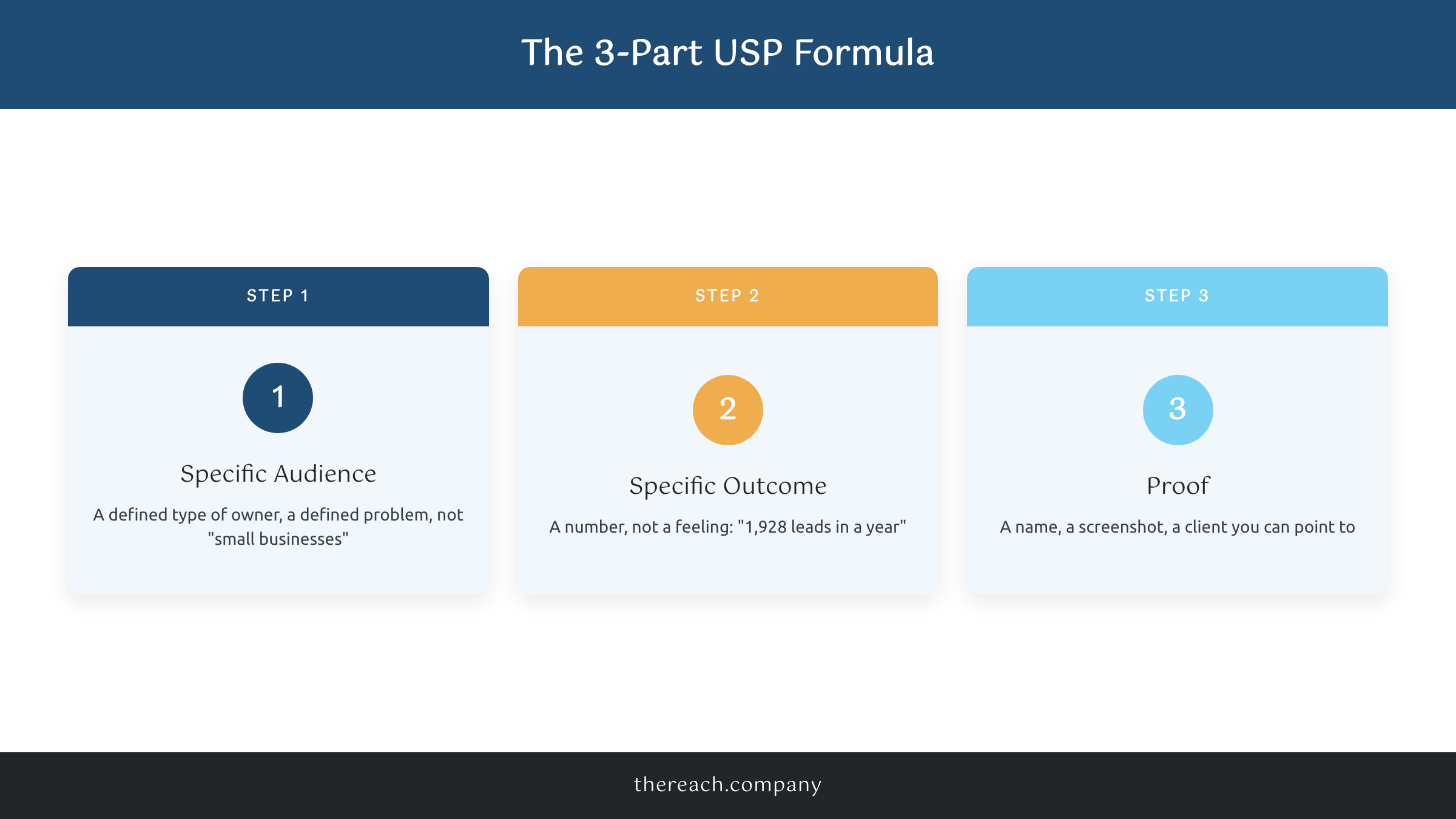
A real USP has three parts, and all three have to be true or it falls apart the first time a prospect asks a follow-up question.
First, a specific audience. Not “small businesses.” Not “everyone in Atlanta.” A specific type of business owner with a specific problem you solve better than the general market.
Second, a specific outcome, stated as a number wherever you possibly can. Not “more leads.” “1,928 leads in a year.” Not “better rankings.” “1st in the Map Pack for 8 different services.” Numbers are the difference between a claim and a fact.
Third, proof you can point to. A client name, a screenshot, a before-and-after, a contract you can show if someone asks. Not “trust us.” Trust is earned in the reading, not asked for in the copy.
HubSpot’s own breakdown describes a USP as a tool salespeople use to “communicate the key factors that separate your product from the competition and why you’re the best possible solution for your prospects based on their unique needs.” Notice what’s missing from that definition: nothing about being the nicest, the most passionate, or the hardest working. It’s about a specific fit for a specific person, backed by something real.
Here’s the test we use with clients: if a competitor could say your USP word-for-word and it would still sound true coming out of their mouth, it’s not a USP. It’s a category description, and category descriptions don’t close deals.
The Contrarian Truth
Here’s the part that stings a little: nobody buying a service is looking for the business that cares the most. They can’t measure caring. What they can measure is risk, and your USP’s actual job is to lower the perceived risk of choosing you over the next name on the list.
That’s why “affordable” isn’t a USP either, even though it feels like one. Affordable compared to what? Compared to whom? Being the cheapest is a race to the bottom that only one business can win, and it’s rarely the business doing the best work. A USP built on price alone is also the easiest thing on earth for a competitor to beat: they just drop their number by $50 next Tuesday.
The businesses actually growing right now, the ones we work with who are pulling ahead of their local competition, aren’t winning on “we’re the friendliest team in town.” They’re winning because they can say something specific and hard to copy overnight: “we’re the only roofer in the county who sends a drone inspection video with every estimate,” or “we’re the medspa ranked first in the Map Pack for 8 services, not just one.” Specific. Provable. Not something a competitor slaps together by Friday.
Proof
Take one of our clients, Chin Up Aesthetics, a medspa in the Atlanta metro. When we started working with them, their messaging read like every other medspa in the region: friendly staff, relaxing atmosphere, quality treatments. All true. None of it a USP, because none of it was specific to them.
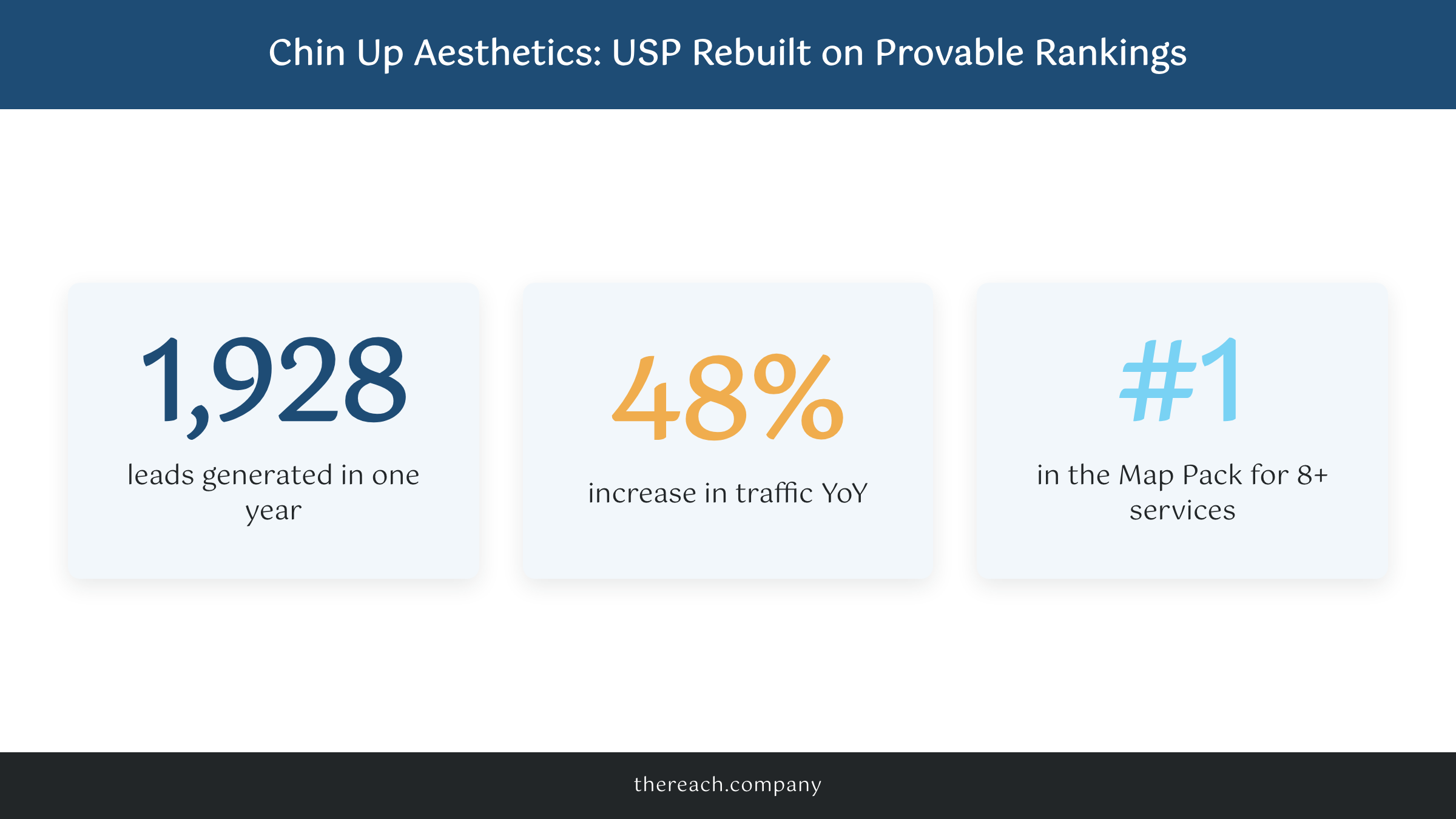
We rebuilt their positioning around something they could actually prove: rankings. Over the course of a year, their website generated 1,928 leads, traffic grew 48% year over year, and they landed 1st in the Map Pack for 8 different services, not just one. That’s the kind of dominance most single-location medspas never get close to. That’s not “trust us, we’re great.” That’s “we rank first for more procedures than any other medspa in this area, and you can search it yourself right now.” Prospects don’t have to take Chin Up’s word for it. Google already agrees.
That’s the shift. A USP isn’t something you write once in a brainstorming session and forget about. It’s something you go earn, then say out loud with the receipts attached.
What to Do Instead
Finding your real USP takes an honest afternoon, not a marketing retreat. Here’s the version we walk clients through:
First, list every result you can actually prove. Numbers from your CRM, your Google Business Profile insights, before-and-afters, review counts, response times you already track. If it’s not written down somewhere, it’s not provable yet, and an unprovable claim isn’t a USP.
Second, ask your last five customers why they picked you over someone else. Get their actual words, not the polished version you wish they’d said. Patterns show up fast, usually within the first three answers.
Third, cut anything a competitor could claim word-for-word. If “quality” or “customer service” shows up in your draft, delete it and dig one layer deeper. Quality measured how? Service how fast, exactly?
Fourth, compress the strongest result into one sentence using this formula: specific audience, plus specific provable outcome, plus proof. That’s your working USP. Test it on your homepage headline and see if it survives a skeptical read from someone who’s been burned by a business like yours before.
This is exactly the kind of positioning work that has to run through your entire marketing system to actually matter, not just sit on one page nobody scrolls to. Our Lead Generation System is built to carry that one differentiator consistently across your website, your ads, and your follow-up, so a prospect hears the same specific reason to choose you no matter where they find you first. And if you want the bigger picture on why a USP can’t live in isolation from your website, SEO, and ads, we broke down why piecemeal marketing never works in What an Integrated Marketing Strategy Actually Is.
You don’t need a rebrand to find your USP. You need one honest afternoon with your own real numbers and the discipline to cut every sentence a competitor could steal word-for-word. Do that, and the sale stops being about who’s cheapest and starts being about who’s the obvious choice. You got this. And if you want a second set of eyes on it, we got you too.

