
You hired a website guy in 2022. An SEO shop last spring. Your nephew ran Facebook ads for three months. Each one sent an invoice. None of them ever talked to each other. And marketing still feels like a money pit.
So let’s answer the real question: what is an integrated marketing strategy? In plain English, it’s your website, SEO, ads, and follow-up running as one system, where every channel feeds the others instead of fighting for its own credit. That’s the whole definition. No jargon required.
Think about building a house. You can hire a great framer, a great electrician, and a great plumber. But with no general contractor and no blueprint, you get walls with no outlets and a sink with no water line. Nobody did bad work. The work just doesn’t connect.
That’s piecemeal marketing. It’s also the most common reason the business owners who call us feel burned. Let me show you what’s actually going wrong, and what one connected system looks like with real numbers attached.
The Real Problem: You Bought Marketing Pieces, Not a Marketing System
Here’s how it usually goes. A service business owner spends $4,000 on a website. It looks great. Then they pay an SEO shop $800 a month, and the monthly report says rankings are up. Then they try Google Ads, and the dashboard says clicks are coming in. Three vendors, three invoices, three reports that all say “good job.”
Meanwhile the phone isn’t ringing any more than it did last year.
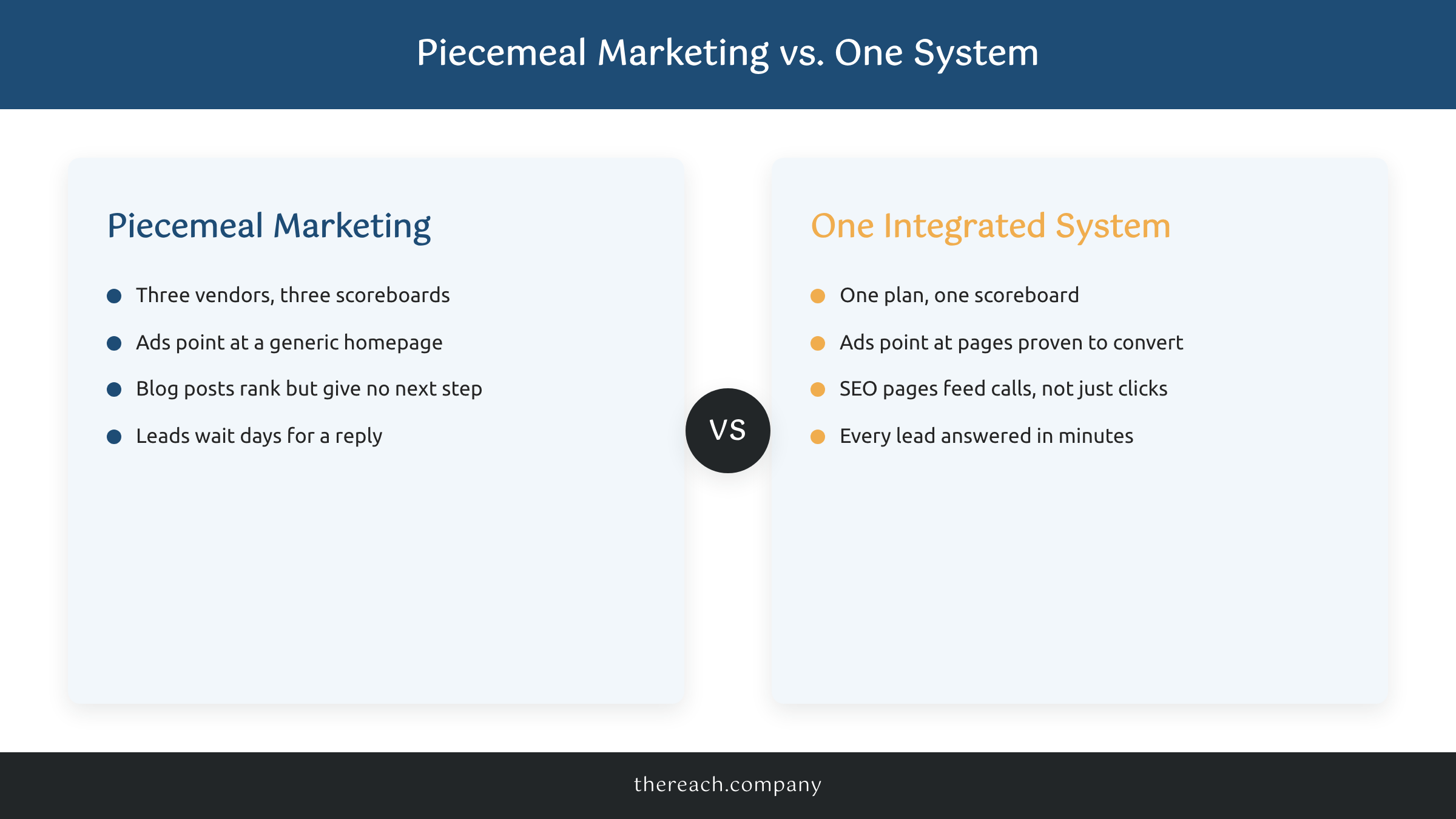
Can I shoot straight with you? The problem is that each vendor is grading their own homework. The web designer’s job ended at “looks professional.” The SEO shop’s job ended at “rankings improved.” The ads manager’s job ended at “clicks got cheaper.” Nobody’s job was the only metric you actually care about: booked work.
And because nobody owns the whole machine, the pieces don’t connect. The ads point at your homepage instead of a landing page built to convert. The blog posts that rank give the reader no reason to call. The website has a contact form, and the leads who fill it out wait two days for a reply. Every piece passed its own inspection. The house still has no running water.
What an Integrated Marketing Strategy Actually Means (Plain English)
People ask us what is an integrated marketing strategy expecting a complicated answer. It’s four parts doing one job:
- Your website is the hub. Every channel drives people to pages built to turn a visitor into a call, a booking, or a quote request. Not a brochure. A conversion machine.
- SEO fills the pipeline. A page for every service, a page for every city you serve. It compounds month over month, so your leads get cheaper over time.
- Ads accelerate what works. Paid traffic puts your proven pages in front of people ready to buy right now, while SEO is still ramping up.
- Follow-up converts it all. Every lead gets a reply in minutes, not days. Missed calls get an automatic text back. Nothing leaks.
One message everywhere. One scoreboard for everything. Every channel handing off to the next like tradesmen on a well-run job site.
Notice what’s not in that definition: doing every channel that exists. Integrated doesn’t mean everywhere. Plenty of service businesses print money with a converting website, Local SEO, and follow-up automation, and no paid ads at all. Integration is about connection, not coverage. Three channels wired together beat six channels running solo.
And the money case is not a vibe. Kantar’s CrossMedia database, built from analysis of more than 1,200 campaigns, found that campaigns can be 2.6 times more effective with the right media spend allocation. Read that again. Not more budget. The same money, arranged differently.
The Contrarian Part: Your Channels Didn’t Fail. The Handoffs Did.
Most owners who tell us “ads don’t work for my business” ran decent ads to a page that was never built to convert. Most who say “SEO was a waste” ranked blog posts that gave the reader no next step. The channel takes the blame. The failure lives in the handoff.
Here’s the math that proves it. Say you spend $2,000 on ads at $2 a click. That’s 1,000 visitors. Send them to a generic homepage that converts at 2% and you get 20 leads at $100 each. Send the same 1,000 visitors to a dedicated page with one clear offer, real reviews, and a form that works on a phone, converting at 8%, and you get 80 leads at $25 each.
Same ads. Same budget. Four times the leads. The ads didn’t get better. The handoff did.
This is why firing vendors one at a time never fixes anything. You’re swapping subcontractors when the missing hire is the general contractor. Piecemeal marketing makes every channel look broken, so owners quit channels that would have worked fine inside a system. Then they tell the next agency “we tried that already.” They didn’t. They tried a piece of it.
Proof: What One Connected System Looks Like
Chin Up Aesthetics is a medspa client of ours in Atlanta. One system: a website rebuilt to convert, Local SEO, Facebook ads, and automated follow-up, all pointed at the same goal.
The results, from one year: 1,928 leads from the website. 1,300+ more leads from Facebook ads. Traffic up 48% year over year. First in the Google Map Pack for 8+ core services.
Here’s the part that matters for this conversation: those aren’t four separate wins. The ads perform because the pages they point at convert. The Map Pack rankings hold because the website’s service pages back them up. And every one of those 1,928 leads got an answer in minutes, because the follow-up runs automatically. Pull any one piece out and the other numbers shrink.
Another client, The Unstuck Group, averages a 14:1 return on Google ads. Not because the ads are magic. Because the landing pages, the offer, and the follow-up were built as one motion.
What to Do Instead: Integrate in This Order
You don’t need to do everything at once. You need to do things in the right order.
- Fix the destination first. Before you buy any traffic, make sure the pages people land on give them a reason to call and an easy way to do it.
- Wire the follow-up second. This is the lead generation system we build on GoHighLevel for $299 a month: instant replies, missed-call text-back, one pipeline. Traffic is worthless if leads leak out the back.
- Turn on SEO third. It takes months to compound, so start it before you think you need it.
- Add ads fourth. Now paid traffic amplifies pages that are proven to convert, instead of subsidizing pages that don’t.
- Keep one scoreboard. Cost per lead and booked jobs. Not likes, not rankings, not clicks. One set of numbers everyone answers to.
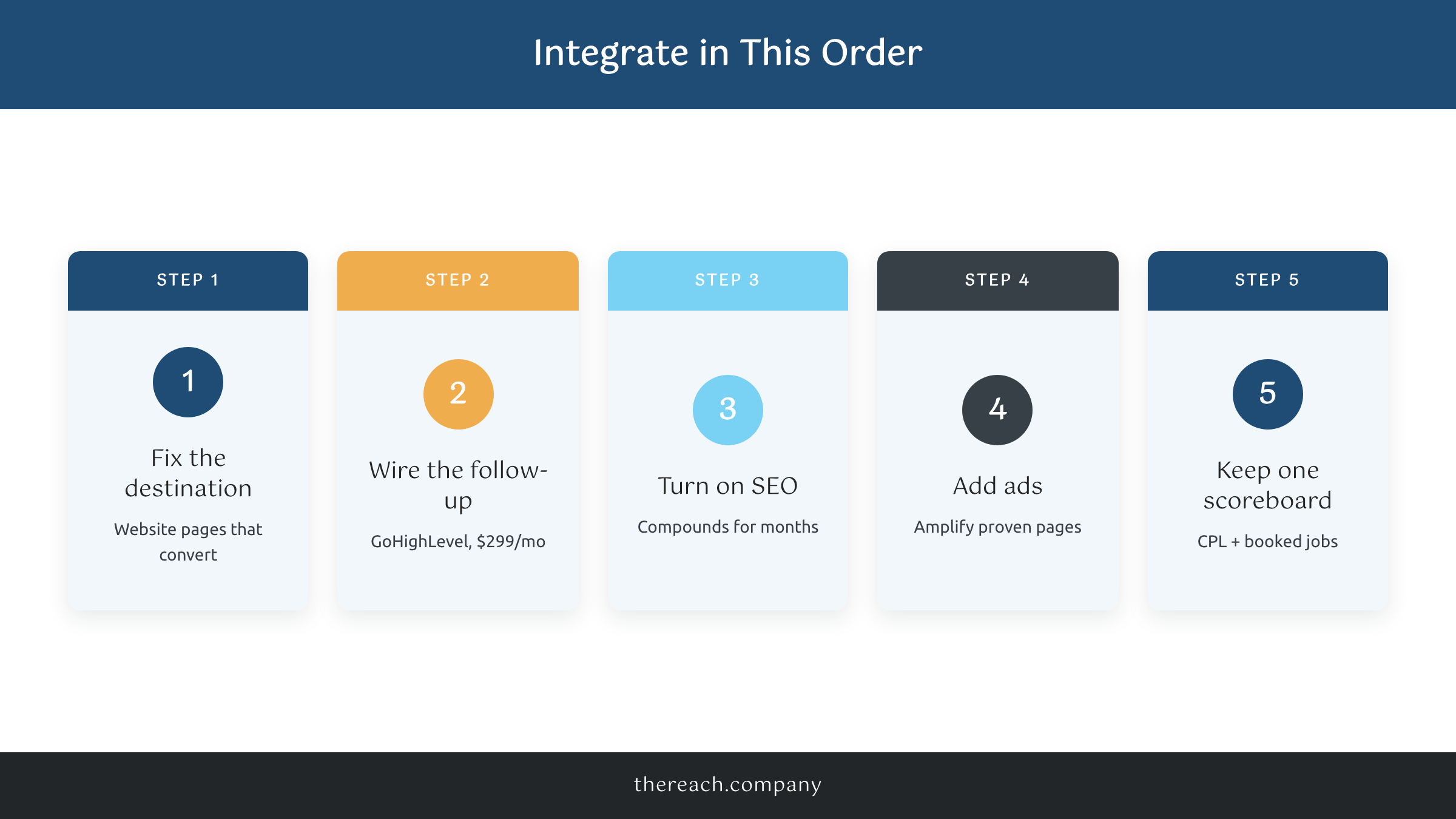
Sequencing matters so much that we wrote a whole breakdown of why website, SEO, and ads must work together, and another on how to split your marketing budget across the stages. The short version: destination, follow-up, compounding, acceleration. In that order, on one scoreboard.
So the next time someone asks what is an integrated marketing strategy, you’ve got the honest answer: it’s the difference between buying marketing pieces and owning a marketing machine. Three vendors with three scoreboards will spend your budget forever and never connect the wires. One system, sequenced right, gets cheaper and stronger every month.
If you’d rather not be your own general contractor, that’s what we do all day. Our pricing is public, our clients are named, and the numbers above are real. Tell us what you’re doing, and we’ll show you where your system is leaking. You got this. And if you want the whole thing handled, we got you too.

